Care homes · October 15, 2026
Researchers read a week of menus from 136 British care homes. Sausages turned up more often than a single meal made only from plants
A University of Surrey team scored the lunch and dinner menus of UK care homes for how plant-forward they were. On average only 8% of meals had no animal foods at all, 16% contained processed meat, and the most common plant protein on the menu was a tin of baked beans served next to meat. The authors want more beans and lentils on the plate; the residents' need for protein and comfort makes that less simple than it sounds.
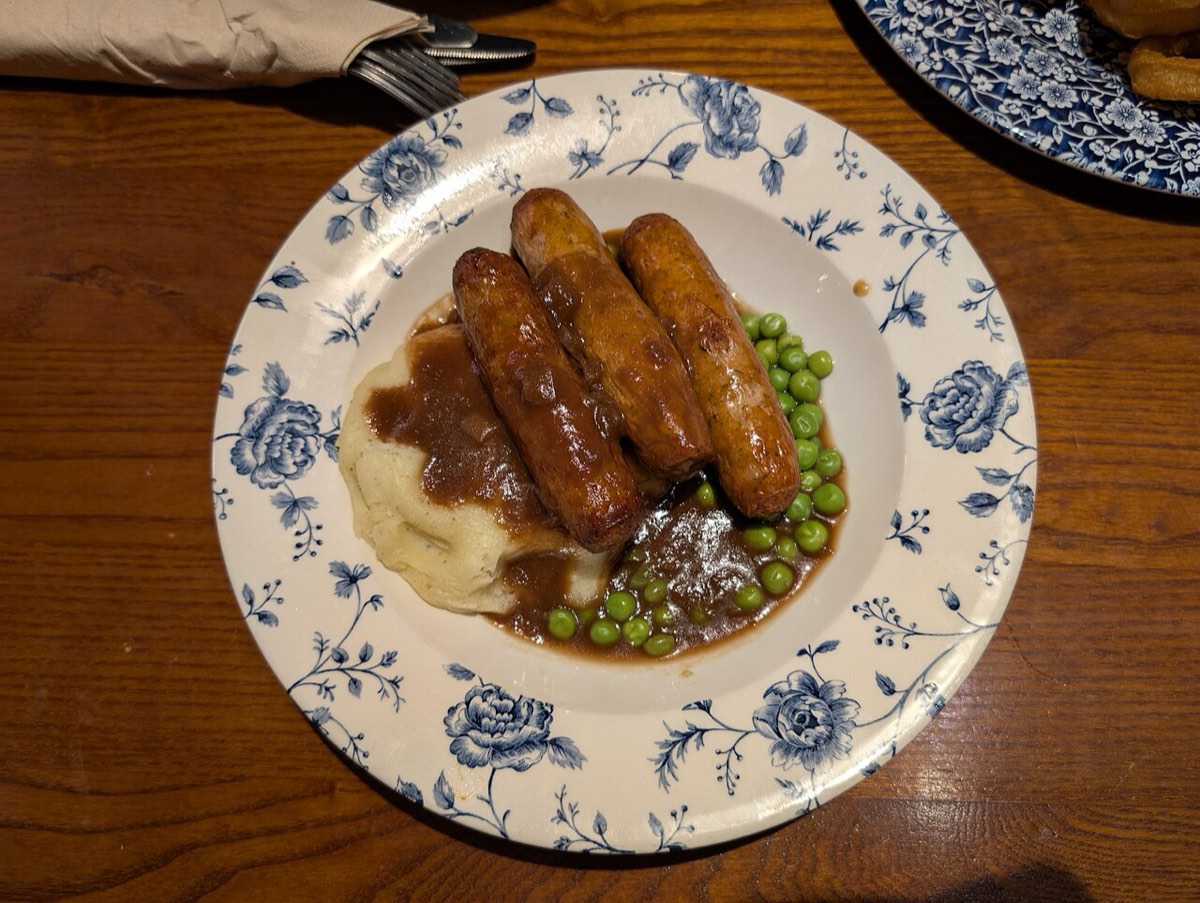
Nobody in a care home writes their own menu. Someone else decides, weeks in advance, what several dozen older people will be offered for lunch and dinner, and for many residents that choice is most of what they will eat that week. So what is actually on those menus?
A study published on 8 October 2026 in the Journal of Human Nutrition and Dietetics tried to find out for the United Kingdom. Researchers at the University of Surrey, with a co-author from the University of Reading, contacted about 1,000 care homes and care companies between August and November 2025 and asked for a copy of their seven-day lunch and dinner menus. They received 52 menus. Because large care groups often send one menu that is used across all their homes, those 52 menus covered 136 homes. Nearly all of them were run for profit, most belonged to a group, and almost every one cooked with its own chef.
Each menu was scored out of 80 with a tool first built to rate hospital menus. Points come from the share of meals with no animal foods at all, the share that are vegetarian or pescatarian, the share free of red meat and free of processed meat, the share containing a plant protein such as beans, lentils, nuts, tofu or mycoprotein, and whether a plant-based and a vegetarian choice appear at both lunch and dinner every day. Fully plant-based meals count double. A higher score means a more plant-forward menu.
The average menu scored 28, and the best managed 41. Only 8% of meals, on average, contained no meat, fish, dairy or egg, and eight of the 52 menus had none at all that week. Vegetarian dishes were more common, and only one menu lacked them entirely. Meat was everywhere: every menu served red meat at least once in the week, and 50 of the 52 included processed meat. On the average menu 17% of meals contained red meat and 16% processed meat, and one menu put processed meat in 38% of its meals. Sausages made up 40% of the processed meat servings, followed by gammon and other cured meats, and bacon.
Plant protein was harder to find. On average 7% of meals contained any, and six menus offered none. More than half of the plant protein that did appear was baked beans, often as a side next to meat. Mycoprotein and pulses such as lentils came next, and only 15 menus offered a meat alternative such as a mycoprotein or soy burger.
The type of home seemed to matter. Small homes with fewer than 30 beds put processed meat in about 22% of their meals, twice the share in large homes, and offered fewer fully plant-based meals. Independent homes served more processed meat than homes in a group. The authors also found differences between regions, but they warn that the sample leaned heavily towards southern England, and the region with the lowest score, Northern Ireland, was represented by a single home.
Why care? The NHS advises people who eat more than 90 g of red and processed meat a day to cut down to 70 g, mainly because of bowel cancer. The World Health Organization's cancer agency classes processed meat as carcinogenic to humans and red meat as probably carcinogenic. The paper calls them possible and probable carcinogens, which slightly understates the agency's verdict on processed meat. Diets in care homes are also often short of fibre, and beans and lentils bring protein and fibre on the same spoon.
There is a real counterweight, and the authors mention it. Many care home residents eat little and are at risk of undernutrition and muscle loss. European guidelines for older people recommend at least 1 g of protein per kilogram of body weight a day, and meat, milk and eggs are an easy way to get it into a small appetite. Familiar food also matters to people living far from their own kitchens. Swapping a sausage for a lentil stew helps no one if the stew comes back uneaten. The authors suggest tasting sessions, training for chefs and asking what residents will actually eat.
Some limits are worth knowing. The score has not been checked by other researchers, it counts meals and not portion sizes, and only the first week of each menu was scored. The homes that answered may not be typical of the roughly 1,000 that were asked. A menu shows what was offered, not what residents chose or ate. And the funding deserves a mention: the doctoral award behind the study came from a UK research council, and the paper adds that the work was also supported by Marlow Foods, the company that makes Quorn mycoprotein, while declaring no conflicts of interest. The scoring tool was developed with a group of plant-based health professionals.
If someone you love lives in a care home, the menu is worth reading. A good question for the kitchen is not whether there is a vegetarian choice, since there nearly always is, but how often the protein on the plate is a bean, a lentil or a piece of fish, and how often it is a sausage.
Cross-sectional menu analysis: week-one lunch and dinner menus from UK care homes for older adults, scored 0 to 80 for how plant-forward they are
52 menus, 136 homes
Menus received and the care homes they covered, out of about 1,000 homes and care companies contacted (August to November 2025)
28 of 80
Average menu score (range 19 to 41). Weighted by the number of homes each menu covered, the average was 30
8%
Average share of meals with no meat, fish, dairy or egg. Eight menus had no fully plant-based meal that week
16%
Average share of meals containing processed meat. 50 of 52 menus served it, and sausages were 40% of those servings
7%
Average share of meals containing plant protein (beans, pulses, nuts, tofu, mycoprotein). Baked beans were 57% of it
22% vs 11%
Share of meals with processed meat in small homes (1 to 29 beds) compared with large homes (51 beds or more)
All figures are from the open access paper (doi 10.1111/jhn.70345, Journal of Human Nutrition and Dietetics, volume 39, issue 5, published online 8 October 2026), its tables and text. Only lunch and dinner were scored; breakfast, desserts and special-diet menus were left out, and only week one of each menu rotation was analysed. The score counts meals, not portion sizes, so the results cannot be compared directly with gram-based advice on meat. 124 of the 136 homes were run for profit and 60 were in South East England; regional figures rest on few homes (Northern Ireland: one). The 22% and 11% are mean shares by home size from the paper's Table 5. The paper says the work was supported by a BBSRC doctoral award and by Marlow Foods, and the authors declare no conflicts of interest.
- Mycoprotein, the protein in Quorn, is made by growing a fungus called Fusarium venenatum in fermentation tanks. It was developed in Britain and went on sale there in the 1980s.
- Baked beans are haricot beans, also called navy beans, in a tomato sauce. In the NHS 5 A Day advice, beans and pulses count as one portion a day however much you eat.
- In 2015 the WHO's International Agency for Research on Cancer put processed meat in Group 1, carcinogenic to humans, and red meat in Group 2A, probably carcinogenic. The groups describe how strong the evidence is, not how big the risk is.
- The NHS lists ham, bacon, salami, sausages and pâtés as processed meat, and says the 70 g a day can be an average: a bigger portion one day can be balanced by less on the next.
- The scoring tool used here was adapted, with its authors' permission, from one built to rate UK hospital menus, which also scored low for plant-based meals.
- Analysis of the Provision of Plant-Based, Vegetarian and Omnivorous Meals in UK Care Homes for Older PeopleJournal of Human Nutrition and Dietetics, 39(5), e70345, published online 8 October 2026 (open access) · The study: methods, scores, meal shares, processed meat and plant protein figures, differences by home type, limitations and funding
- PubMed Central full text PMC13648222US National Library of Medicine · Free full text with Tables 1 to 5
- Meat in your dietNHS · The 90 g to 70 g advice on red and processed meat and the list of processed meats
- Cancer: carcinogenicity of the consumption of red meat and processed meatWorld Health Organization, questions and answers, 2015 · IARC classification: processed meat Group 1, red meat Group 2A
- ESPEN guideline on clinical nutrition and hydration in geriatricsClinical Nutrition, 38(1), 10 to 47, 2019 · Recommendation of at least 1 g protein per kg body weight a day for older people
- Bangers and mash - The Perkin Warbeck 2025-07-26.jpgWikimedia Commons · Image, CC0, by Andy Li
General information, not medical advice. This study looked at what care home menus offered, not at what residents ate or at their health. Older people who eat little may need extra protein and energy; if you are concerned about the diet of someone in care, talk to the home, their doctor or a registered dietitian.
Analysis by NutroPractic from the sources listed. Written for general readers; it does not replace advice from your own doctor.
From our articles
Read, then eat a little better
Plain-language guides on nutrition and wellness, backed by research.

Supplements and vitamins
Spermidine from food or capsules: measured milligrams in wheat germ, soybeans and cheese, and what the one year-long trial found
Wheat germ holds about 22 to 34 mg of spermidine per 100 g, matured cheese about 0.12 mg. The only year-long capsule trial used 0.9 mg a day and found no memory benefit. Measured values, worked doses and safety.
22 Nov 2026

Supplements and vitamins
Zinc carnosine for the gut lining: what the two human trials gave, the zinc in each dose, and the copper catch
Zinc carnosine is only about 22.6% zinc, so 75 mg twice a day is roughly 34 mg of zinc a day. Here are the doses and results of the 10-person NSAID permeability trial and the 20-person aspirin pilot, and the copper cautions.
22 Nov 2026

Women's health
Inositol for PCOS: the 40:1 ratio, trial doses, and food milligrams
Why do randomized trials in polycystic ovary syndrome prioritize the 40:1 myo to D-chiro inositol ratio? Here is the science behind the ovarian epimerase paradox, clinical ovulation and insulin metrics, and why cantaloupe cannot replace 4,000 mg trial powder.
21 Nov 2026
Newsfeed for your website
Want this feed on your website?
Add it to any site with one copy-and-paste snippet. No sign-up, and it updates itself every hour.
Start with a virtual consultation
Tell Dr. Triveni what you want to change. You will leave with a clear next step, whether you are in Toronto, London, New York or Chennai.