Edible insects · October 25, 2026
Scientists in Nagaland ground up 13 wild insects that people there eat, from giant water bugs to hornets. Protein ran from 19% to 68% of the dried weight, fat from 4% to 35%, and hornet pupae carried more than 20 times the antioxidant reading of a water bug
A Nagaland University team tested crickets, beetles, water bugs, weaver ants, caterpillars and a night-flying hornet at three stages of its life. "Insects" turned out to be a poor label for a food: the bush cricket was under a fifth protein, the adult hornet more than two-thirds, and the same hornet changed a lot between larva and adult.
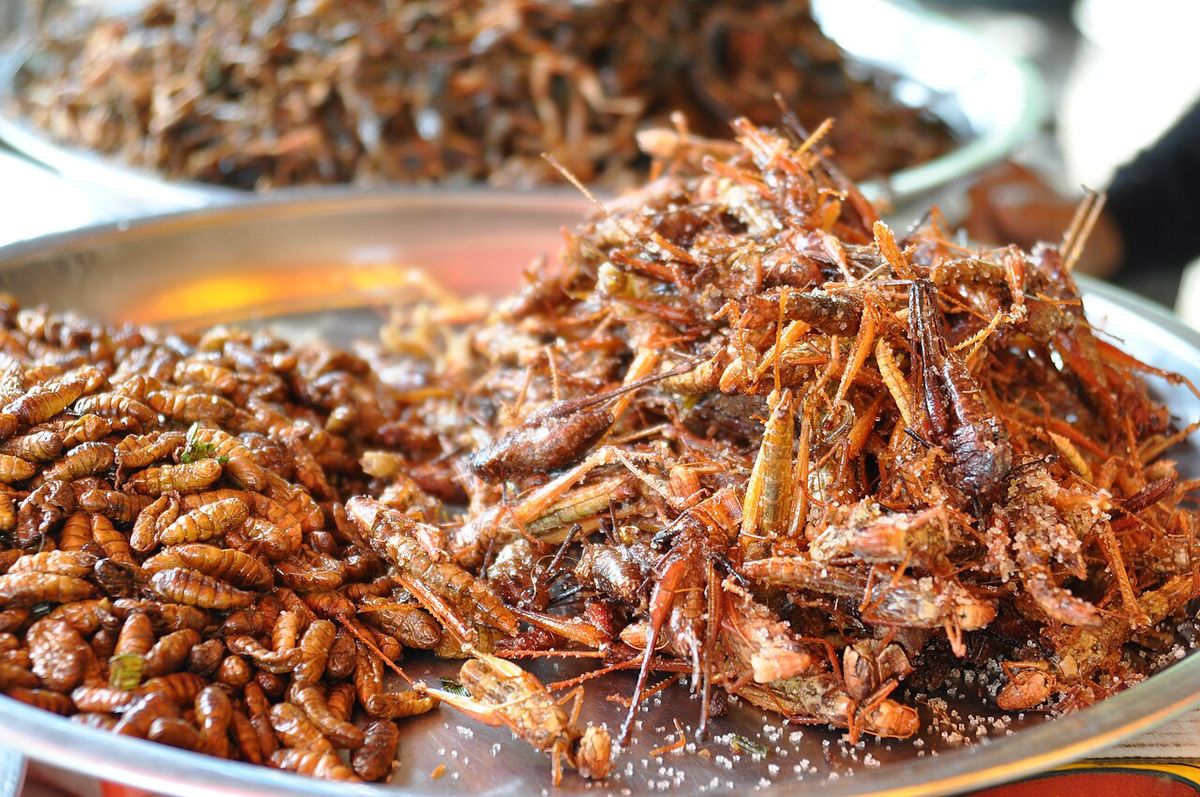
In the hill state of Nagaland, in India's far north-east, insects are ordinary food. Hornet nests are raised for their grubs, silkworm pupae are cooked with local spices, and water bugs and beetles are netted from ponds. Edible insects are often sold to the rest of the world as a single "superfood" category, but most of the species people actually eat have never been properly analysed. A team from Nagaland University and research institutes in Assam, Uttarakhand, New Delhi and Jammu set out to measure 13 of them. Their study was published in Frontiers in Nutrition on 14 October.
The insects were caught in the wild by hand, sweep net or pond sampling: a dragonfly nymph, a bush cricket (Mecopoda elongata), a large field cricket, a stink bug, a water scorpion, the giant water bug, a diving beetle, a water scavenger beetle, the weaver ant, a carpenter moth caterpillar, the bamboo caterpillar, the eri silkworm and a night-flying hornet (Provespa barthelemyi), tested as larva, pupa and adult. Each was washed, oven-dried, ground to powder and analysed in triplicate for protein, fat, carbohydrate, phenolic compounds and antioxidant capacity, with amino acids and fatty acids measured by lab instruments on pooled samples.
The spread was wide. On a dried-weight basis, protein ran from 18.9% in the bush cricket and 20.7% in the eri silkworm to 63.9% in the water scorpion and 68.3% in the adult hornet. The two beetles, the giant water bug and the field cricket sat between 54.6% and 59.2%. Fat ran from 4.3% in the bush cricket to 35.1% in the stink bug, and carbohydrate never went above 7.7% (the weaver ant). The caterpillars were the least protein-dense group, at 20.7% to 36.2%. Life stage mattered too: the hornet went from 49.9% protein and 25.8% fat as a larva to 68.3% protein and 19.9% fat as an adult.
The plant-like compounds varied even more. The antioxidant reading ran from 2.0 units in the giant water bug to 45.1 in hornet pupae, more than 20 times as much, and phenolic content was highest in the bamboo caterpillar and the weaver ant. In every one of the 13 insects the commonest fatty acid was oleic acid, the main fat in olive oil. Linoleic acid, an omega-6, made up about a fifth of the fat in dragonfly nymphs but almost none in the carpenter moth caterpillar. On amino acids, the hornet larva stood out for leucine, lysine, valine and methionine.
This is a lab analysis of wild-caught samples from one region, not a study of anyone eating them, so it says nothing about health effects, and how well people digest insect protein was not measured. Nutrient content can shift with season, habitat and cooking, and each species was one pooled sample tested three times. The authors did no microbiological testing and call that an important gap, since wild insects can carry bacteria. Parts of the paper do not match each other: the abstract gives protein up to 63.9% while its table shows 68.3% for the adult hornet, the text gives 64.3% fat for the carpenter moth caterpillar against 20.6% in the table, and amino acid and fatty acid amounts are labelled in units that look like a slip, so we used the table figures and quote fatty acids only as shares. The work was funded by India's Department of Biotechnology, and the authors declare no conflicts. We read the full open-access paper.
Composition of 13 wild edible insects from Nagaland, India, dried weight (Frontiers in Nutrition, 14 October 2026)
68.3%
Protein in the adult night-flying hornet, the highest of any sample
18.9%
Protein in the bush cricket Mecopoda elongata, the lowest
4.3–35.1%
Range of fat content, from the bush cricket to a stink bug
≤7.7%
Carbohydrate in every sample (highest in the weaver ant)
22×
Antioxidant reading of hornet pupae (45.1) against the giant water bug (2.0)
13 of 13
Insects whose commonest fatty acid was oleic acid, the main fat in olive oil
Source: Mozhui LL, Kakati LN, Trivedi N, Tanwar AK, Dhillon MK, Ao B, Pankaj PP, Chhetri RK, Anal JMH, 'Nutritional diversity and bioactive potential of thirteen wild edible insects in India: implications for sustainable food and nutrition security', Frontiers in Nutrition 2026;13:1942254, published 14 October 2026, doi 10.3389/fnut.2026.1942254, open access (CC BY). Species: dragonfly nymphs, Mecopoda elongata, Tarbinskiellus portentosus, Coridius singhalanus, Laccotrephes ruber, Lethocerus indicus, Cybister limbatus, Hydrophilus caschmirensis, Provespa barthelemyi (larva, pupa, adult), Oecophylla smaragdina (workers), Cossus sp. larvae, Omphisa fuscidentalis larvae, Samia cynthia ricini larvae, wild-collected in Nagaland, oven-dried at 50 °C and powdered. Protein by Kjeldahl (N × 6.25), lipid by sulpho-phospho-vanillin, carbohydrate by phenol-sulphuric acid, phenolics by Folin-Ciocalteu (mg gallic acid equivalent per g, range 2.80-13.89), antioxidant capacity by phosphomolybdenum assay (mg ascorbic acid equivalent per g, range 2.01-45.11), amino acids by HPLC, fatty acids by GC-MS. Figures are means of three replicates from the paper's Table 1 (protein, fat, carbohydrate on a dry-weight basis; moisture 17.3-57.3% on a fresh-weight basis). The abstract's protein range (18.90-63.91%) leaves out the adult hornet's 68.28% shown in Table 1, and the text's 64.29% fat for Cossus larvae differs from Table 1's 20.55%; we used Table 1. Fatty acid amounts are labelled μg per 100 g but each row sums to about 100, so we read them as shares of total fatty acids (monounsaturated 46.3-56.9, saturated 29.7-42.5, polyunsaturated 0.1-20.1). The '22×' ratio and the plain-English insect names are ours. No microbiological testing. Funding: DBT-NER project BT/PR53947/NER/95/2200/2024 (Department of Biotechnology, Government of India).
- The UN Food and Agriculture Organization estimated in 2013 that insects are part of the traditional diets of at least 2 billion people, and that more than 1,900 species have been used as food.
- In 2021 dried yellow mealworm became the first insect authorised as a novel food in the European Union.
- The European Food Safety Authority warned in its 2021 opinion on mealworms that people allergic to crustaceans such as prawns, or to house dust mites, may also react to insects.
- Water content alone varied threefold: the giant water bug was 57% water by fresh weight, the dragonfly nymph only 17%.
- Nutritional diversity and bioactive potential of thirteen wild edible insects in India: implications for sustainable food and nutrition securityFrontiers in Nutrition · The study, open access, published 14 October 2026, with the full tables
- Edible insects: future prospects for food and feed securityFood and Agriculture Organization of the United Nations · The 2 billion people and 1,900 species estimates (2013)
- Commission Implementing Regulation (EU) 2021/882 authorising dried Tenebrio molitor larva as a novel foodEUR-Lex, European Union · The first EU insect food authorisation, 1 June 2021
- Safety of dried yellow mealworm (Tenebrio molitor larva) as a novel food pursuant to Regulation (EU) 2015/2283EFSA Journal · The allergy warning for people allergic to crustaceans and dust mites (January 2021)
- Fried bamboo worm (L) and crickets (R)Wikimedia Commons · The photo, CC BY 2.0
General information, not medical advice. This is a laboratory analysis of insect samples and says nothing about health effects in people. Wild-caught insects can carry bacteria and contaminants, and people with shellfish or dust mite allergies may react to insects, so talk to your doctor before trying them if you have food allergies.
Analysis by NutroPractic from the sources listed. Written for general readers; it does not replace advice from your own doctor.
From our articles
Our guides on this subject
Plain-language guides on nutrition and wellness, backed by research.
Everyday eating
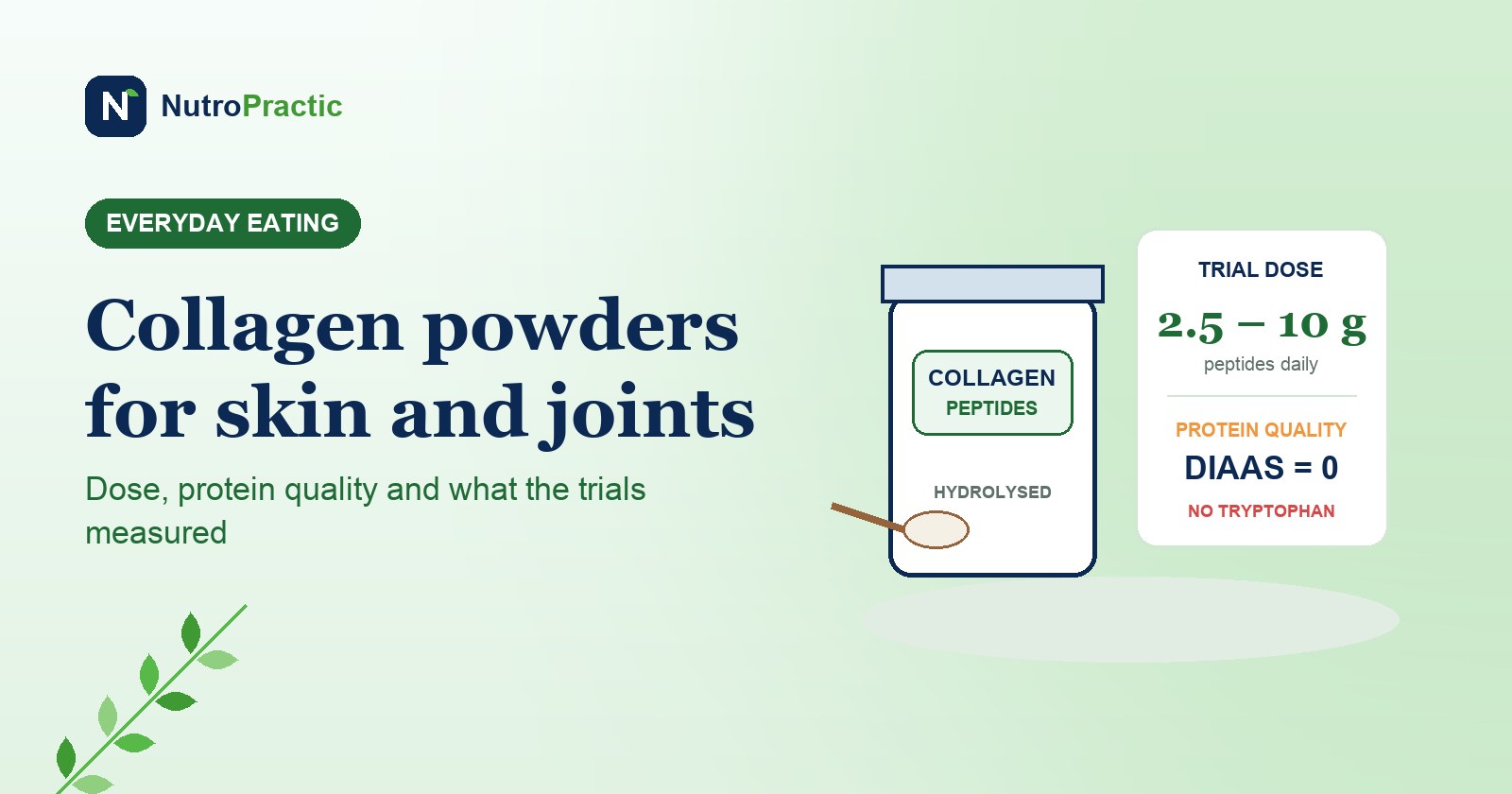
Collagen powders for skin and joints: dose, protein quality and what the trials measured
A 10 g scoop gives 9 g protein, but its protein quality score is zero. Here is what 19 skin trials and knee studies measured at 2.5 g to 10 g daily—and what collagen cannot do.
10 Nov 2026
Everyday eating
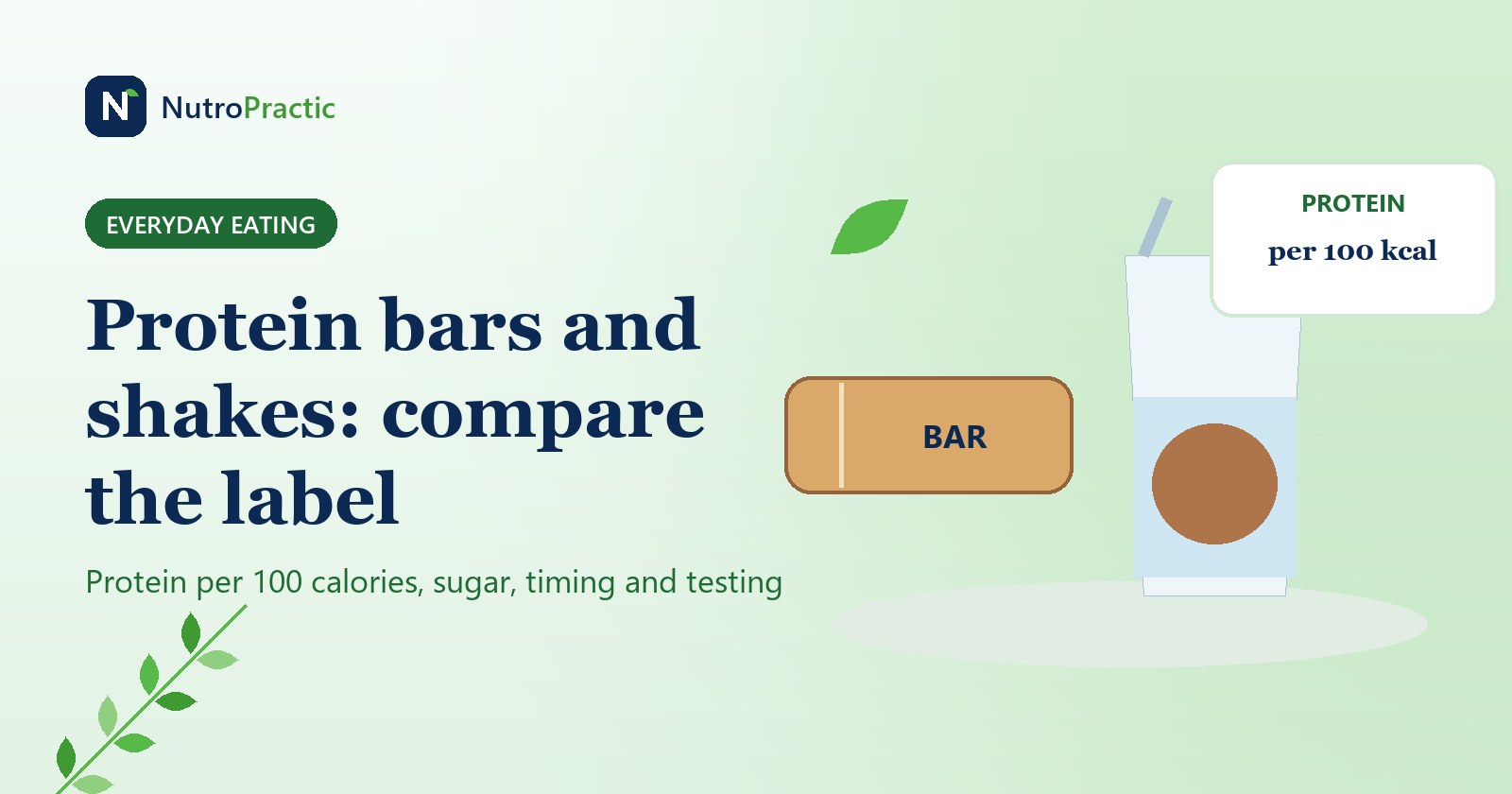
Protein bars and shakes: what you get per 100 calories
Four current labels range from 6.3 to 20 g protein per 100 kcal. Here is how bars, shakes, eggs, yogurt and lentils compare—and when a supplement actually helps.
6 Nov 2026
Everyday eating
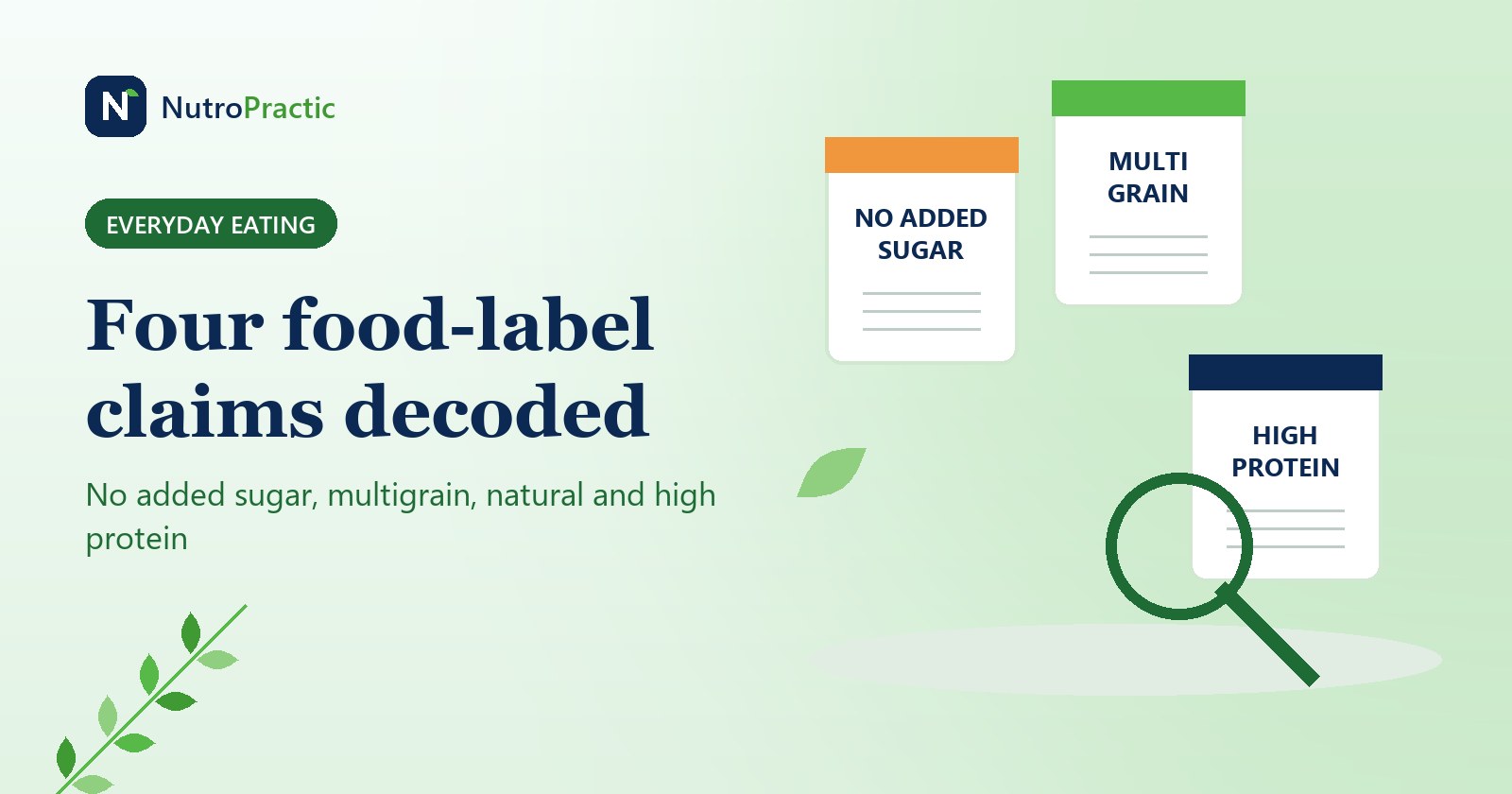
Food label claims decoded: 'no added sugar', 'multigrain', 'natural' and 'high protein'
A no-added-sugar biscuit with only 13% fewer calories. A 7-grain loaf with refined flour listed first. A 'high protein' bar that clears the legal line at 21%. What each claim legally requires in the EU/UK, US and India, with worked reads of real packs.
2 Nov 2026
Newsfeed for your website
Want this feed on your website?
Add it to any site with one copy-and-paste snippet. No sign-up, and it updates itself every hour.
Start with a virtual consultation
Tell Dr. Triveni what you want to change. You will leave with a clear next step, whether you are in Toronto, London, New York or Chennai.