Gut health · October 18, 2026
A litre a day of sulfate-rich mineral water, 157 constipated adults across Germany: by week two the drinkers went about once more a week than the control group. At week three, the finish line they had registered, the gap was no longer clear
A home-based trial tested an old spa remedy against ordinary low-mineral water. It sped up results for some people. The main test, the one fixed in advance, came out short, and the water is easy to tell apart by taste.
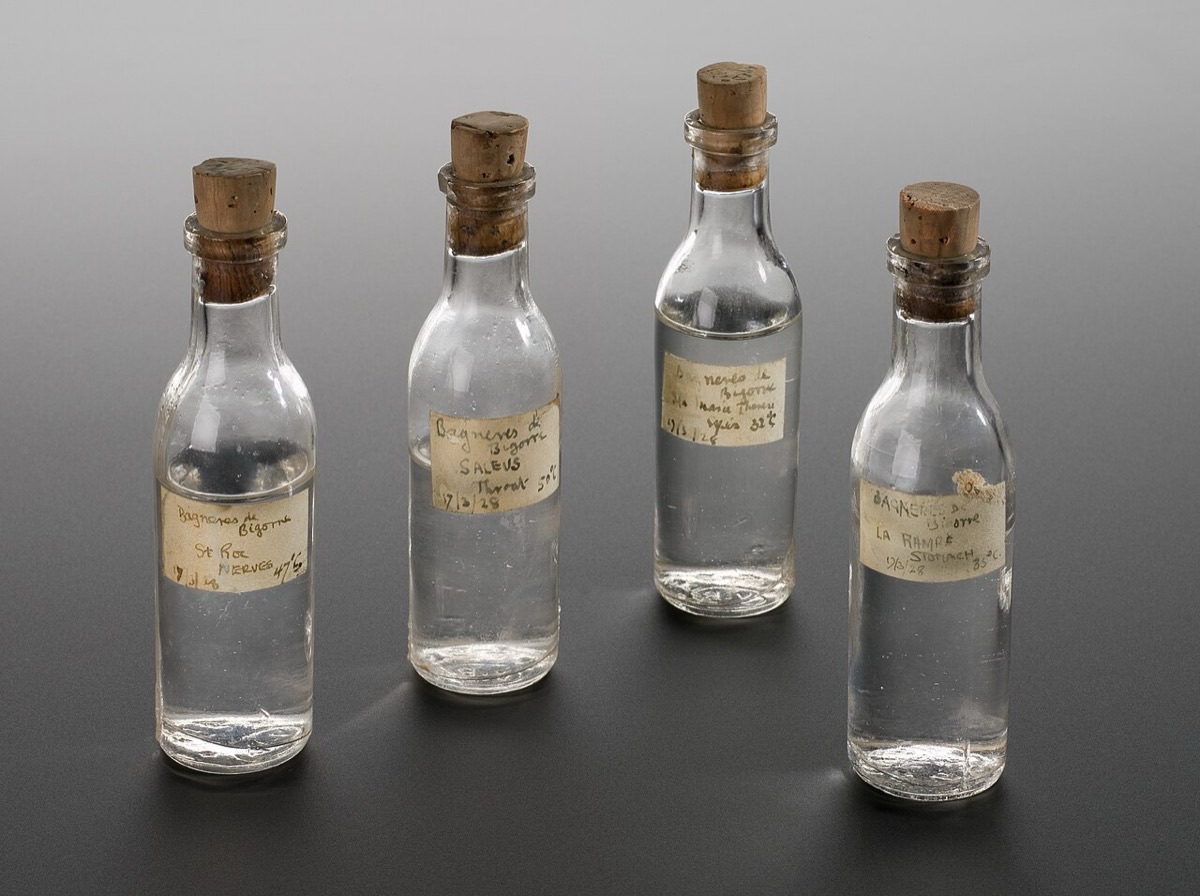
People have travelled to spa towns to drink bitter mineral water for their bowels for centuries. A team at Leibniz University Hanover wanted to know whether it works at home, in an ordinary week, with nobody watching. Their trial, run entirely online and by post across Germany, was published in Frontiers in Nutrition on 9 October 2026.
Of 473 people who filled in the screening questionnaire, 157 adults with chronic constipation by the Rome IV criteria were randomised: 144 women and 13 men, average age 49. Everyone first spent a week drinking 1.5 to 2 litres a day of a plain low-mineral spring water. Then, for three weeks, one group drank a litre a day of a heavily mineralised water (St. Antonin: 1,450 mg of sulfate, 89 mg of magnesium and 568 mg of calcium per litre) and the other a litre of a low-mineral water (27 mg of sulfate, 19 mg of magnesium). Both groups could top up with the plain spring water. Bottles arrived at the door, and people logged every bowel movement, every drink and its Bristol stool type in a daily diary.
The main question, registered before the trial began, was how much weekly bowel movements changed by the end of week three. The answer: up 1.19 a week with the mineral water and 0.62 with the control water, a difference that was not statistically significant. At week two, an extra analysis, the numbers were 1.31 against 0.34, and that gap was. People on the mineral water also reached a set improvement sooner (a median of 9 days against 16), and by week three 54% of them counted as responders against 33%. Stool consistency, symptom scores, quality of life and gut transit time, measured by eating blue-dyed cookies and waiting for blue-green stools, did not differ between the groups; both groups improved on all of them.
So why might the week-two result be weaker than it looks? Sulfate water has a strong, bitter taste, and the authors accept that some people probably knew which water they had, which matters when every outcome is self-reported. The two groups did not start in quite the same place: going by the paper's charts, about one in five of the mineral-water group had fewer than three bowel movements a week after the run-in, against fewer than one in ten of the control group, so the mineral-water group had more room to improve. Most people in both groups already had three or more a week, which is part of why the overall changes were small. The trial recruited 157 of the 206 people it had planned for. And the study was partly funded by Saint Antonin, the maker of the test water, although the authors say the sponsor had no role in the design, analysis or writing.
There are smaller signs of haste as well. The text gives the test water's total mineral content as 2,240 mg per litre and the table as 2,440, and the baseline table counts 16 men where the text counts 13. Neither changes the main results, but both are the kind of detail a careful reader notices. A finding that a subgroup who drank more fluid did much better on the mineral water is, as the authors say, exploratory: those people chose to drink more after they were randomised.
What does it add up to? Drinking enough is already standard first-line advice for constipation, along with fibre, and this trial fits an earlier pattern: mineral waters like this one seem to help a little in the first couple of weeks, with the difference fading later as the control group catches up. For someone already drinking well who wants to try it, a litre of sulfate-rich water is a gentle, low-risk experiment. It is not a proven treatment, and it is no substitute for seeing a doctor about constipation that is new, severe or comes with bleeding or weight loss.
Sulfate- and magnesium-rich mineral water vs low-mineral water, 1 litre a day for 3 weeks: randomised double-blind home-based trial, 157 adults with chronic constipation, Germany
157
Adults randomised (144 women, 13 men); 133 analysed at week 3
1,450 vs 27 mg/L
Sulfate in the test water vs the control water
+1.19 vs +0.62
Change in bowel movements a week by week 3, the registered main outcome: not significant (p = 0.144)
+1.31 vs +0.34
Change by week 2, an extra analysis (p = 0.043)
9 vs 16 days
Median time to a set improvement in frequency
54% vs 33%
Responders on frequency at week 3
No difference
Stool consistency, symptom scores, quality of life and transit time
Part-funded
By Saint Antonin, maker of the test water
Figures from Mansouri K, Hanh T, Meyer R, Hahn A, 'Daily consumption of sulfate- and magnesium-rich mineral water enhances bowel function in adults with chronic constipation: a randomized double-blind real-world trial', Frontiers in Nutrition 2026;13:1924028, published 9 October 2026, doi 10.3389/fnut.2026.1924028 (Tables 2, 4, 5 and 6 and Results). Per-protocol analysis; the authors report similar intention-to-treat results in the supplement. Registered at the German Clinical Trials Register, DRKS00034871. All outcomes were self-reported in daily diaries and online questionnaires. The share of each group with fewer than three bowel movements a week at baseline is read from the paper's Figure 2.
- Epsom salt is magnesium sulfate. It takes its name from a bitter spring at Epsom in Surrey, England, whose water was famous as a purge in the 1600s.
- Sulfate and magnesium are both absorbed slowly and incompletely in the gut, so they hold water in the bowel by osmosis. That is the same principle behind several over-the-counter laxatives.
- The Bristol stool scale, which sorts stools into seven types from hard lumps to liquid, was published by doctors at the Bristol Royal Infirmary in 1997.
- To time how long food took to pass through, participants ate cookies coloured with blue food dye and noted when their stools turned blue-green. They were asked to avoid beetroot and spinach that week so nothing else could change the colour.
- Women made up 91% of this trial. Surveys suggest chronic constipation affects women about twice as often as men, and it becomes more common with age.
- Daily consumption of sulfate- and magnesium-rich mineral water enhances bowel function in adults with chronic constipation: a randomized double-blind real-world trialFrontiers in Nutrition, 9 October 2026 · The trial paper (open access, CC BY): design, waters, results, funding and limitations
- Full text of the trial paperPubMed Central · Same paper, free to read
- Trial registration DRKS00034871German Clinical Trials Register (DRKS) · The registered plan, including the week-three main outcome
- Treatment for ConstipationUS National Institute of Diabetes and Digestive and Kidney Diseases (NIH) · Plain-language guide to diet, fluids and laxatives for constipation
General information, not medical advice. This trial tested one brand of sulfate- and magnesium-rich mineral water for three weeks in adults with chronic constipation. People with kidney disease, heart rhythm problems or on medicines affected by magnesium should check with a doctor before drinking mineral-rich water in quantity. See a doctor about constipation that is new, severe, or comes with bleeding, weight loss or pain.
Analysis by NutroPractic from the sources listed. Written for general readers; it does not replace advice from your own doctor.
From our articles
Our guides on this subject
Plain-language guides on nutrition and wellness, backed by research.

Supplements and vitamins
Zinc carnosine for the gut lining: what the two human trials gave, the zinc in each dose, and the copper catch
Zinc carnosine is only about 22.6% zinc, so 75 mg twice a day is roughly 34 mg of zinc a day. Here are the doses and results of the 10-person NSAID permeability trial and the 20-person aspirin pilot, and the copper cautions.
22 Nov 2026

Gut health
Probiotic capsules: which ones have trial evidence, what they can do, and when to skip them
Children on antibiotics: 8% got diarrhoea with a probiotic, 19% without. Older hospital patients: 10.8% with, 10.4% without. Which capsules have evidence, what three guidelines say about IBS, what a course costs per case prevented, and who shouldn't take them.
2 Nov 2026

Gut health
Gluten-free without coeliac disease: who actually benefits, and what the blinded gluten challenges found
In blinded trials only 16% of people who said gluten made them ill reacted to gluten rather than placebo, and in Oslo fructans caused more bloating than gluten. Who really needs to avoid it, how to get tested before you stop, how much gluten is in a slice of bread or a roti, and what gluten-free food costs (159% more in the UK) and lacks.
1 Nov 2026
Newsfeed for your website
Want this feed on your website?
Add it to any site with one copy-and-paste snippet. No sign-up, and it updates itself every hour.
Start with a virtual consultation
Tell Dr. Triveni what you want to change. You will leave with a clear next step, whether you are in Toronto, London, New York or Chennai.