Family nutrition · October 19, 2026
Three Israeli schools, seven months of free 12 kg boxes of rescued fruit and veg: more parents said they ate extra fruit, but a detailed food questionnaire saw no change and vegetables didn't budge
A food-rescue charity handed families boxes of surplus produce every two weeks through their children's schools. About twice as many parents at the box schools reported eating more fruit as at the school without boxes, yet a 116-item food questionnaire found no difference, children's intake didn't move, and household food insecurity rose everywhere during a war. Here's what one school per group can and can't tell us.
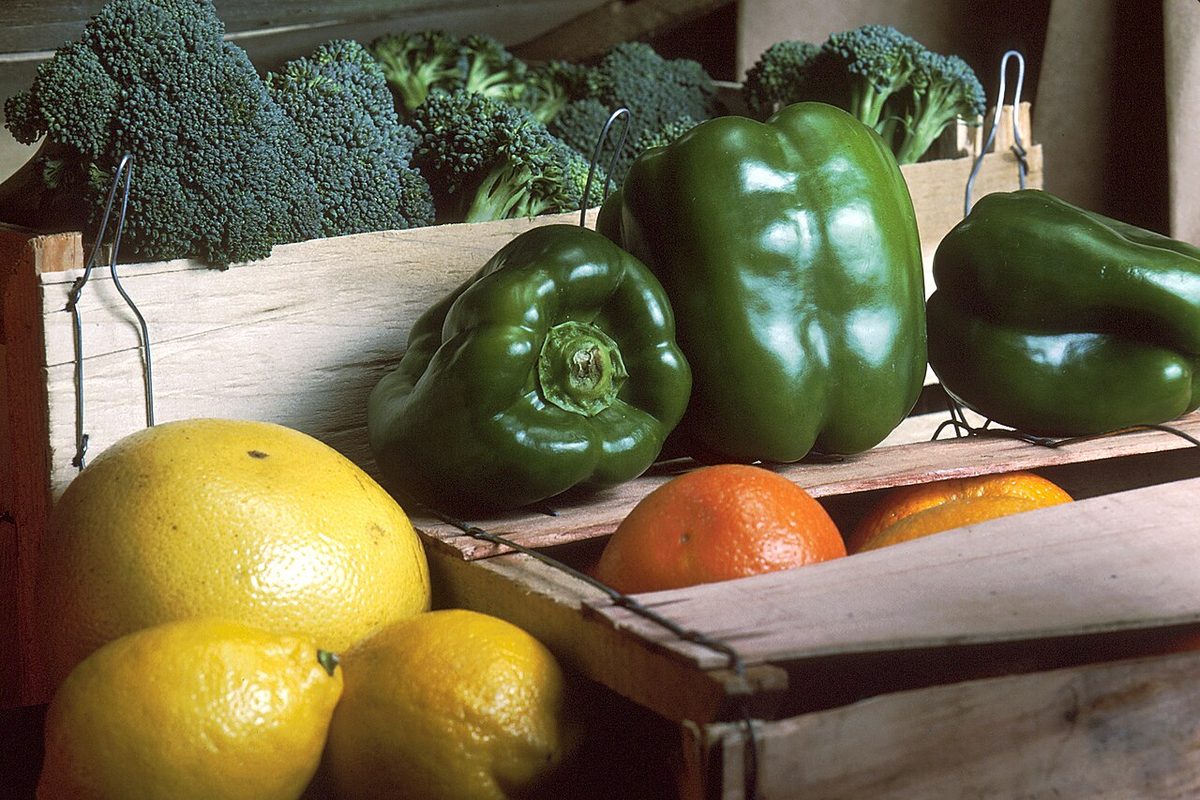
Every year farms grow fruit and vegetables that never get sold: produce that is the wrong size, left in the field after harvest, or surplus to what shops will take. Food-rescue charities collect it and pass it on. In Israel, the charity Leket Israel runs a school programme called Leket Health that does something unusual with it: rather than targeting families known to be struggling, it offers a box of rescued produce to every family at a participating school, so that nobody is singled out. The new study, published on 13 October in the journal Nutrients, asked whether that changed what parents ate at home.
Researchers from Ariel University and Leket Israel worked with three elementary schools in a small town on Israel's periphery during the 2023 to 2024 school year. One school got the full programme: a box of about 12 kg of fresh produce every two weeks, each with an information sheet and a recipe for what was inside, plus four hour-long classroom lessons with a dietitian for the children. A second school got the boxes only, and a third got nothing and served as the comparison. Over seven months there were 15 deliveries, and on average about 37% of each box was fruit. 281 parents of fourth and fifth graders signed up, and 196, almost nine in ten of them mothers, answered questionnaires at both the start and the end.
At the start, most parents ate little produce: about 78% had fewer than three servings of vegetables a day and 79% fewer than two of fruit, with lack of time or energy to deal with the food the most common reason given, especially for vegetables. Seven months later, when parents were asked how many servings of fruit they usually ate, 28% at the full-programme school and 33% at the boxes-only school said more than before, against 14% at the school without boxes, a difference between the groups that was statistically significant. Vegetables were a different story: there was no difference between the schools in how many parents reported eating more of them.
The trouble is that the study measured diet two ways and they disagreed. A 116-item food frequency questionnaire, a more detailed tool that asks how often people eat specific foods, showed no significant difference between the schools in grams of fruit or vegetables eaten each day. The children's own reports didn't change either: fruit stayed at about 435 g a day and vegetables dipped slightly, with no difference between schools. The researchers also tested how much the fruit result depended on the parents who dropped out, more of them at the comparison school: under their main assumption, parents at the full-programme school ate about 0.38 more servings of fruit a day than comparison parents by the end, but under a more pessimistic assumption about those who left, the gap shrank to 0.15.
Families did use the produce. More than nine in ten parents said their household ate most of the fruit and vegetables in the boxes, and about 64% said the variety of fruit and vegetables at home had improved. Collection was much higher at the full-programme school, where families picked up about 12.7 of the 15 boxes on average, than at the boxes-only school, about 9.2. Each extra box collected went with slightly higher odds of a parent reporting more fruit, though families who keep collecting may simply be the keener ones. Meanwhile, the share of households classed as food insecure rose from 8.7% to 14.3% over the study, which ran through the first months of the Israel–Hamas war, and it worsened at all three schools to a similar degree.
The authors are frank about the limits. With one school per group, the schools differ in many ways besides the programme, so any difference could come from the school rather than the boxes; schools weren't assigned at random, no main diet outcome was fixed in advance, and the trial wasn't registered. The planned parent workshops were cut back to one online talk because of the war, and only 12 of 104 invited parents attended, so the study can't say whether the education added anything. It was funded by Leket Israel, which runs the programme and employs two of the five authors; the statistics were done by an external statistician. The authors call the findings exploratory and say a larger trial with several schools per group is needed before the model is scaled up.
Rescued produce boxes, with or without nutrition education, at three elementary schools in a peripheral Israeli town, 2023 to 2024
281 → 196
Parents enrolled, and those who answered at both the start and after seven months
15 × ~12 kg
Fortnightly boxes of rescued fruit and vegetables offered to every family at the two box schools
28% / 33% / 14%
Parents reporting more daily fruit servings: full programme, boxes only, no boxes (p = 0.028)
No difference
Between schools in vegetable servings, or in fruit and vegetable grams on the 116-item food questionnaire
+0.38 to +0.15
Extra fruit servings a day, full programme versus no boxes, depending on assumptions about dropouts
8.7% → 14.3%
Households classed as food insecure, start to end, rising at all three schools during the war
Study: Hod-Ovadia S, Kilzi M, Factor H, Boaz M, Kaufman-Shriqui V, 'School-Based Rescued Produce Distribution, and Changes in Parental Fruit Intake and Household Dietary Behaviors: A Non-Randomized Controlled Cluster Trial', Nutrients 2026, 18(20), 3355, published 13 October 2026 (received 2 September, accepted 9 October), doi 10.3390/nu18203355, CC BY, read in full on the publisher's site. Non-randomised design, one school per arm (intervention schools chosen by their principals' willingness); not registered in a public trial registry. Complete-case share of parents with an increase in self-reported daily fruit servings: 28.0% full intervention, 32.8% partial (boxes only), 14.3% control; vegetables p = 0.738. Sensitivity analyses among 269 identifiable enrolled parents (100 multiple imputations): adjusted difference versus control +0.38 portions/day (95% CI 0.04 to 0.71) full and +0.25 (−0.10 to 0.61) partial under missing-at-random; +0.29 and +0.27 if dropouts were assumed unchanged; +0.15 and +0.06 under adverse missingness. Retention 76.9% full, 69.5% partial, 61.0% control. Boxes collected 12.71 ± 3.17 versus 9.21 ± 5.13 (p < 0.001); odds ratio per box for reporting more fruit 1.067 (95% CI 1.003 to 1.135), a post-allocation adherence analysis. Children (n = 179 with paired data): fruit 433 to 437 g/day, vegetables 325 to 294 g/day, no between-group differences. Food insecurity (18-item USDA-based questionnaire) 8.7% to 14.3%, no between-group difference in deterioration (p = 0.810). Funding: Leket Israel, which implemented the programme; two authors are employed by Leket Israel, a disclosed competing interest; the open-access charge was paid by Ariel University.
- Israel's dietary guidelines, as cited in the paper, recommend at least five servings of vegetables and three of fruit a day, yet nearly four in five parents here reported fewer than three servings of vegetables.
- Parents named lack of time or energy as the main reason they ate little produce, more often for vegetables than fruit, which the authors note usually needs no washing, chopping or cooking.
- Other reasons parents gave for eating little fruit and veg included personal taste, finding it not filling enough, and saving it for their children rather than eating it themselves.
- The boxes went to every family at the participating schools, not just those in need: a deliberate choice meant to avoid stigma and to reach families whose hardship doesn't show up in welfare records.
- School-Based Rescued Produce Distribution, and Changes in Parental Fruit Intake and Household Dietary Behaviors: A Non-Randomized Controlled Cluster TrialNutrients, October 2026 · The study: design, results, sensitivity analyses, limitations and funding
- Leket IsraelLeket Israel · The food-rescue charity that runs the Leket Health school programme and funded the study
General information, not medical advice. This was a small, non-randomised study at three schools, with diets reported by the families themselves. If you're struggling to afford fresh food, a local food bank, school or social worker may be able to point you to help.
Analysis by NutroPractic from the sources listed. Written for general readers; it does not replace advice from your own doctor.
From our articles
Read, then eat a little better
Plain-language guides on nutrition and wellness, backed by research.
Supplements and vitamins
Spermidine from food or capsules: measured milligrams in wheat germ, soybeans and cheese, and what the one year-long trial found
Wheat germ holds about 22 to 34 mg of spermidine per 100 g, matured cheese about 0.12 mg. The only year-long capsule trial used 0.9 mg a day and found no memory benefit. Measured values, worked doses and safety.
22 Nov 2026

Supplements and vitamins
Zinc carnosine for the gut lining: what the two human trials gave, the zinc in each dose, and the copper catch
Zinc carnosine is only about 22.6% zinc, so 75 mg twice a day is roughly 34 mg of zinc a day. Here are the doses and results of the 10-person NSAID permeability trial and the 20-person aspirin pilot, and the copper cautions.
22 Nov 2026

Women's health
Inositol for PCOS: the 40:1 ratio, trial doses, and food milligrams
Why do randomized trials in polycystic ovary syndrome prioritize the 40:1 myo to D-chiro inositol ratio? Here is the science behind the ovarian epimerase paradox, clinical ovulation and insulin metrics, and why cantaloupe cannot replace 4,000 mg trial powder.
21 Nov 2026
Newsfeed for your website
Want this feed on your website?
Add it to any site with one copy-and-paste snippet. No sign-up, and it updates itself every hour.
Start with a virtual consultation
Tell Dr. Triveni what you want to change. You will leave with a clear next step, whether you are in Toronto, London, New York or Chennai.