Protein and strength · October 23, 2026
Protein on top of lifting added about 7 kg to young adults' squats and 2.6 kg to their bench press. In the few trials that ran past 12 weeks, the squat edge was gone
A new pooled look at 23 small trials in 611 healthy young adults found that people who took protein while doing strength training gained a little more strength than those who trained with a placebo drink. The extra came mostly in shorter trials and in men, the results varied a lot from trial to trial, and most studies never checked how much protein people already ate.
Protein shakes are a fixture of gym bags, sold on the idea that extra protein turns training into more muscle and more strength. Trials testing that idea have disagreed: some find a benefit, others none. A team from three colleges in Jiangxi, China, pooled the randomised trials that asked a narrow question in a narrow group: in healthy adults under 45 doing resistance training, does adding protein raise the most a person can lift once in a bench press or a squat, compared with the same training plus a placebo or nothing?
They searched four databases up to April 2026, screened 11,596 records and kept 23 trials published between 2004 and 2023, with 611 people whose average age was 25. Trials ran from 6 to 36 weeks, most groups trained three or four times a week, and the largest trial had 63 people. Whey was the most common protein, with others using milk, yoghurt, beef, soy, collagen, casein mixes or even insect protein, and most control groups drank a carbohydrate placebo such as maltodextrin. The review was published in Frontiers in Nutrition on 13 October.
Across 32 comparisons, adding protein raised the one-rep-max bench press by 2.63 kg more than training alone. Across 15 squat comparisons from 12 trials, the extra was 7.40 kg. The authors put that at roughly 4 to 7% of a typical beginner's bench and 7 to 12% of a typical squat, larger than the usual error of a one-rep-max test. Both results held when any single trial was dropped and when non-dairy or mixed-protein trials were left out, and the GRADE rating of the evidence was moderate for bench press and high for squat.
The averages hide a lot of spread: the results differed between trials far more than chance would explain (I² above 90% for both lifts). For squat, trial length mattered. In trials of 12 weeks or less the extra was 10.6 kg, while in the three comparisons that lasted longer there was no clear benefit (about 3 kg less, a result that could be chance). Men-only trials showed the squat benefit; there were only three bench and one squat comparisons in women, none of them significant. Taking protein both around training and before sleep gave the largest gains, but that rests on two or three comparisons and the authors call it a hypothesis, not a rule.
The authors' main caution is about the diet people already ate. Most trials added protein without measuring or fixing participants' usual intake, and an earlier large review found that extra protein stops adding muscle once daily intake is above about 1.6 g per kg of body weight. Someone already eating plenty of protein may see little from a shake. Other limits: most participants were men, doses could not be compared, and some trials shared one control group across several arms. The work was funded by provincial and college research grants in Jiangxi, and the authors declare no commercial conflicts. We read the full open-access paper.
Protein added to resistance training versus training alone: 23 randomised trials, 611 healthy young adults (average age 25)
+2.63 kg
Extra gain in one-rep-max bench press with protein (32 comparisons)
+7.40 kg
Extra gain in one-rep-max squat with protein (15 comparisons from 12 trials)
+10.6 kg
Extra squat gain in trials of 12 weeks or less
No clear gain
Squat in the 3 comparisons longer than 12 weeks (about 3 kg less, not significant)
92.8–93.9%
Heterogeneity (I²) for bench and squat: trial results differed widely
6 to 36 weeks
Length of the trials; 12 to 63 people in each
Study: Zhang C, Wang Y, Huang W, 'Protein supplementation and resistance training-induced strength gains in young adults: a meta-analysis', Frontiers in Nutrition 13, published 13 October 2026, doi 10.3389/fnut.2026.1946052, open access; PROSPERO CRD42024534481. Searched PubMed, Web of Science, Cochrane Library and SPORTDiscus to 1 April 2026 (11,596 records). Included randomised trials in healthy adults under 45 comparing resistance training plus protein with training plus placebo or nothing; 23 trials (2004–2023), 611 participants, mean age 25.32. Random-effects weighted mean differences in one-rep-max change. Bench press: 32 interventions, WMD 2.63 kg (95% CI 0.77–4.49), I² 92.8%. Squat: 15 interventions from 12 studies, WMD 7.40 kg (2.15–12.66), I² 93.9%. Squat by duration: ≤12 weeks 10.64 kg (5.42–15.86), >12 weeks −2.99 kg (−6.53 to 0.55); meta-regression p = 0.037 for duration, p = 0.073 for timing. Bench by duration: ≤12 weeks 2.89 kg (0.81–4.96), >12 weeks 0.74 kg (−2.41 to 3.89). Squat in men-only studies 10.64 kg (4.47–16.81); women-only studies: bench 4.65 kg (−1.33 to 10.64, 3 interventions), squat −1.60 kg (1 intervention). Protein after and before exercise and before sleep: bench 7.23 kg (3.93–10.52, 3 interventions), squat 10.14 kg (6.42–13.85, 2 interventions). Bench in untrained participants 1.92 kg (0.46–3.38); squat in well-trained participants 7.75 kg (4.44–11.06). Sensitivity analyses (leave-one-out, excluding non-dairy/non-whey or mixed-protein studies, splitting shared control groups) kept both pooled effects significant. No publication bias on Begg's or Egger's tests. GRADE: bench press moderate, squat high. The percentage-of-baseline figures are the authors' estimates from typical untrained one-rep maxes, not measured in these trials. Limitations stated by the authors: high heterogeneity, no dose-response analysis possible, few interventions in some subgroups, mostly male participants, habitual protein intake rarely measured, shared control groups. Funding: Humanities and Social Sciences Foundation of Jiangxi Province's universities (TY25202) and Nanchang Normal College of Applied Technology (NYSRW2401); no commercial or financial conflicts declared. The 1.6 g/kg/day figure is from Morton et al., British Journal of Sports Medicine 2018.
- Whey, the watery part of milk left after cheese-making, was the protein used most often in these trials; others tested milk, yoghurt, beef, soy, collagen and insect protein.
- Most control groups drank a placebo of carbohydrate such as maltodextrin, so the comparison was protein against a similar-looking drink without the protein, not against nothing at all.
- A one-rep max is the heaviest weight a person can lift once with good form; the authors note test-to-test variation of roughly 2 to 9%, which the bench and squat gains exceeded.
- A 2018 review in British Journal of Sports Medicine found extra protein stopped adding muscle once total intake passed about 1.6 g per kg of body weight a day, around 112 g for a 70 kg person.
- Only one of the 23 trials lasted longer than 16 weeks, a 36-week study in 63 young men and women who had not done resistance training before.
- Protein supplementation and resistance training-induced strength gains in young adults: a meta-analysisFrontiers in Nutrition · The paper, open access
- A systematic review, meta-analysis and meta-regression of the effect of protein supplementation on resistance training-induced gains in muscle mass and strength in healthy adultsBritish Journal of Sports Medicine · Morton et al., 2018: source of the 1.6 g/kg/day figure
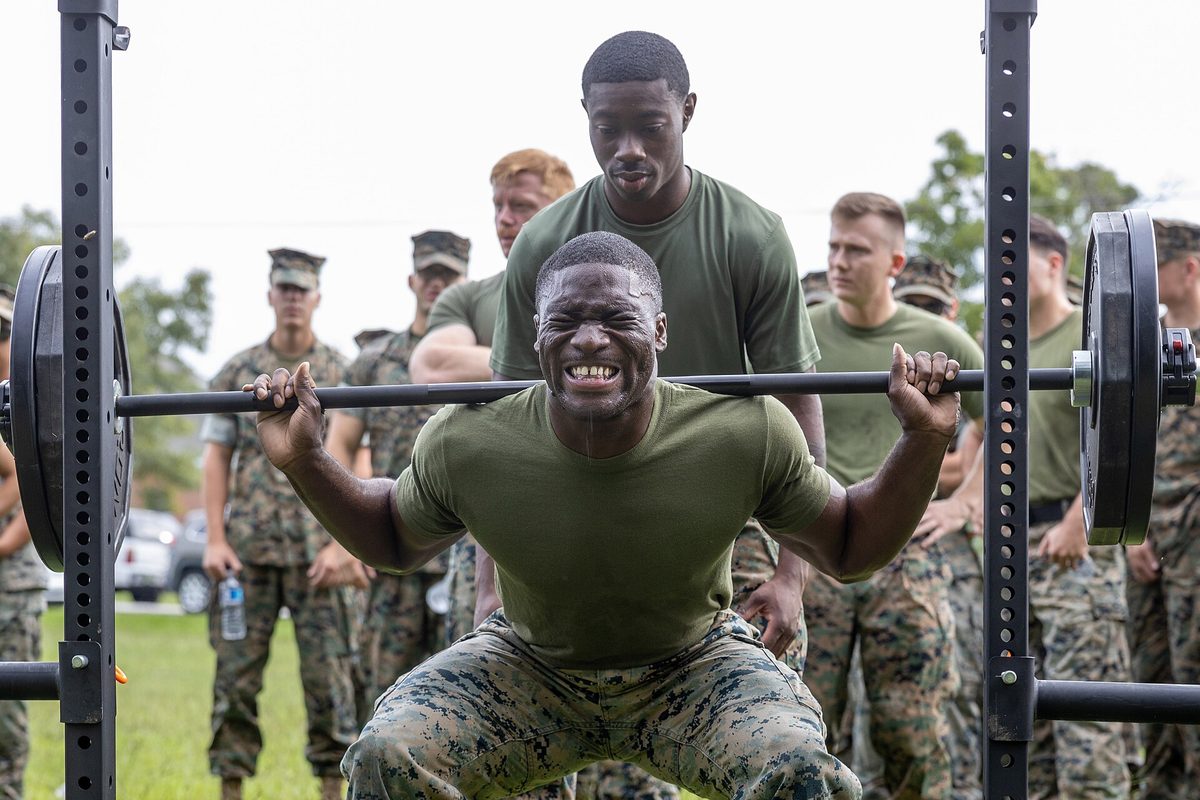
- 1st Lt. Nsikakabasi Ndem barbell squatsWikimedia Commons · The photo, public domain (U.S. Marine Corps)
General information, not medical advice. These trials were in healthy young adults doing supervised strength training. If you have kidney disease, diabetes or another long-term condition, are pregnant, or are thinking about protein supplements for an older relative or a teenager, talk to a doctor or registered dietitian first. Food sources of protein count towards the same daily total as shakes.
Analysis by NutroPractic from the sources listed. Written for general readers; it does not replace advice from your own doctor.
From our articles
Our guides on this subject
Plain-language guides on nutrition and wellness, backed by research.
Everyday eating
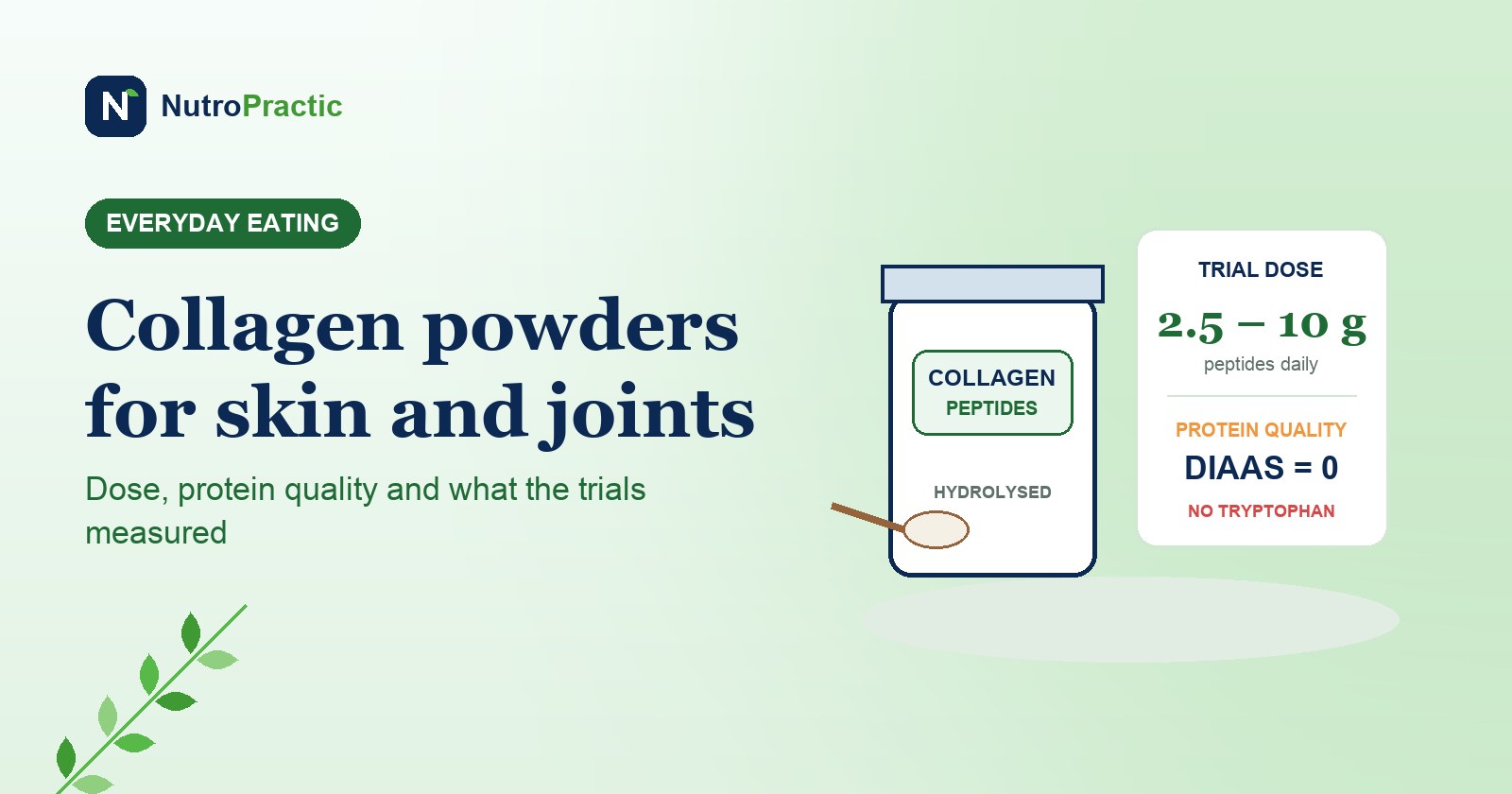
Collagen powders for skin and joints: dose, protein quality and what the trials measured
A 10 g scoop gives 9 g protein, but its protein quality score is zero. Here is what 19 skin trials and knee studies measured at 2.5 g to 10 g daily—and what collagen cannot do.
10 Nov 2026
Everyday eating
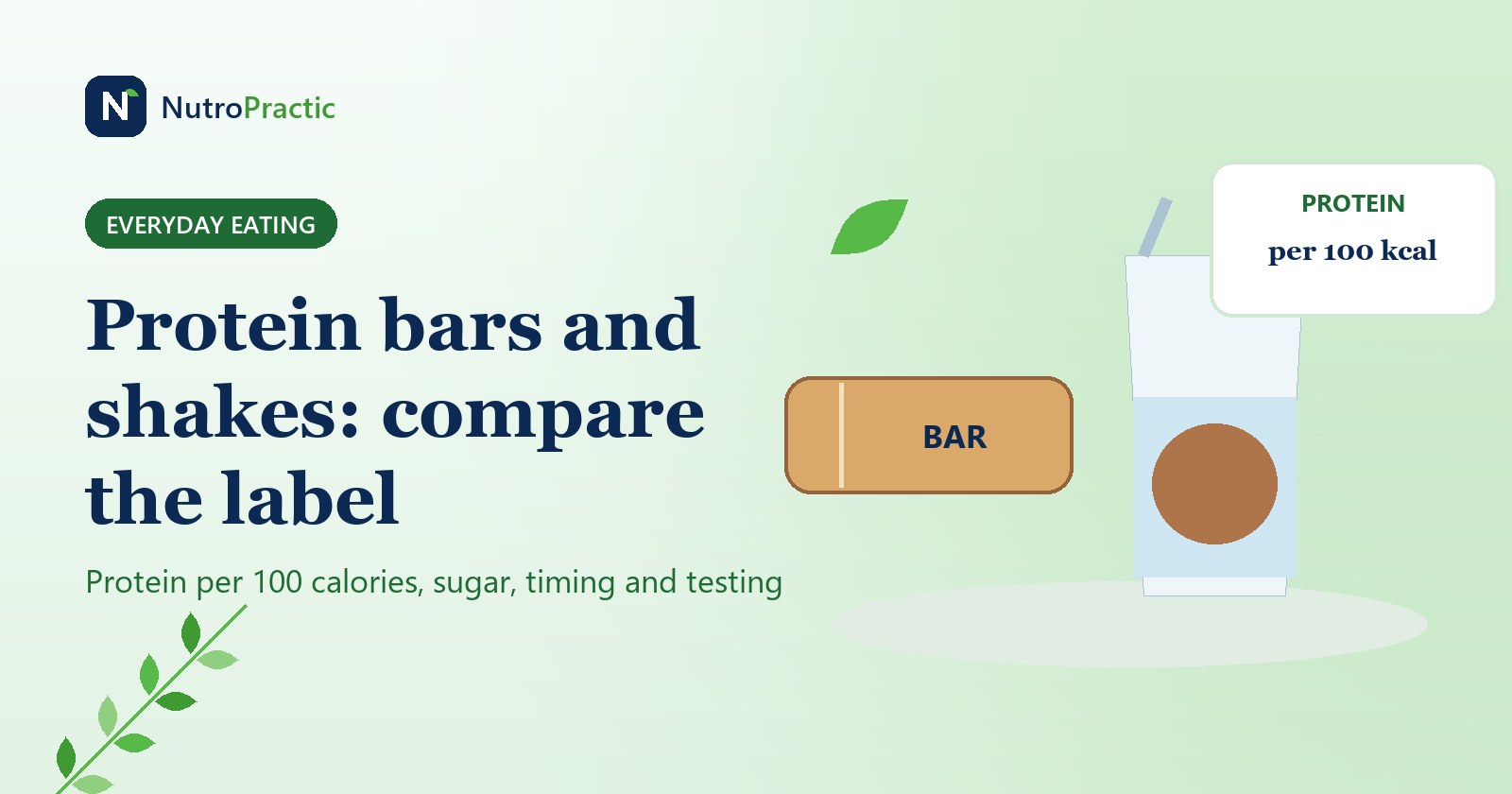
Protein bars and shakes: what you get per 100 calories
Four current labels range from 6.3 to 20 g protein per 100 kcal. Here is how bars, shakes, eggs, yogurt and lentils compare—and when a supplement actually helps.
6 Nov 2026
Everyday eating
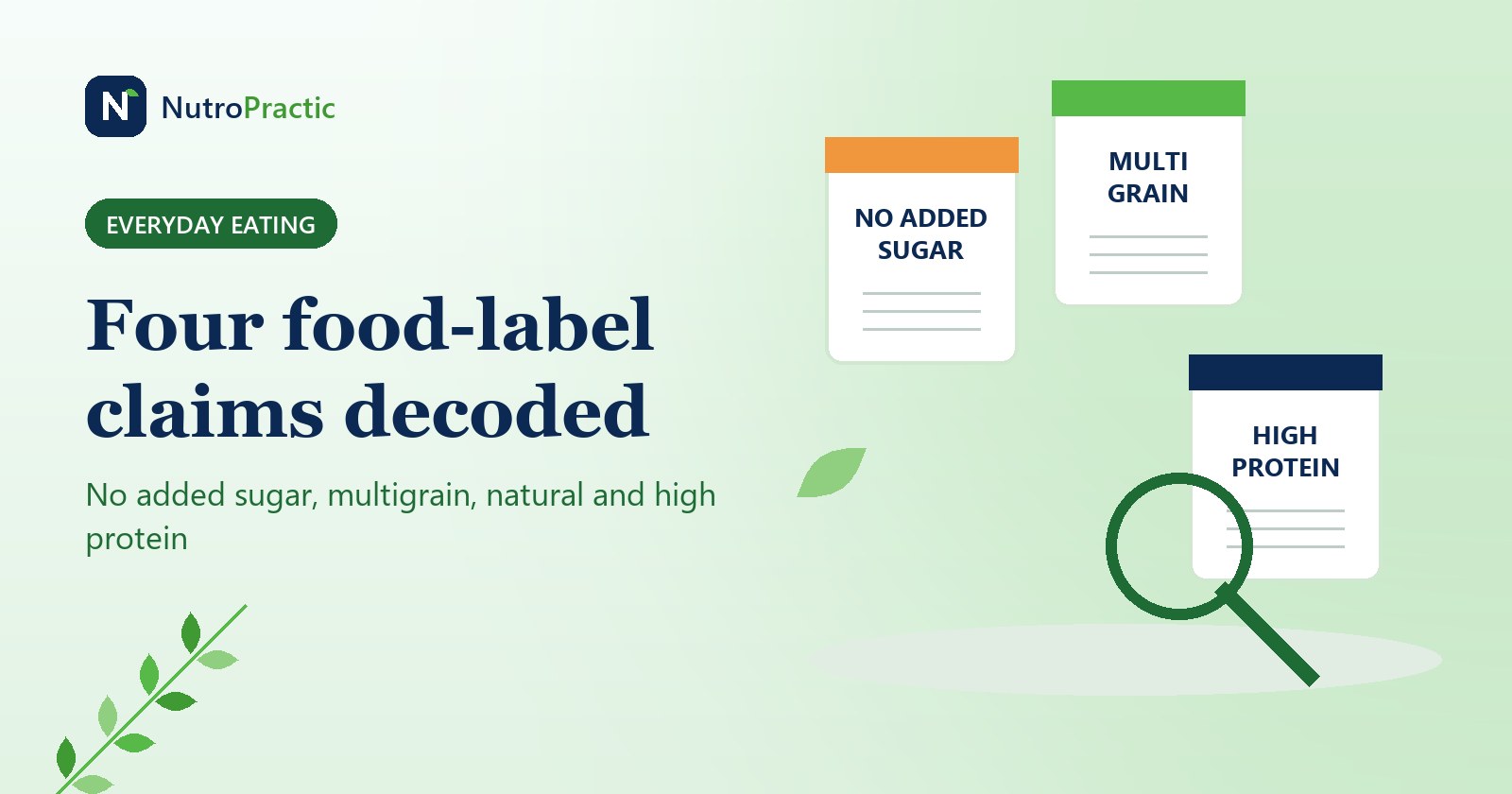
Food label claims decoded: 'no added sugar', 'multigrain', 'natural' and 'high protein'
A no-added-sugar biscuit with only 13% fewer calories. A 7-grain loaf with refined flour listed first. A 'high protein' bar that clears the legal line at 21%. What each claim legally requires in the EU/UK, US and India, with worked reads of real packs.
2 Nov 2026
Newsfeed for your website
Want this feed on your website?
Add it to any site with one copy-and-paste snippet. No sign-up, and it updates itself every hour.
Start with a virtual consultation
Tell Dr. Triveni what you want to change. You will leave with a clear next step, whether you are in Toronto, London, New York or Chennai.