Food is medicine · October 18, 2026
67 older patients in Buffalo got free fruit and veg on prescription for 12 weeks. Those sent to a market picked it up about 3 weeks in 12; those who got it delivered took it nearly every week
A small trial gave adults 65 and over who struggle to get fresh food a weekly produce box at home, a weekly meal kit at home, or a voucher for a mobile market. Delivery roughly tripled the food that reached people's kitchens. The pricier meal kits added nothing on top, and the lead author part-owns the business that packed the boxes, which the paper discloses.
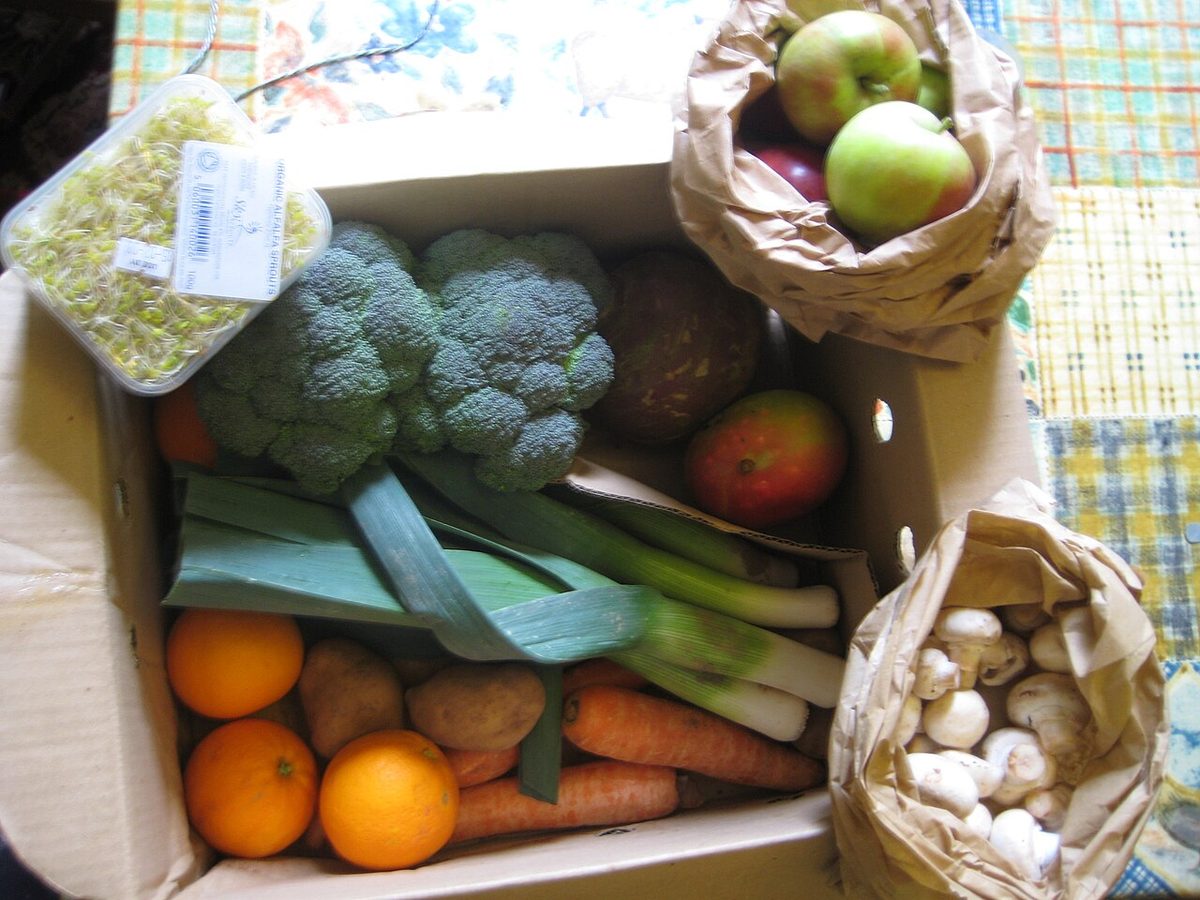
"Food is medicine" programmes let doctors prescribe free fruit and vegetables to patients who can't easily afford or reach them. Their weak spot is that many prescriptions are never collected: a review the authors cite found people redeemed only about a third to three-fifths of their food vouchers. A trial published on 9 October 2026 in Frontiers in Public Health asked whether bringing the food to the door fixes that for older adults, who may not drive or find it hard to carry shopping.
Researchers at the University at Buffalo, New York, worked with two hospital primary care clinics. Patients aged 65 and over qualified if a routine screening question showed they had cut back on food for lack of money or had no fresh produce within two miles of home. Between September 2024 and January 2025, 67 people took part: on average 71 years old, 73% African American, more than half living on under $20,000 a year. Each was offered one of three free 12-week prescriptions, all worth about 12 servings of fruit and vegetables a week per person: a produce box delivered home, a meal kit delivered home with the ingredients and recipes for three meals plus extra fruit, or the usual local approach, a weekly voucher for a mobile market at the clinic or at any of 11 stops across the city. Everyone also got recipes and basic cooking equipment.
Getting the food mattered most. People in both delivery groups reported receiving their food in 89.2% of weeks, about 10.7 of the 12, against 28.3% in the market group, about 3.4 weeks. The delivery firm's own records matched (about 11 deliveries per person), while returned vouchers confirmed only 1.8 market pick-ups per person on average. Once the food was in the house, all three groups said they used most of it, 83 to 85%. Put together, the delivery groups used about three-quarters of all the food on offer (75.7% for produce boxes, 77.7% for meal kits) against a quarter (24.9%) for the market group.
The meal kits did not beat the plain produce box. Meal kit users cooked about 27 of their 36 recipes, but they used the same share of produce, and the authors put the kits at $91 to $107 per household a week against $27 to $36 per person a week for produce boxes. Their community advisory board of older residents told them most already knew how to cook. In a follow-up analysis, 70.6% of produce box users who answered said they spent less of their own money on fruit and vegetables, against 29.4% in the market group. Few people customised their orders, mostly because they had no internet access, and the most common complaint was too much food.
This is a small study about uptake, not health. It did not measure what people actually ate, their weight, blood sugar or blood pressure, and food use was self-reported in weekly surveys that people in the market group often skipped. Each arm started with 22 or 23 people and 16 to 20 completed follow-up. The paper has some loose ends: in the dosage section of Table 4 the labels on two comparisons appear swapped (the text and chart show both delivery groups beating the market, not each other), and the flow chart's description gives different randomisation numbers from the text.
The lead author has an ownership interest in the local business that packed and delivered the produce boxes and meal kits. The paper declares this, says the university's research compliance office reviewed it, and says she had no part in paying the vendor. The trial was funded by the American Heart Association, the anonymised data are posted openly on the Open Science Framework, and the article is open access under a CC BY licence. The authors conclude that delivery was the biggest factor in getting prescribed food to older adults and plan to report diet and health outcomes later.
Three ways to fill a free fruit-and-veg prescription: 67 adults aged 65+ in Buffalo, New York, 12 weeks
67
Primary care patients aged 65+ with trouble affording or reaching fresh food (22 market voucher, 22 produce box, 23 meal kit)
89.2% vs 28.3%
Share of the 12 weeks people reported getting their food: either delivery arm vs mobile market voucher
1.8
Average market pick-ups per person confirmed by returned vouchers, vs about 11 confirmed home deliveries
83–85%
Share of the food received that people said they used, similar in all three groups
~76% vs 25%
Share of all the food on offer that was used: delivery groups (75.7% box, 77.7% meal kit) vs market voucher
$91–107 vs $27–36
Weekly cost of a meal kit per household vs a produce box per person, including delivery
70.6% vs 29.4%
Produce box users vs market voucher users who said they spent less of their own money on fruit and veg
Figures from Leone LA, Lally Mathiebe A, Stoll J, Paluch RA and Tirabassi JN, 'A randomized controlled study comparing three food prescription programs for older adults: program design, implementation, and utilization', Frontiers in Public Health, published 9 October 2026, doi 10.3389/fpubh.2026.1855988 (open access, CC BY). Redemption and food use were self-reported in weekly surveys; missed surveys counted as no food received. The spending figures are from the paper's sensitivity analysis, which left out non-responders. Costs are the authors' estimates; the market figure rises to $52–60 a week per person once the $10,000 paid to run a market at the clinic is included. The lead author has a disclosed ownership interest in the delivery business.
- In the US, produce prescriptions have their own federal grant programme: the 2018 Farm Bill set up the Gus Schumacher Nutrition Incentive Program, which funds produce prescription projects alongside incentives for buying fruit and vegetables.
- Only about 1 in 8 American adults eats the recommended amount of fruit and about 1 in 10 the recommended amount of vegetables, according to CDC estimates from 2019 survey data.
- US dietary guidelines advise adults to eat 1.5 to 2 cups of fruit and 2 to 3 cups of vegetables a day, depending on age and sex.
- Before they started, members of the study's community advisory board tried the meal kits for a week and asked for more adventurous recipes, saying they already knew how to cook and didn't need simple ones.
- A randomized controlled study comparing three food prescription programs for older adults: program design, implementation, and utilizationFrontiers in Public Health, 9 October 2026 · The trial: design, results tables, costs, limitations, funding and conflict of interest
- Full text of the trial (PMC13645783)PubMed Central, US National Library of Medicine · Open-access copy with Tables 3 to 5, used to check the figures
- Study data on the Open Science FrameworkOpen Science Framework · The raw data the authors posted with the paper
- Adults meeting fruit and vegetable intake recommendations, United States, 2019CDC, Morbidity and Mortality Weekly Report, January 2022 · How few US adults eat enough fruit and vegetables
- Gus Schumacher Nutrition Incentive Program (GusNIP)USDA National Institute of Food and Agriculture · The federal programme that funds produce prescription projects
General information, not medical advice. This small trial measured whether older adults received and used prescribed food, not whether their health improved. If you find it hard to afford or reach fresh food, ask your doctor, a social worker or a registered dietitian what food programmes are available where you live.
Analysis by NutroPractic from the sources listed. Written for general readers; it does not replace advice from your own doctor.
From our articles
Read, then eat a little better
Plain-language guides on nutrition and wellness, backed by research.
Supplements and vitamins
Spermidine from food or capsules: measured milligrams in wheat germ, soybeans and cheese, and what the one year-long trial found
Wheat germ holds about 22 to 34 mg of spermidine per 100 g, matured cheese about 0.12 mg. The only year-long capsule trial used 0.9 mg a day and found no memory benefit. Measured values, worked doses and safety.
22 Nov 2026

Supplements and vitamins
Zinc carnosine for the gut lining: what the two human trials gave, the zinc in each dose, and the copper catch
Zinc carnosine is only about 22.6% zinc, so 75 mg twice a day is roughly 34 mg of zinc a day. Here are the doses and results of the 10-person NSAID permeability trial and the 20-person aspirin pilot, and the copper cautions.
22 Nov 2026

Women's health
Inositol for PCOS: the 40:1 ratio, trial doses, and food milligrams
Why do randomized trials in polycystic ovary syndrome prioritize the 40:1 myo to D-chiro inositol ratio? Here is the science behind the ovarian epimerase paradox, clinical ovulation and insulin metrics, and why cantaloupe cannot replace 4,000 mg trial powder.
21 Nov 2026
Newsfeed for your website
Want this feed on your website?
Add it to any site with one copy-and-paste snippet. No sign-up, and it updates itself every hour.
Start with a virtual consultation
Tell Dr. Triveni what you want to change. You will leave with a clear next step, whether you are in Toronto, London, New York or Chennai.