Food safety · October 18, 2026
28 tea brands, brewed at 95 °C for three minutes: a cup made with a plastic tea bag held hundreds to a couple of thousand microplastic particles. Loose tea held a handful
Researchers in Türkiye's tea country counted what comes out of the bag. Every large particle from the plastic bags was a nylon fibre, and the BPA from bagged tea reached a fifth of Europe's new, very strict daily limit. The risk estimate still came out below the danger line.
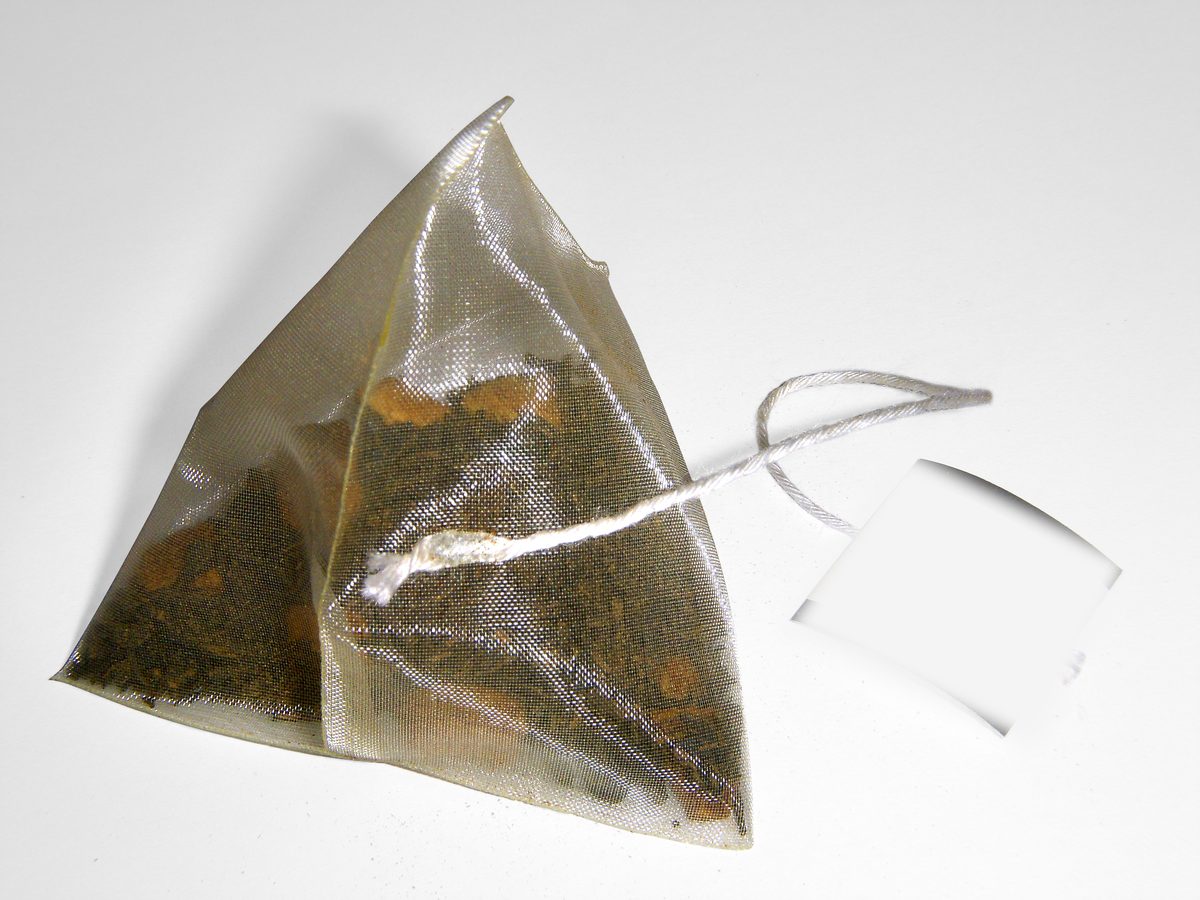
The shiny pyramid tea bag looks like an upgrade on the old paper square: roomier, so the leaves can unfurl, and see-through, so you can admire them. But many of those mesh bags are plastic, and they go into water just off the boil. What ends up in the cup?
Two researchers at Recep Tayyip Erdoğan University in Rize, on Türkiye's Black Sea coast, set out to measure it. Necla Pehlivan and Kenan Gedik brewed infusions from 14 brands of bagged tea and 14 brands of loose tea under the same controlled conditions, 95 °C for three minutes, and published the results in npj Science of Food on 13 October 2026. They identified the plastic particles with infrared spectroscopy, measured bisphenol A (BPA) and a group of plasticisers called phthalate esters by mass spectrometry, and then estimated what those amounts might mean for health.
The gap between the two kinds of tea was wide. Plastic tea bags released between 555 and 2,498 microplastic particles per cup. Loose tea released between 0.3 and 2.4. The particles also told different stories. Every piece larger than 100 micrometres (a tenth of a millimetre) that came from the tea bags was a polyamide fibre, the plastic family that includes nylon, which the authors read as the bag itself breaking down in hot water. The few particles in loose tea were a mix of polyethylene, polypropylene, PET and polyamide, mostly fragments rather than fibres, the sort of background contamination that creeps in during growing, processing and packing.
Then the chemicals. BPA, a building block of some plastics that can act on hormones, came out of the bagged tea, and in the worst case it reached 21.7% of the tolerable daily intake set by the European Food Safety Authority. That sounds modest, but the yardstick is unusually tight: in 2023 EFSA cut its BPA limit to 0.2 nanograms per kilogram of body weight per day, 20,000 times lower than its 2015 figure, and the EU has since restricted BPA in materials that touch food. Adding BPA and the phthalates together, the study's combined hazard index stayed below 1, the line above which a risk is flagged.
So should you change how you make tea? The authors think so: they conclude that plastic bags act as active carriers of particles and chemicals, and they argue for a shift towards loose tea and closer checks on food-contact packaging. Brewing loose leaves in a pot, a metal infuser or a paper filter avoids the bag altogether, and the study gives no reason to drink less tea.
A few cautions. This is a laboratory brewing test, not a study of people, and nobody yet knows what swallowing microplastics does to human health. The paper does not name the brands or say what each bag was made of beyond the polymer it shed. And not every detail lines up: the online supplement lists per-brand counts for only four bagged brands, with averages of 740 to 2,221 particles, and gives loose-tea averages of 2.3 to 11.3, higher than the per-cup range in the abstract. The full article was not yet online when we wrote this, so we report the abstract's figures and flag the difference.
Pehlivan and Gedik, npj Science of Food, 13 October 2026: microplastics, BPA and phthalates in tea from 14 bagged and 14 loose brands
28
Tea brands tested: 14 bagged, 14 loose
95 °C, 3 min
Brewing conditions for every cup
555 to 2,498
Microplastic particles per cup from plastic tea bags
0.3 to 2.4
Microplastic particles per cup from loose tea
All
Tea-bag particles over 100 micrometres that were polyamide (nylon-type) fibres
21.7%
Highest share of EFSA's tolerable daily BPA intake, from bagged tea
Below 1
Combined hazard index for BPA and phthalates (1 is the risk threshold)
Figures are from the abstract of Pehlivan N, Gedik K, 'Microplastic release from plastic tea bags versus bulk tea and migration of bisphenol A and plasticizer esters', npj Science of Food, published 13 October 2026, doi 10.1038/s41538-026-01175-x (open access; full text not yet posted when we checked). The supplementary tables give per-brand averages for 4 bagged brands (740 to 2,221 particles) and 14 loose brands (2.3 to 11.3), and BPA of 1.34 to 6.4 ng per litre in the 4 bagged infusions; we could not reconcile the loose-tea figures with the abstract without the full text. EFSA's limit and the 20,000-fold cut are quoted from Commission Regulation (EU) 2024/3190.
- A 2019 study from McGill University counted about 11.6 billion microplastics and 3.1 billion nanoplastics in one cup brewed with a single plastic tea bag at 95 °C. Its counts are far higher than the new study's because it looked for much smaller particles; how many you find depends heavily on how small you can see.
- EFSA's 2023 limit for BPA, 0.2 nanograms per kilogram of body weight a day, is 20,000 times lower than the temporary limit of 4 micrograms it set in 2015. For a 70 kg adult that is 14 billionths of a gram a day.
- The EU adopted Regulation (EU) 2024/3190 on 19 December 2024, restricting BPA and other hazardous bisphenols in materials and articles that come into contact with food, such as can linings and plastics.
- Rize, where the study was done, is the heart of Türkiye's tea growing, on the steep, rainy slopes above the Black Sea.
- Polyamide is the chemical family that includes nylon, the same material the McGill team identified in the plastic tea bags they tested alongside PET.
- Microplastic release from plastic tea bags versus bulk tea and migration of bisphenol A and plasticizer estersnpj Science of Food, published 13 October 2026 · The study: 28 brands, particle counts, polymer types, BPA and the hazard index (abstract and supplementary tables)
- Commission Regulation (EU) 2024/3190 on the use of bisphenol A and other bisphenols in food contact materialsEUR-Lex, Official Journal of the European Union, 19 December 2024 · EFSA's 0.2 ng/kg tolerable daily intake for BPA, 20,000 times lower than in 2015, and the EU restriction
- Plastic Teabags Release Billions of Microparticles and Nanoparticles into TeaEnvironmental Science & Technology, 2019 (Hernandez and colleagues, McGill University) · The earlier tea bag study: 11.6 billion microplastics and 3.1 billion nanoplastics per cup
General information, not medical advice. This was a laboratory brewing test, and the health effects of swallowing microplastics are not yet known. Tea itself is not the concern here: if you want fewer particles, brew loose leaves in a pot, a metal infuser or a paper filter. Talk to your doctor or a registered dietitian about any worries about your diet.
Analysis by NutroPractic from the sources listed. Written for general readers; it does not replace advice from your own doctor.
From our articles
Read, then eat a little better
Plain-language guides on nutrition and wellness, backed by research.

Supplements and vitamins
Spermidine from food or capsules: measured milligrams in wheat germ, soybeans and cheese, and what the one year-long trial found
Wheat germ holds about 22 to 34 mg of spermidine per 100 g, matured cheese about 0.12 mg. The only year-long capsule trial used 0.9 mg a day and found no memory benefit. Measured values, worked doses and safety.
22 Nov 2026

Supplements and vitamins
Zinc carnosine for the gut lining: what the two human trials gave, the zinc in each dose, and the copper catch
Zinc carnosine is only about 22.6% zinc, so 75 mg twice a day is roughly 34 mg of zinc a day. Here are the doses and results of the 10-person NSAID permeability trial and the 20-person aspirin pilot, and the copper cautions.
22 Nov 2026

Women's health
Inositol for PCOS: the 40:1 ratio, trial doses, and food milligrams
Why do randomized trials in polycystic ovary syndrome prioritize the 40:1 myo to D-chiro inositol ratio? Here is the science behind the ovarian epimerase paradox, clinical ovulation and insulin metrics, and why cantaloupe cannot replace 4,000 mg trial powder.
21 Nov 2026
Newsfeed for your website
Want this feed on your website?
Add it to any site with one copy-and-paste snippet. No sign-up, and it updates itself every hour.
Start with a virtual consultation
Tell Dr. Triveni what you want to change. You will leave with a clear next step, whether you are in Toronto, London, New York or Chennai.