Global child health · October 15, 2026
Twice a year, every child under five in 284 Burkina Faso villages got an antibiotic or a dummy dose. Three years on, their arms and weights looked the same
Mass doses of azithromycin are given to young children in parts of Africa to cut child deaths, and one idea was that clearing hidden infections helps them grow. A re-analysis of the CHAT trial, covering 80,282 children, found no difference in arm size or infant weight between villages that got the antibiotic and villages that got a placebo.
In several high-mortality parts of sub-Saharan Africa, giving every young child a single dose of the antibiotic azithromycin twice a year has been tested as a way to prevent child deaths. Nobody is quite sure why it might work. One idea is that it clears infections, including ones that cause no obvious illness, and that children who are sick less often eat, absorb and grow better. A new analysis, published on 13 October 2026 in PLOS Global Public Health, tested that idea with data from one of the biggest of these trials.
The Child Health with Azithromycin Treatment (CHAT) trial ran from August 2019 to February 2023 in Nouna District, a rural farming area in north-western Burkina Faso. Communities were randomly assigned to azithromycin (a single 20 mg/kg dose) or an identical-tasting placebo for every child aged 1 to 59 months, every six months. Families, field staff and investigators did not know which their village got. At each six-monthly visit, the team measured the mid-upper arm circumference of every child, a quick tape check for undernutrition, and weighed babies under a year old to work out their dose.
The analysis covered 284 communities: 80,282 children with arm measurements and 26,983 babies with weights. After 36 months, the average arm circumference was 14.7 cm in both groups (a difference of 0.01 cm). Babies' weight-for-age scores averaged -0.81 in azithromycin villages and -0.95 in placebo villages, a gap that could easily be chance (p = 0.30). Following individual children over time told the same story: arms grew in both groups at the same pace, and babies first weighed before six months were no heavier six months later in the antibiotic villages.
The authors also looked at the children who started out thinnest, because earlier trials suggested the survival benefit might be larger in malnourished children. Among 3,888 children with a low arm circumference (under 12.5 cm) and among underweight babies, azithromycin made no measurable difference either. Younger children showed a slight hint of more benefit, but no single age group showed a clear effect, and the authors call this exploratory.
The result fits earlier work. Mass azithromycin programmes for child survival and for the eye disease trachoma, studied in trials in Niger and Ethiopia, have not been found to help children grow. Antibiotics do seem to help weight gain in children who are already sick or severely malnourished, which is why they are part of routine treatment for severe acute malnutrition, but those effects tend to be short-lived. The authors conclude that better growth is probably not a main reason mass azithromycin might save lives.
It is worth knowing what the parent trial itself found. CHAT recorded 8.2 deaths per 1,000 child-years in azithromycin communities against 10.0 in placebo communities, an 18% lower rate, but the difference fell just short of statistical significance (p = 0.07), in an area where children were also getting seasonal malaria-prevention medicine. Mass antibiotic use also raises concerns about drug resistance, which this growth analysis does not address.
There are limits. This growth analysis was not in the trial's original analysis plan. Measurements were six months apart, so a short-term boost that faded within six months would have been missed. Only babies under a year were weighed, on hanging scales used for dosing, and no heights were taken, so stunting could not be studied. Most children were reasonably well nourished and the median age was 34 months, so the results may not apply where severe undernutrition is more common or children are younger. Rising insecurity also put some villages out of reach during the trial. The work was funded by the Bill & Melinda Gates Foundation, Pfizer donated the azithromycin and placebo, and the authors say the funders had no role in the study design, analysis or decision to publish.
CHAT cluster randomised trial, Nouna District, Burkina Faso (2019-2023): twice-yearly mass azithromycin vs placebo for children aged 1-59 months; secondary analysis of arm circumference (MUAC) in all children and weight-for-age (WAZ) in babies aged 1-11 months
80,282
Children aged 1-59 months with arm measurements, in 284 communities (144 azithromycin, 140 placebo)
14.7 cm / 14.7 cm
Average mid-upper arm circumference after 36 months, azithromycin vs placebo communities (difference -0.01 cm, p = 0.90)
-0.81 / -0.95
Babies' average weight-for-age score after 36 months, azithromycin vs placebo (p = 0.30)
p = 0.94
Test for a difference in how individual children's arm size changed over time between the two groups
3,888
Children who started with a low arm circumference (under 12.5 cm); no measurable benefit in this group either
8.2 vs 10.0
Deaths per 1,000 child-years in the parent trial, azithromycin vs placebo (rate ratio 0.82, p = 0.07)
Growth figures are from Ouattara, Hu, Bountogo and colleagues, 'Mass azithromycin distribution and nutritional status among children aged 1-59 months: A secondary analysis of a cluster randomized trial', PLOS Global Public Health 6(10): e0007473, doi 10.1371/journal.pgph.0007473, published 13 October 2026 (open access, CC BY). Mortality figures are from the parent trial report, Oldenburg and colleagues, JAMA 2024;331(6):482-490, doi 10.1001/jama.2023.27393. The paper gives 95% confidence intervals of -0.13 to 0.11 cm for the 36-month arm difference and -0.41 to 0.13 for the weight-for-age difference. Child-level analyses used 64,762 children with more than one arm measurement and 10,271 babies with two weights. Weight-for-age is a z-score against the WHO growth reference: 0 is the reference median and -2 or below counts as underweight. This was a non-prespecified secondary analysis; the trial was sized for its mortality outcome.
- Children in the trial with an arm circumference under 11.5 cm, the cut-off for severe acute malnutrition, were referred for treatment and kept in the analysis.
- Babies' doses were worked out from their weight, but older children's doses were judged from a height stick, which is why only babies were weighed.
- Nouna District gets its rain from June to September and harvests once a year in November; in 2017-2019 about 6% of young children there were wasted and 24% stunted.
- Communities of 2,000 people or more were split into smaller units before randomisation, and the more urban town of Nouna was left out because of its lower child death rate.
- Escalating insecurity, including the risk of kidnapping and attacks, made some villages unsafe to visit during the trial; they could rejoin once it was safe again.
- Mass azithromycin distribution and nutritional status among children aged 1-59 months: A secondary analysis of a cluster randomized trialPLOS Global Public Health, published 13 October 2026 (open access, CC BY) · The study: methods, community- and child-level results, subgroups and limitations
- Full text on PubMed CentralPMC (PMC13660883) · Open-access full text with tables and figures
- Mass Azithromycin Distribution to Prevent Child Mortality in Burkina Faso: The CHAT Randomized Clinical TrialJAMA, 2024 · The parent trial and its mortality results
- Child Health with Azithromycin Treatment (CHAT), NCT03676764ClinicalTrials.gov · Trial registration
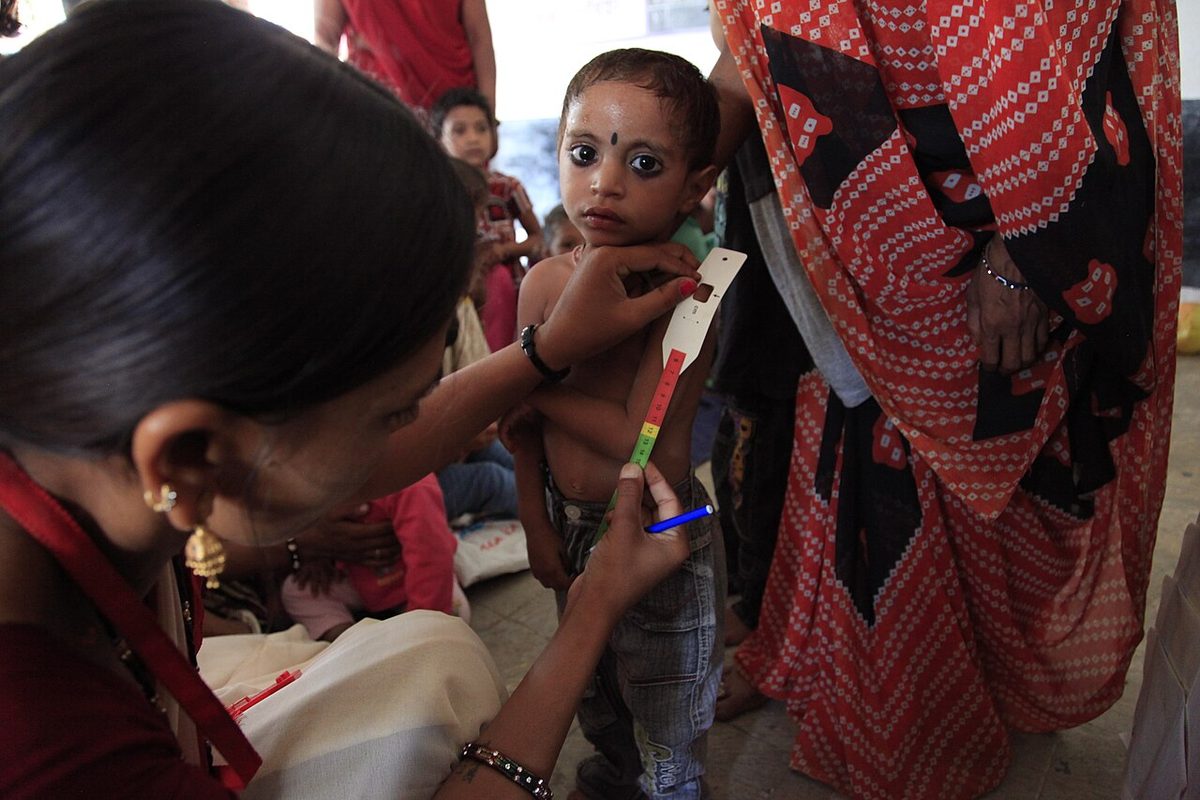
- Measuring for malnutrition in Madhya PradeshWikimedia Commons · Image, CC BY 2.0, by DFID - UK Department for International Development
General information, not medical advice. This trial tested community-wide antibiotic doses as a public-health programme in a high-mortality setting; it says nothing about giving antibiotics to an individual child, which should only happen when a doctor prescribes them. If you are worried about your child's growth or weight, talk to your doctor, a paediatrician or a registered dietitian.
Analysis by NutroPractic from the sources listed. Written for general readers; it does not replace advice from your own doctor.
From our articles
Read, then eat a little better
Plain-language guides on nutrition and wellness, backed by research.

Supplements and vitamins
Spermidine from food or capsules: measured milligrams in wheat germ, soybeans and cheese, and what the one year-long trial found
Wheat germ holds about 22 to 34 mg of spermidine per 100 g, matured cheese about 0.12 mg. The only year-long capsule trial used 0.9 mg a day and found no memory benefit. Measured values, worked doses and safety.
22 Nov 2026

Supplements and vitamins
Zinc carnosine for the gut lining: what the two human trials gave, the zinc in each dose, and the copper catch
Zinc carnosine is only about 22.6% zinc, so 75 mg twice a day is roughly 34 mg of zinc a day. Here are the doses and results of the 10-person NSAID permeability trial and the 20-person aspirin pilot, and the copper cautions.
22 Nov 2026

Women's health
Inositol for PCOS: the 40:1 ratio, trial doses, and food milligrams
Why do randomized trials in polycystic ovary syndrome prioritize the 40:1 myo to D-chiro inositol ratio? Here is the science behind the ovarian epimerase paradox, clinical ovulation and insulin metrics, and why cantaloupe cannot replace 4,000 mg trial powder.
21 Nov 2026
Newsfeed for your website
Want this feed on your website?
Add it to any site with one copy-and-paste snippet. No sign-up, and it updates itself every hour.
Start with a virtual consultation
Tell Dr. Triveni what you want to change. You will leave with a clear next step, whether you are in Toronto, London, New York or Chennai.