Clinical micronutrients & neurology · November 26, 2026
Leucovorin benefits specific folate-related epilepsies but shows minimal response in Rett syndrome: Bayesian meta-analysis
A patient-level systematic review and Bayesian meta-analysis across 38 studies reveals that leucovorin (folinic acid) achieves high seizure reduction in FOLR1 cerebral folate deficiency and pyridoxine-dependent epilepsy, but exhibits low response rates in Rett syndrome and PNPO deficiency.

Folate is vital for single-carbon metabolism, nucleotide synthesis, and neurotransmitter regulation in the developing central nervous system. While folic acid is the synthetic form widely used in fortification, leucovorin (folinic acid, 5-formyltetrahydrofolate) directly crosses the blood-brain barrier independently of folate receptor alpha via reduced folate carriers. Leucovorin holds FDA approval for FOLR1-related cerebral folate transport deficiency and is prescribed off-label across diverse intractable pediatric epilepsies.
To resolve inconsistent clinical responses across distinct genetic etiologies, researchers conducted a PRISMA-compliant patient-level systematic review and Bayesian meta-analysis published in Nutrients. The investigators gathered data from 38 publications encompassing 79 individual patients across eight distinct etiologic categories, utilizing a Bayesian hierarchical logistic model to estimate cluster-conditional response probabilities.
The meta-analysis revealed sharp differences in clinical responsiveness based on underlying genetic etiology. The model-estimated probability of any seizure reduction was highest in pyridoxine-dependent epilepsy/folinic acid-responsive seizures (0.94, 95% highest density interval [HDI]: 0.79–1.00) and FOLR1-related cerebral folate deficiency (0.91, 95% HDI: 0.80–1.00). In these groups, timely leucovorin therapy frequently resulted in profound seizure reduction or complete cessation.
Conversely, the authors documented markedly lower efficacy in other conditions: patients with Rett syndrome and pyridoxamine 5'-phosphate oxidase (PNPO) deficiency had an estimated seizure reduction probability of only 0.31 (95% HDIs spanning down to 0.00). Furthermore, the authors caution that sample sizes in the smallest etiologic strata were very limited, and safety reporting across the underlying historical literature was incomplete, though no deaths or severe adverse events were attributed to leucovorin.
Bayesian patient-level seizure reduction probabilities by etiology
79 Patients
individual patients across 38 publications and 8 etiologic strata analyzed
0.94 Probability
estimated seizure reduction in pyridoxine-dependent/folinic acid-responsive seizures (HDI 0.79–1.00)
0.91 Probability
estimated seizure reduction in FOLR1-related cerebral folate transport deficiency
0.31 Probability
substantially lower seizure reduction in Rett syndrome and PNPO deficiency (low response)
Patient-level systematic review and meta-analysis published in Nutrients (DOI: 10.3390/nu18223868), 20 November 2026.
- Unlike folic acid, folinic acid (leucovorin) does not require reduction by dihydrofolate reductase (DHFR) before entering the active tetrahydrofolate metabolic pool.
- Cerebral folate deficiency (CFD) is characterized by low 5-methyltetrahydrofolate (5-MTHF) in cerebrospinal fluid despite normal peripheral blood folate levels.
- Autoantibodies targeting folate receptor alpha can block folate transport across the choroid plexus into the brain, a mechanism responsive to high-dose folinic acid.
- Leucovorin for Seizures in Folate-Related and Folinic Acid-Responsive Epilepsies: A Patient-Level Systematic Review and Meta-Analysis by EtiologyNutrients · Patient-level systematic review and Bayesian meta-analysis (PROSPERO CRD420261422063). Published 20 November 2026.
- File:DSCF0308 Fresh bundles of leafy greens neatly tied and stacked at a bustling market stall.jpgWikimedia Commons · Photograph by PattayaPatrol, licensed under CC BY-SA 4.0.
Educational summary of nutrition research, not personal medical advice. Speak to your doctor or dietitian before changing your diet or supplements, especially if you are pregnant, take medicines or have a medical condition.
Analysis by NutroPractic from the sources listed. Written for general readers; it does not replace advice from your own doctor.
From our articles
Our guides on this subject
Plain-language guides on nutrition and wellness, backed by research.

Supplements and vitamins
Chlorella and detox claims: what the human studies measured on hair metals, dioxins and vitamin B12, and what they did not
We found no placebo-controlled trial of chlorella removing mercury or lead. One 16-person study saw hair mercury and lead fall 39% on a chlorella-seaweed mix with no control group; breast-milk dioxin was about 30% lower in Japanese mothers; B12 ranges from under 0.1 to 415 micrograms per 100 g between brands.
26 Nov 2026
Micronutrients
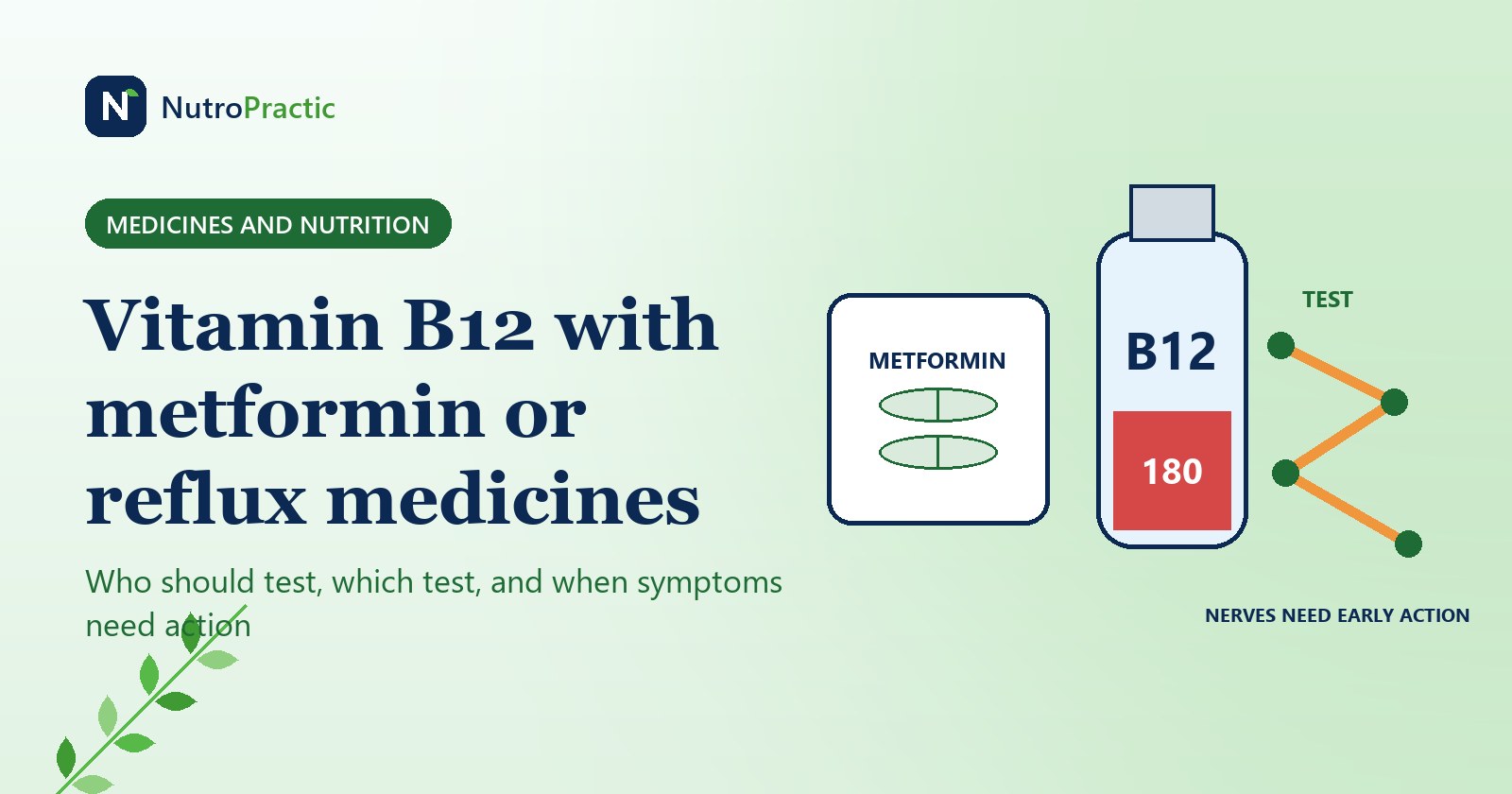
Vitamin B12 on metformin or acid-reflux medicines: who should test, and how often?
Metformin lowered B12 by 19% in a 4.3-year trial, but a PPI alone is not a rule for annual screening. Here is when to test, how to read 180 and 350 ng/L, when MMA helps, and which nerve symptoms should not wait.
9 Nov 2026

Women's health
Nausea in pregnancy: ginger, vitamin B6, small meals and when it's hyperemesis, from the trials
Only 1.8% of women in one diary study had nausea just in the morning. Ginger at 1 g a day, B6 at 30 to 75 mg and doxylamine with B6 each have trial data, while diet advice has none. The score to track it, the doses, and the signs that mean a phone call.
5 Nov 2026
Newsfeed for your website
Want this feed on your website?
Add it to any site with one copy-and-paste snippet. No sign-up, and it updates itself every hour.
Start with a virtual consultation
Tell Dr. Triveni what you want to change. You will leave with a clear next step, whether you are in Toronto, London, New York or Chennai.