Food choices · October 18, 2026
A university vending machine in Venice smelled of jasmine for a week, and 85% of the snacks people bought were ones students rate as healthy. A nature poster beside it the week before changed nothing
Italian researchers tried two quiet nudges on one campus snack machine: a poster of a green landscape, then a hidden jasmine diffuser. The poster week looked just like an ordinary week. The scent week looked very different, but far fewer people bought anything at all, and that is where the story gets interesting.
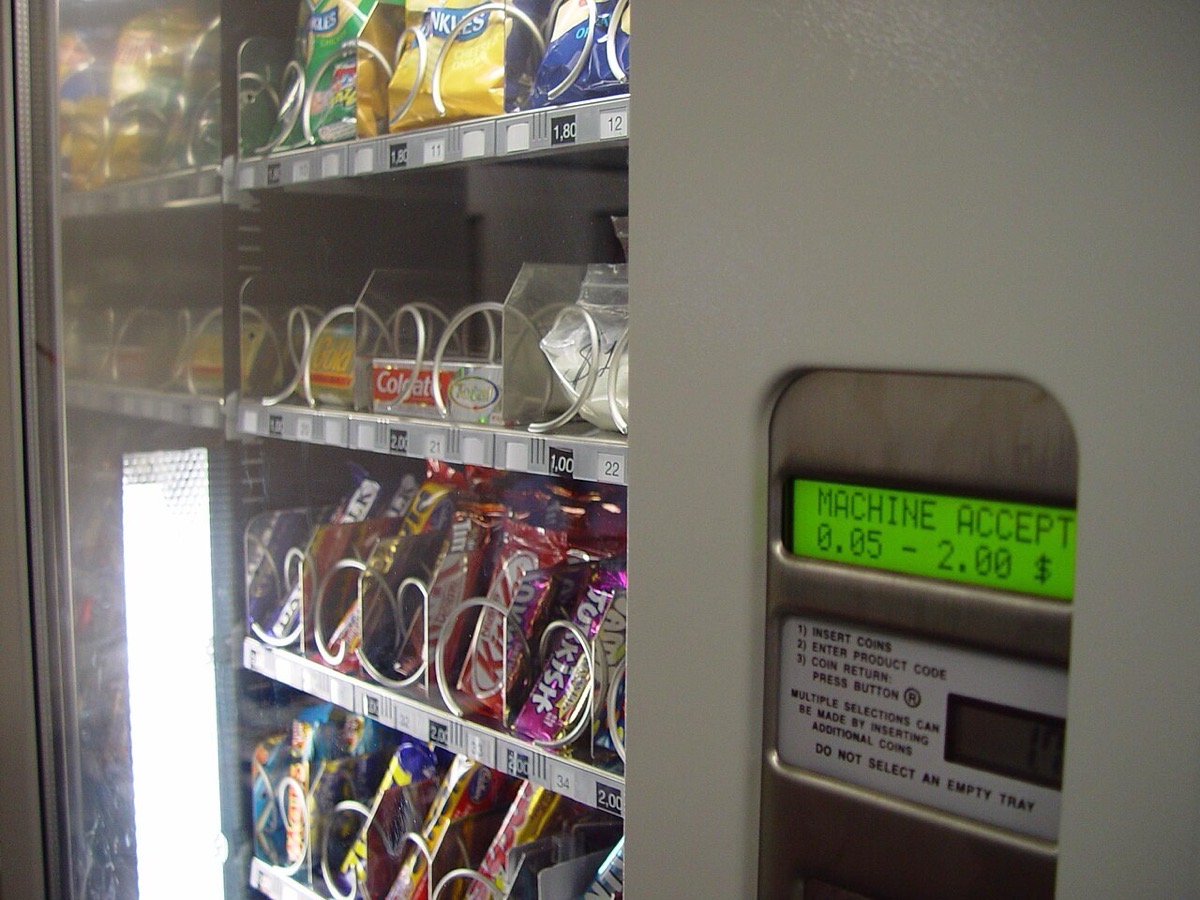
Most attempts to make snacking healthier change what is on offer, what it costs or what the label says. A field study published on 7 October 2026 in the journal Nutrients left all of that alone and changed only what people saw and smelled while they stood at the machine.
The researchers picked the busiest vending machine in a teaching building on the San Basilio campus of Ca' Foscari University of Venice, used mostly by undergraduate and master's students. In November 2024 they ran three back-to-back weeks: an ordinary week with nothing added, a week with a 50 by 70 cm poster of a nature scene on an easel at eye level beside the machine, and a week with a diffuser hidden behind the machine releasing jasmine fragrance oil from half an hour before the building opened until it closed. Products, prices, their places in the machine and the restocking routine were kept the same throughout.
"Healthy" here means healthy in the eyes of the people buying. Before the study, 149 people rated the machine's snacks and cold drinks on six health questions from a standard food choice questionnaire, and the products were split at the median into a healthier-rated half and a less healthy-rated half. The analysis used the 25 packaged products that were stocked in all three weeks, and left out coffee, tea, hot chocolate and water, which removed most of the machine's 4,343 sales and left 1,043 purchases.
In the ordinary week, 179 of 395 purchases (45.3%) were healthier-rated products. In the poster week the figure was 177 of 396 (44.7%), statistically no different. In the jasmine week it jumped to 214 of 252 (84.9%). After allowing for price, the odds that a purchase was a healthier-rated product were about seven times higher in the jasmine week than in the ordinary week (odds ratio 6.96). Pricier choices were less likely to be healthier-rated ones, and the time of day made no difference.
The authors are careful not to oversell this, and readers should be too. The jasmine week had about 140 fewer purchases than the other two weeks, and the scent was always the last week rather than in a random or rotating order (to stop the fragrance lingering into the other weeks). So the change could come partly from who came to the machine that week, from people skipping it, or from something else that differed between weeks, such as class timetables or the weather, rather than from the scent swaying their choice. Purchases were anonymous, so repeat buyers couldn't be told apart, and nobody was asked whether they noticed the poster or the smell.
It was also one machine, in one Italian university, with one scent, for one week each. A healthier-rated snack is not necessarily a more nutritious one: the authors point out that a fruit bar people see as healthy can still be high in sugar, and they did not score the products on sugar, energy or a nutrient profile. The study had no outside funding, and two of the authors are guest editors of the special issue it appears in, which the paper declares. They call it field evidence that scent may be a cheap nudge worth testing, and say it now needs randomised designs across several sites.
One snack machine, three weeks: ordinary, nature poster, jasmine scent (Ca' Foscari University of Venice, November 2024)
1,043
Packaged snack and cold drink purchases analysed, out of 4,343 sales in the three weeks
45.3%
Share of purchases that were healthier-rated products in the ordinary week (179 of 395)
44.7%
Same share in the nature poster week (177 of 396), no real change
84.9%
Same share in the jasmine scent week (214 of 252)
6.96
Odds ratio for a healthier-rated purchase, jasmine week vs ordinary week, allowing for price (95% CI 4.61 to 10.53)
252 vs 395
Purchases in the jasmine week vs the ordinary week: far fewer sales, the main reason for caution
25
Products in the analysis, split into healthier and less healthy halves by 149 people's ratings
Figures from Chiarelli S, Casiraghi C, Jacomuzzi AC, Micheletto V, Russo V, Zito M and Gifuni G, '"Health Is in the Air": Visual and Olfactory Nudges and Food Choices at University Vending Machines', Nutrients 18(19):3292, published 7 October 2026, doi 10.3390/nu18193292 (open access, CC BY 4.0). Quasi-experimental field study: the three weeks ran in a fixed order (control, poster, scent), not at random. "Healthier" means rated as healthier by a survey sample, not a nutrient score. Hot drinks, bottled water and products not stocked all three weeks were left out. No external funding.
- The diffuser was hidden behind the machine, so buyers in the jasmine week had nothing to see: only the smell had changed.
- The jasmine idea came from a 2012 laboratory study in the journal Appetite, in which non-food smells, jasmine among them, reduced people's cravings for chocolate.
- The poster idea came from a 2016 study in Appetite, which found more healthy snack purchases at a vending machine next to a nature poster than next to a poster with an indulgent theme. In Venice the poster made no difference.
- Bottled water was left out of the analysis because a free water dispenser stood next to the machine and nobody recorded how often it was used.
- The health questions used to rate the snacks come from the Food Choice Questionnaire, a survey published in 1995 that asks people how much things like health, price, convenience and mood matter in what they eat.
- "Health Is in the Air": Visual and Olfactory Nudges and Food Choices at University Vending MachinesNutrients, 7 October 2026 · The study: setting, product ratings, purchase counts, regression results, limitations and declarations
- Non-food odorants reduce chocolate cravingsAppetite, 2012 · The laboratory study behind the choice of jasmine
- An (un)healthy poster: When environmental cues affect consumers' food choices at vending machinesAppetite, 2016 · The earlier vending machine poster study the Venice team set out to build on
- Development of a measure of the motives underlying the selection of food: the Food Choice QuestionnaireAppetite, 1995 · The questionnaire whose health questions were used to rate the snacks
General information, not medical advice. This was a short, non-randomised study of one vending machine, and it measured which snacks people bought, not what they ate or any health outcome. For help with snacking habits or your diet, talk to your doctor or a registered dietitian.
Analysis by NutroPractic from the sources listed. Written for general readers; it does not replace advice from your own doctor.
From our articles
Read, then eat a little better
Plain-language guides on nutrition and wellness, backed by research.

Supplements and vitamins
Spermidine from food or capsules: measured milligrams in wheat germ, soybeans and cheese, and what the one year-long trial found
Wheat germ holds about 22 to 34 mg of spermidine per 100 g, matured cheese about 0.12 mg. The only year-long capsule trial used 0.9 mg a day and found no memory benefit. Measured values, worked doses and safety.
22 Nov 2026

Supplements and vitamins
Zinc carnosine for the gut lining: what the two human trials gave, the zinc in each dose, and the copper catch
Zinc carnosine is only about 22.6% zinc, so 75 mg twice a day is roughly 34 mg of zinc a day. Here are the doses and results of the 10-person NSAID permeability trial and the 20-person aspirin pilot, and the copper cautions.
22 Nov 2026

Women's health
Inositol for PCOS: the 40:1 ratio, trial doses, and food milligrams
Why do randomized trials in polycystic ovary syndrome prioritize the 40:1 myo to D-chiro inositol ratio? Here is the science behind the ovarian epimerase paradox, clinical ovulation and insulin metrics, and why cantaloupe cannot replace 4,000 mg trial powder.
21 Nov 2026
Newsfeed for your website
Want this feed on your website?
Add it to any site with one copy-and-paste snippet. No sign-up, and it updates itself every hour.
Start with a virtual consultation
Tell Dr. Triveni what you want to change. You will leave with a clear next step, whether you are in Toronto, London, New York or Chennai.