Eye health · October 15, 2026
Four years of eye checks on 204,238 short-sighted children: what they ate barely moved the needle. Which district their school was in moved it a lot
A Chinese city followed its myopic schoolchildren for four years to see who went on to severe short sight. A plant-based way of eating came out a few per cent ahead, about as small as a finding can be and still count. Two hours a day outdoors did better. Living in one of the poorer districts outweighed both.
Most short-sighted children do fine with a pair of glasses. The worry is the minority whose eyes keep stretching until they reach high myopia, the point where the eyeball is long enough that problems with the retina later in life become far more likely. Parents ask what they can do about it, and food is one of the first questions.
A study published on 2 October 2026 in the Journal of Global Health gives one of the largest answers so far, and for food it is a modest one. Researchers from Tianjin Medical University Eye Hospital and Tianjin Medical University General Hospital used the city's school eye-screening programme, known as TCARE, which checks pupils every semester in primary school and every year in secondary school. They took 204,238 pupils in grades 1 to 9 who were already short-sighted in 2021, but not severely, and followed them through eight check-ups to the end of 2024. High myopia meant a prescription of −6.00 dioptres or stronger.
Over those four years, 26,879 of the children (13.2%) crossed that line. Those who did were a little older at the start, already had stronger prescriptions (an average of −4.1 against −2.1 dioptres) and more often had a parent with myopia (54% against 41%).
Now the food. From a questionnaire filled in by families, the team sorted children into three eating patterns: energy-dense, plant-based and what they call traditional nutrient-rich. The raw rates of high myopia were close: 13.5% in the energy-dense group, 13.1% in the plant-based group and 12.9% in the traditional group. In the main model the plant-based pattern carried a hazard ratio of 0.97 against the energy-dense one, a 3% lower risk, with a confidence interval running from 0.94 to exactly 1.00, the line where there is no difference at all. The traditional pattern, at 0.98, was not statistically different. In a more heavily adjusted check the plant-based figure firmed up to 0.94. The authors themselves call the diet effects modest. The main text does not say which foods defined each pattern; that is left to a supplement.
Time outdoors did better. Only 15% of these children spent more than two hours a day outside, and they had an 8% lower risk (hazard ratio 0.92). The link was strongest in children aged 6 to 12 (0.88) and weaker in teenagers. Schools in greener surroundings, measured from satellite images around each school, also did better: about 5% lower risk for each step up in greenness.
The biggest number by far was about place. The team scored Tianjin's 16 districts on output per head, education and health budgets, doctors, nurses and hospital beds, then split them into thirds. Children in the poorest third of districts had a 54% higher risk of reaching high myopia than those in the richest third (hazard ratio 1.54), and in the middle third 17% higher. Outdoor time also seemed to help less in the poorer districts (0.96, against 0.89 in the richest). The authors suggest reasons such as later diagnosis, less access to myopia treatment, school pressure and fewer green spaces, but say they could not test them.
Some cautions. This is an observational study, so it shows links, not causes. Outdoor time and diet were reported once, at the start, and never updated. Wealth was measured for whole districts, not families. The paper describes the behaviour survey as going to a randomly selected sample, yet reports an eating pattern for every child, and its two main tables do not line up: the second counts fewer cases in total, and different case numbers for the poorer districts, without saying why. The reported spread of ages (an average of 10.8 years, give or take 4.7) is also wide for pupils in grades 1 to 9. The work was funded by Tianjin government research grants. One of the three joint first authors lists an affiliation with an optometric technology company, and the authors declare no relevant interests.
So what does it mean for a family with a short-sighted child? A diet built mostly on plants is good for plenty of reasons, but this study gives little reason to expect it to hold back a child's prescription. Daylight has the stronger case: a randomised trial in Guangzhou found that adding a 40-minute outdoor class to each school day cut new cases of myopia in young children. And regular eye checks, which catch a fast-changing prescription early, matter most for children with a short-sighted parent.
Population cohort: 204,238 short-sighted pupils in grades 1 to 9 in Tianjin, China, followed through eight school eye screenings from 2021 to 2024 for progression to high myopia (−6.00 dioptres or stronger)
13.2%
Reached high myopia during follow-up (26,879 of 204,238 children)
0.97
Hazard ratio for a plant-based eating pattern compared with an energy-dense one (95% CI 0.94 to 1.00). 0.94 in the more adjusted sensitivity analysis
13.5% / 13.1% / 12.9%
Raw share reaching high myopia in the energy-dense, plant-based and traditional nutrient-rich eating patterns
0.92
Hazard ratio for more than two hours a day outdoors (95% CI 0.89 to 0.96). Only 15.1% of children reported that much
1.54
Hazard ratio for children in the poorest third of districts compared with the richest third (95% CI 1.46 to 1.61). Middle third: 1.17
0.88
Hazard ratio for outdoor time in children aged 6 to 12 (95% CI 0.82 to 0.95), the strongest subgroup result
Figures are from the open access paper (Journal of Global Health 16: 04298, doi 10.7189/jogh.16.04298, published 2 October 2026), its abstract, Tables 1 and 2 and results text. Raw rates by eating pattern are calculated from Table 1 (9,864 of 73,280; 9,315 of 71,123; 7,700 of 59,835). Table 2, used for the hazard ratios, counts 23,223 cases across the diet groups and different case numbers for the medium and low wealth districts than Table 1; the paper does not explain the difference. Hazard ratios are adjusted, from Cox regression. Eating patterns were derived by factor analysis of a family questionnaire; their food content is described only in the online supplement. Greenness is the satellite NDVI around each school, per standard deviation (hazard ratio 0.95). Funding: Tianjin Key Medical Discipline Construction Project, Tianjin Health Research Project and Haihe Laboratory of ITAI; the authors declare no relevant interests.
- A prescription of −6.00 dioptres, the line for high myopia in this study, means that without glasses the eye sees sharply only up to about 17 cm away: one sixth of a metre.
- A 2016 analysis of 145 studies in the journal Ophthalmology projected that by 2050 about 4.8 billion people, close to half the world, will be short-sighted, and about 938 million will have high myopia.
- In a randomised trial in 12 primary schools in Guangzhou, adding one 40-minute outdoor class to each school day lowered the three-year rate of new myopia in children aged about 6 from 39.5% to 30.4%.
- The greenness score in studies like this comes from satellites. Healthy leaves reflect a lot of near-infrared light and absorb red light, so comparing the two bands from space shows how much living vegetation there is around a school.
- Myopia that keeps getting worse in childhood is mostly a matter of the eyeball growing too long from front to back, which is why glasses correct it but do not undo it.
- Influence of environmental, economic, dietary, and behavioural factors on high myopia onset in children: a 4-year large-scale cohort studyJournal of Global Health, 16, 04298, published 2 October 2026 (open access, CC BY) · The study: cohort, definitions, eating patterns, district wealth score, greenness, hazard ratios, limitations and funding
- PubMed Central full text PMC13634204US National Library of Medicine · Free full text with Tables 1 and 2
- Global Prevalence of Myopia and High Myopia and Temporal Trends from 2000 through 2050Ophthalmology, 123(5), 1036 to 1042, 2016 · Projection of 4,758 million people with myopia and 938 million with high myopia by 2050 (high myopia defined there as −5.00 dioptres or stronger)
- Effect of Time Spent Outdoors at School on the Development of Myopia Among Children in China: A Randomized Clinical TrialJAMA, 314(11), 1142 to 1148, 2015 · The Guangzhou trial of one extra 40-minute outdoor class each school day: 30.4% against 39.5% new myopia over three years
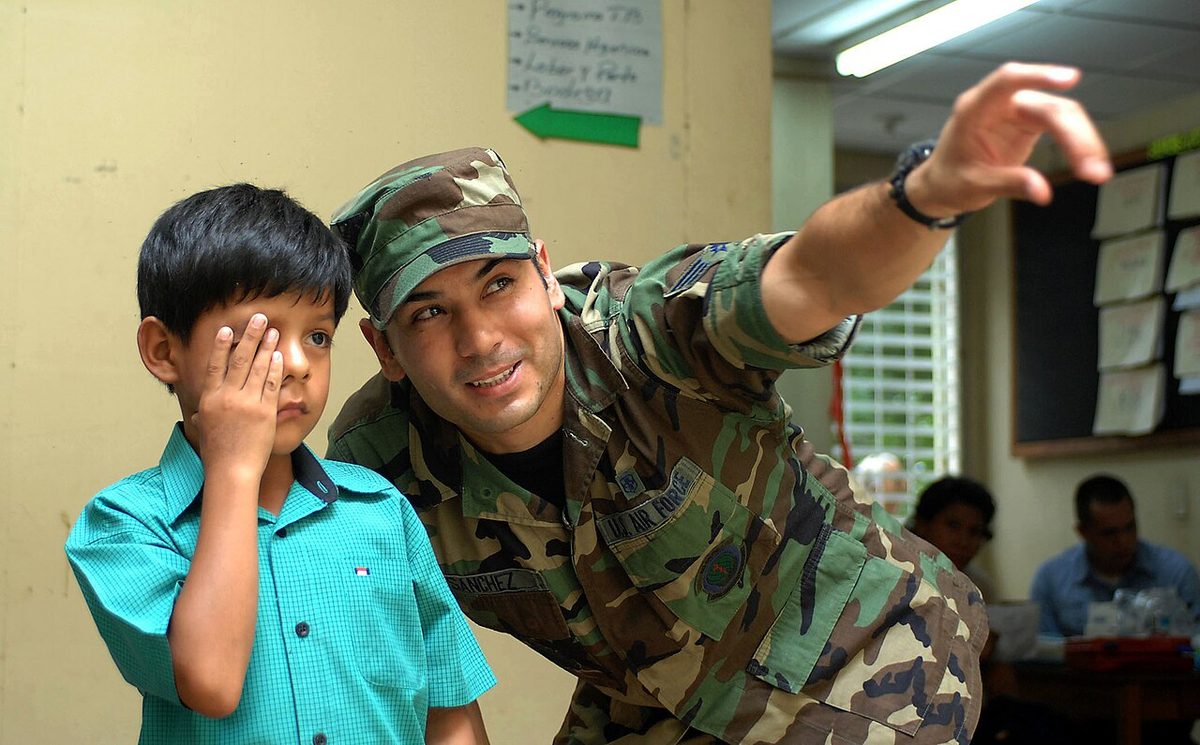
- US Navy 070721-N-0194K-187, eye examination in ChinandegaWikimedia Commons · Image, public domain, U.S. Navy photo by Steven King
General information, not medical advice. This study shows links between children's surroundings, habits and short sight, not causes. If your child squints, holds things very close or has a short-sighted parent, have their eyes checked by an optometrist or eye doctor and ask about ways to slow myopia.
Analysis by NutroPractic from the sources listed. Written for general readers; it does not replace advice from your own doctor.
From our articles
Read, then eat a little better
Plain-language guides on nutrition and wellness, backed by research.
Supplements and vitamins
Spermidine from food or capsules: measured milligrams in wheat germ, soybeans and cheese, and what the one year-long trial found
Wheat germ holds about 22 to 34 mg of spermidine per 100 g, matured cheese about 0.12 mg. The only year-long capsule trial used 0.9 mg a day and found no memory benefit. Measured values, worked doses and safety.
22 Nov 2026

Supplements and vitamins
Zinc carnosine for the gut lining: what the two human trials gave, the zinc in each dose, and the copper catch
Zinc carnosine is only about 22.6% zinc, so 75 mg twice a day is roughly 34 mg of zinc a day. Here are the doses and results of the 10-person NSAID permeability trial and the 20-person aspirin pilot, and the copper cautions.
22 Nov 2026

Women's health
Inositol for PCOS: the 40:1 ratio, trial doses, and food milligrams
Why do randomized trials in polycystic ovary syndrome prioritize the 40:1 myo to D-chiro inositol ratio? Here is the science behind the ovarian epimerase paradox, clinical ovulation and insulin metrics, and why cantaloupe cannot replace 4,000 mg trial powder.
21 Nov 2026
Newsfeed for your website
Want this feed on your website?
Add it to any site with one copy-and-paste snippet. No sign-up, and it updates itself every hour.
Start with a virtual consultation
Tell Dr. Triveni what you want to change. You will leave with a clear next step, whether you are in Toronto, London, New York or Chennai.