Family eating · October 15, 2026
What 478 dads ate as teenagers, years before they had children, lined up with how often their toddlers ate vegetables. The family rules explained only a sliver of it
A US study followed men from their school years into fatherhood. Those whose eating got healthier through adolescence had small children far more likely to eat vegetables twice a day. The researchers expected house rules and family meals to carry that link. They carried very little of it.
Most research on what small children eat is really research on mothers. Fathers turn up as a footnote, if at all. A paper published on 12 October 2026 in the International Journal of Behavioral Nutrition and Physical Activity flips that around, and it reaches back much further than usual: to what the fathers ate when they were boys.
The men came from the Growing Up Today Study, a US cohort that began in 1996 and asked its young members about their food again and again, with a food questionnaire made for children and teenagers, until 2011. Years later, researchers at Boston College and the University of Guelph in Canada invited members who had become fathers into a new study, Fathers & Families. This analysis covers 478 of them, each with a child aged two to six, who answered surveys in 2021–2022 and again in 2022–2023.
From the teenage questionnaires, the team had already sorted the men into three paths, scored with the Healthy Eating Index: diets that stayed low in quality through ages 10 to 18, diets that got worse, and diets that got better. In an earlier paper on 584 of these fathers, half were on the low path, just over a third on the declining one and about one in seven on the improving one.
The new question was simple. Do the children of the improvers eat more fruit and vegetables? For vegetables, the answer was a clear yes. Compared with children of fathers on the low path, their children were 22 percentage points more likely to eat vegetables at least twice a day, as reported by the father. For fruit, the difference was much smaller and showed up only through one route.
That route is what the study was built to test. The researchers expected the link to run through the home: fathers who ate better as teenagers might, as parents, use more 'structure' (in this field, things like routines, limits and a home where healthy food is on hand) and sit down to more family meals. Structure did play a part. The improvers used more of it, and that accounted for about 3 of the 22 points for vegetables and for the whole of a small 3.5-point gap for fruit.
Family meals did not carry the link at all, although children who ate more meals with the family were more likely to eat fruit and vegetables twice a day, whatever their father's teenage diet. And most of the vegetable difference, nearly 20 points, ran along a 'direct' path the study could not explain. It might be what the father cooks, buys or eats in front of his child, his partner's habits, money, or things the surveys never asked about.
This is an observational study, so it cannot show that a boy's diet causes anything in his future child's bowl. The children's intake came from the fathers' own answers on a short screener, the teenage diets were self-reported too, and men who stay in a cohort for 25 years are not a random slice of American fathers. The authors weighted their analysis to account for fathers who dropped out between surveys. The work was funded by the US National Institute of Child Health and Human Development.
What a reader can take from it: a father's eating is not a side issue in a family's diet, and the habits a teenager builds may still be on the table when he has children of his own. For parents now, the study's clearest practical thread is a familiar one: more family meals went with children eating fruit and vegetables more often.
Fathers & Families study: 478 US fathers of children aged 2 to 6, whose diets were recorded from ages 10 to 18 (1996 to 2011) in the Growing Up Today Study; surveys in 2021–2022 and 2022–2023; observational
478
Fathers in the analysis, each with a child aged 2 to 6
+22 pp
Higher likelihood that a child ate vegetables at least twice a day, fathers whose teenage diet improved vs. stayed low (95% CI 10.8 to 33.2)
19.8 pp
Part of that vegetable gap on the 'direct' path, not explained by the home food measures
2.9 pp
Part of the vegetable gap that ran through fathers' greater use of structure-based food parenting
+3.5 pp
Higher likelihood of fruit at least twice a day, entirely through structure-based food parenting (95% CI 0.3 to 6.7)
13.5%
Share of fathers whose teenage diet quality improved, in the earlier paper on 584 men from the same study (50.0% low, 36.5% declining)
Figures are from the published abstract of De Oliveira et al., International Journal of Behavioral Nutrition and Physical Activity, doi 10.1186/s12966-026-01996-9 (received 18 June, accepted 7 October, published 12 October 2026, open access, CC BY 4.0), and from the earlier paper on the same cohort (doi 10.1186/s12966-026-01914-z, published 1 May 2026) for the share of fathers in each teenage diet pattern and how the patterns were built from Healthy Eating Index-2020 scores. pp = percentage points. The vegetable effect of 22.03 pp splits into a direct effect of 19.78 pp (95% CI 8.73 to 30.82) and an indirect effect through structure-based food parenting of 2.86 pp (0.21 to 5.52). Family meal frequency was not a mediator but was linked on its own with fruit (probit β 0.096, 95% CI 0.032 to 0.160) and vegetables (β 0.127, 0.053 to 0.200) at least twice a day. Mediation was tested with structural equation modelling, with inverse probability of censoring weights for fathers lost between surveys. Children's intake was reported by the fathers. The abstract gives no separate result for the declining pattern. Funding: NICHD grant R01 HD098421.
- The Growing Up Today Study began in 1996 with the children of women taking part in the Nurses' Health Study II, one of the largest long-running health studies of women in the US. Some of those children are now the parents being studied.
- The Healthy Eating Index scores a diet from 0 to 100 on how closely it matches the Dietary Guidelines for Americans. The 2020 version is the one used to sort these fathers' teenage diets.
- A gap in percentage points is not the same as a percentage gap. If 40% of one group of children ate vegetables twice a day and 62% of another did, that is 22 percentage points apart, but the second group is 55% more likely to do it.
- In the earlier paper on the same men, fathers whose teenage diets improved were less likely to use 'coercive control' with their children's food, such as pressure to eat or using food as a reward (odds ratio 0.57), and more likely to use structure (odds ratio 1.93).
- The study asked fathers, not mothers, how their child ate, which is unusual: the authors of the earlier paper note that evidence linking fathers' own past eating to their later parenting is limited.
- Fathers' preconception diet quality and their children's fruit and vegetable intake: longitudinal mediation through the home food environmentInternational Journal of Behavioral Nutrition and Physical Activity, published 12 October 2026 (open access, CC BY 4.0) · The study: sample, timeline, diet patterns, mediation results, funding
- Men's preconception diet quality patterns predict supportive food parenting practices: evidence from a longitudinal cohort studyInternational Journal of Behavioral Nutrition and Physical Activity, published 1 May 2026 (open access) · Earlier paper on the same fathers: how the three teenage diet patterns were built and how common each was
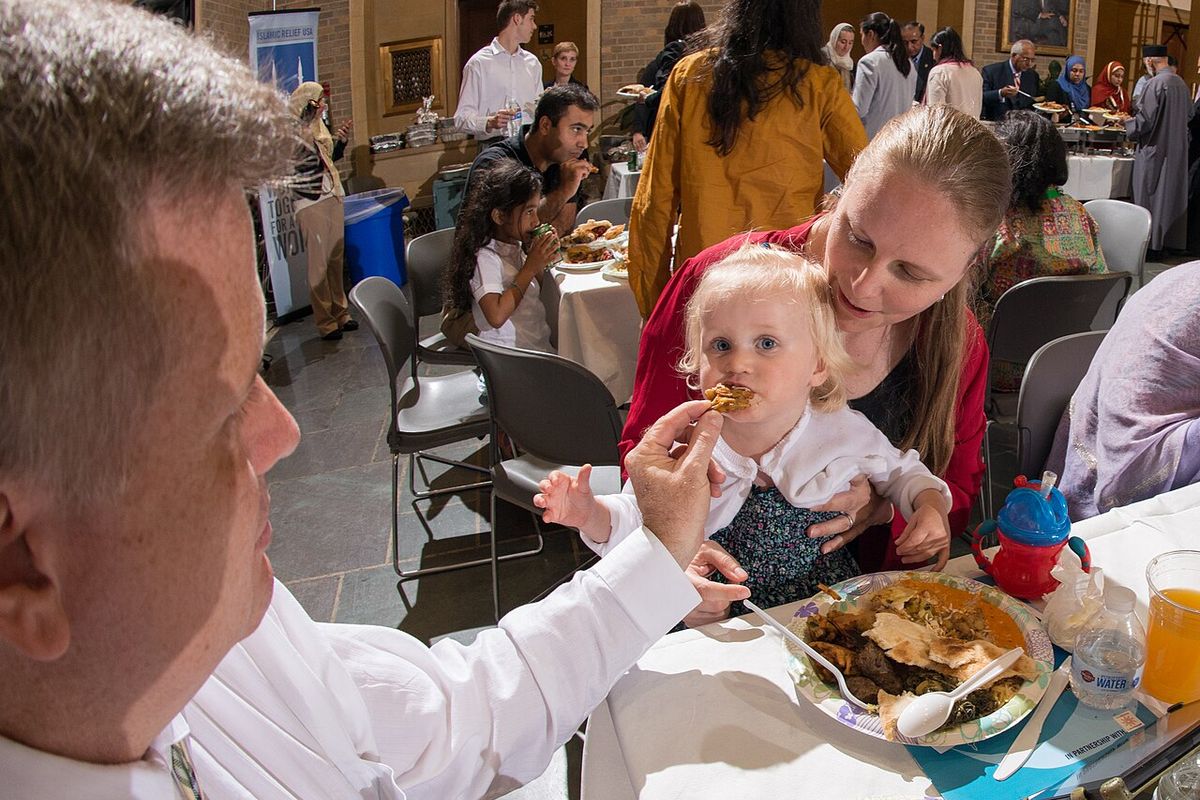
- 20160628-OSEC-LSC-0420Wikimedia Commons · Image, public domain (US Department of Agriculture), by Lance Cheung
General information, not medical advice. This was an observational study based on fathers' own reports, so it shows a link, not that a father's teenage diet causes his child's eating. If you have concerns about your child's diet or growth, talk to your paediatrician or a registered dietitian.
Analysis by NutroPractic from the sources listed. Written for general readers; it does not replace advice from your own doctor.
From our articles
Read, then eat a little better
Plain-language guides on nutrition and wellness, backed by research.

Supplements and vitamins
Spermidine from food or capsules: measured milligrams in wheat germ, soybeans and cheese, and what the one year-long trial found
Wheat germ holds about 22 to 34 mg of spermidine per 100 g, matured cheese about 0.12 mg. The only year-long capsule trial used 0.9 mg a day and found no memory benefit. Measured values, worked doses and safety.
22 Nov 2026

Supplements and vitamins
Zinc carnosine for the gut lining: what the two human trials gave, the zinc in each dose, and the copper catch
Zinc carnosine is only about 22.6% zinc, so 75 mg twice a day is roughly 34 mg of zinc a day. Here are the doses and results of the 10-person NSAID permeability trial and the 20-person aspirin pilot, and the copper cautions.
22 Nov 2026

Women's health
Inositol for PCOS: the 40:1 ratio, trial doses, and food milligrams
Why do randomized trials in polycystic ovary syndrome prioritize the 40:1 myo to D-chiro inositol ratio? Here is the science behind the ovarian epimerase paradox, clinical ovulation and insulin metrics, and why cantaloupe cannot replace 4,000 mg trial powder.
21 Nov 2026
Newsfeed for your website
Want this feed on your website?
Add it to any site with one copy-and-paste snippet. No sign-up, and it updates itself every hour.
Start with a virtual consultation
Tell Dr. Triveni what you want to change. You will leave with a clear next step, whether you are in Toronto, London, New York or Chennai.