Infant nutrition · October 19, 2026
Frozen, heated, then frozen again: donated breast milk kept its fat, protein and calories through a Spanish milk bank, with small dips in copper and iodine along the way
When a premature baby's mother can't make enough milk, hospitals turn to milk banks, where donated milk is frozen, pasteurised and frozen again before it reaches the baby. A hospital in northern Spain tested the same milk from 22 donors at every step. The calories survived. Two minerals wobbled, and traces of mercury and arsenic turned up. How worried should anyone be?
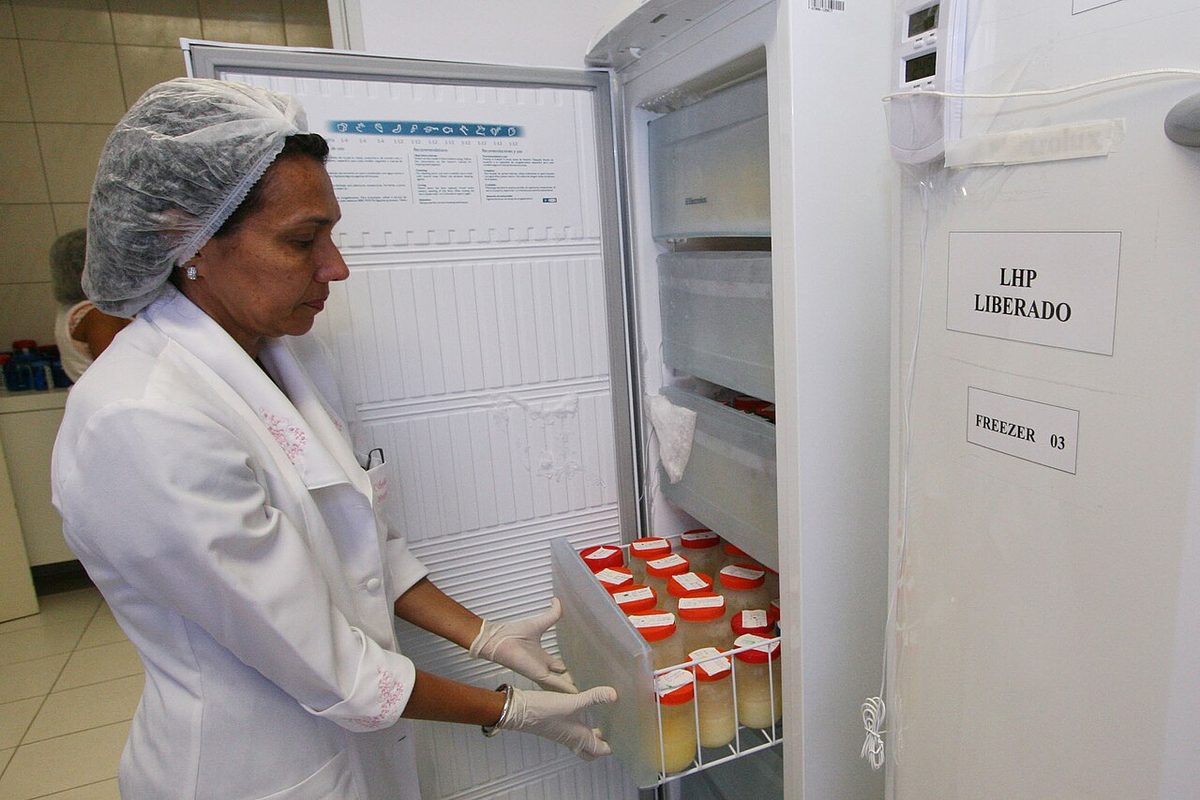
For a baby born weeks early, breast milk does more than feed: it lowers the risk of serious gut and infection problems. But mothers of premature babies often can't produce enough at first, so the WHO and the American Academy of Pediatrics recommend donated milk from a milk bank when the mother's own isn't available. Before it can be given to a fragile newborn, that milk is frozen, thawed, pasteurised and frozen again. A study published on 15 October in the British Journal of Nutrition asked what that journey does to what's in the bottle.
Researchers at the Central University Hospital of Asturias in Oviedo collected fresh milk from 22 donating mothers between February and October 2024, half of whom had given birth prematurely. They followed each donation through the milk bank's standard routine: first into a −20 °C freezer (for about six weeks on average), then Holder pasteurisation, which holds the milk at 62.5 °C for 30 minutes, and finally long-term storage at −80 °C (about three months). They tested a small portion at each of the four stages, 88 samples in all, so every donation was compared with itself.
The big picture was reassuring. Fat stayed at about 4.1 to 4.2 g per 100 mL, protein at about 1.1 to 1.2 g, and energy between roughly 77 and 79 kcal per 100 mL, with no significant change across the four stages. Earlier studies have often found that freezing and pasteurisation cost some of the fat; this one didn't. Zinc and selenium also held steady.
Two minerals moved. Iodine, which babies need to make thyroid hormone for growth and brain development, fell by about 16 micrograms per litre (from roughly 206 to 190) after the first freezing, then partly recovered. Copper dropped by about 5% during pasteurisation. By the end of the chain, neither was significantly different from the fresh milk, but the authors still suggest keeping an eye on both for premature babies, whose milk is often topped up with fortifiers anyway.
Then the metals. Cadmium and lead weren't found at any stage. Mercury and arsenic were detectable in roughly six in ten samples but always below the level the lab could measure precisely, and the authors say under WHO limits. The processing didn't add any, which matters because plastic containers and handling have been suggested as possible sources. Oddly, mercury became harder to detect after the long −80 °C storage, which the team thinks may be the metal sticking to the container walls.
Keep the scale in mind: 22 donors at one milk bank, no colostrum (the first milk after birth), and an infrared milk analyser for the main nutrients rather than slower lab methods. The longer milk sat at −20 °C, the lower its measured sugar content, a hint that freezer time matters. Still, the study is a useful check that a routine used in neonatal units around the world keeps donated milk's main nutrition intact and doesn't add contaminants.
The same donated milk tested at four milk bank stages (fresh, −20 °C, pasteurised, −80 °C)
22
Donating mothers, one milk bank in Asturias, Spain; 88 samples in all
4.2 → 4.1 g
Fat per 100 mL, fresh vs after the full process (not a significant change)
79 → 78 kcal
Energy per 100 mL, fresh vs after the full process (not significant)
−16 µg/L
Iodine after the first −20 °C freezing (about 206 to 190), partly back later
−5%
Copper during Holder pasteurisation (62.5 °C for 30 minutes)
0
Samples with detectable cadmium or lead at any stage
Study: Rubio-Granda A, Suárez-Rodríguez M, Cardo González L, González-López C, Peláez-Nava MT, Arias-García N, Prieto-García B, Solis-Sanchez G, 'Nutritional, trace element and heavy metal stability in human milk during standard milk bank processing', British Journal of Nutrition, First View pp. 1-6, published online 15 October 2026, doi 10.1017/S0007114526108654, open access (CC BY 4.0). Samples collected February to October 2024 at the Human Milk Bank of Asturias; mean donor age 33.8 years, mean gestational age at delivery 34.1 weeks, 50% preterm births; 5 transitional and 17 mature milk samples, no colostrum. Mean storage 41.6 days at −20 °C and 98.6 days at −80 °C. Macronutrients by MIRIS human milk analyser; trace elements and metals by ICP-MS. Means, fresh vs −20 °C vs pasteurised vs −80 °C: fat 4.2, 4.1, 4.1, 4.1 g/100 mL; protein 1.2, 1.1, 1.1, 1.1 g/100 mL; energy 79.1, 76.6, 76.7, 78.3 kcal/100 mL (repeated-measures ANOVA, all p ≥ 0.07). Iodine 205.9, 189.9, 198.5, 198.7 µg/L (overall p = 0.02); change −16 µg/L after −20 °C freezing (p < 0.01), +8.6 after pasteurisation (p < 0.01), −7.3 fresh to final (p = 0.12). Copper 40.8, 41.4, 39.4, 40.6 µg/dL in 21 samples (overall p < 0.01); −1.9 µg/dL during pasteurisation (p < 0.01), the paper's 4.7%; −0.2 fresh to final (p = 0.72). Zinc and selenium not significant. Mercury detectable in 59% of fresh samples and 27% after −80 °C storage; arsenic in 59 to 68%; both below the limits of quantification (1.25 µg/L mercury, 2.5 µg/L arsenic) at every stage. Carbohydrate fell with longer −20 °C storage (r = −0.63, p = 0.002). Funded by the Ernesto Sánchez Villares Foundation; the authors declare no competing interests.
- Holder pasteurisation is the slow 'holding' method: the milk is kept at a set temperature for a set time, rather than flash-heated for a few seconds as most supermarket cow's milk is.
- The world's first human milk bank opened in Vienna in 1909, and one followed in Boston the next year.
- Brazil runs the largest network of human milk banks in the world, with more than 200 banks. The photo above was taken at one of them, in Salvador, Bahia.
- Because each donation in this study was tested at every stage, every sample acted as its own comparison. That design can spot small changes with only a couple of dozen donors, which is how the copper and iodine dips showed up at all.
- Nutritional, trace element and heavy metal stability in human milk during standard milk bank processingBritish Journal of Nutrition, October 2026 · The study, open access
- Full text with tablesCambridge Core · Article page with the five data tables, funding and competing-interest statements
- Donor Human Milk for the High-Risk Infant: Preparation, Safety, and Usage Options in the United StatesPediatrics (American Academy of Pediatrics), 2017 · The AAP's clinical report on when and how donor milk is used
General information, not medical advice. This was a small study of donated milk at one milk bank and is about milk bank processing, not milk stored at home. If your baby is premature or in neonatal care, ask the neonatal team or a lactation consultant about feeding, donor milk and fortifiers.
Analysis by NutroPractic from the sources listed. Written for general readers; it does not replace advice from your own doctor.
From our articles
Our guides on this subject
Plain-language guides on nutrition and wellness, backed by research.
Women's health
Eating while breastfeeding: extra calories, iodine, caffeine, fish and alcohol, with the actual numbers
Breastfeeding usually adds about 330–400 kcal a day, but the smaller numbers can matter more: 290 mcg iodine, 400 IU vitamin D for baby, 8–12 oz fish a week, and a caffeine total you can actually add up.
6 Nov 2026
Children's nutrition
Feeding a teenage athlete: energy, iron, calcium and the sports drink question
Teenage athletes are growing and training at the same time, and under-eating (REDs) is found in up to 80% of female and 70% of male athletes in studies. A worked energy example for a 15-year-old footballer, protein and carbohydrate targets, iron and calcium in the growth spurt, when sports drinks help and when they are dessert, and the supplements to skip.
20 Oct 2026
Supplements and vitamins
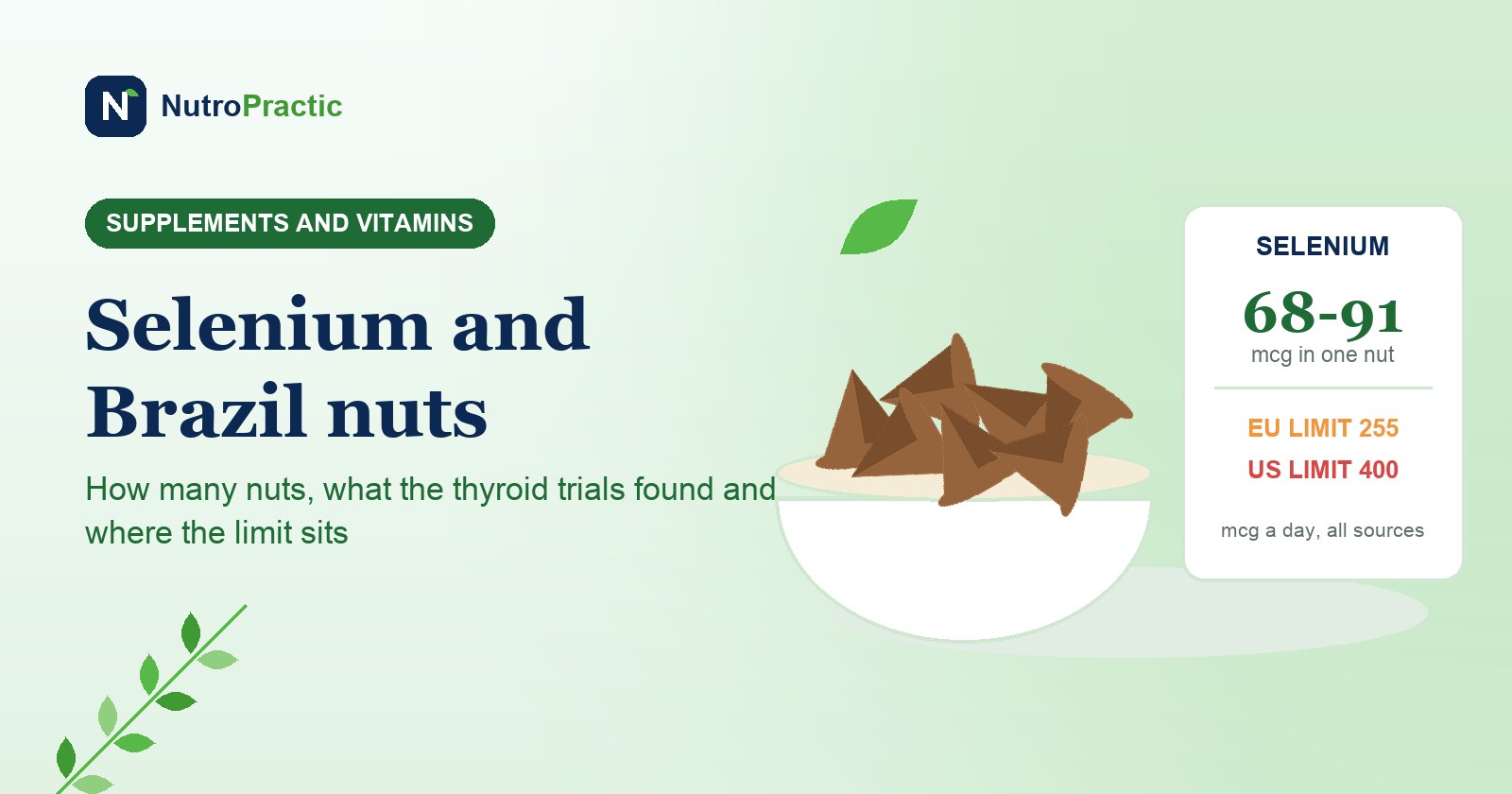
Selenium: how many Brazil nuts, what the thyroid trials found, and where the upper limit sits
One Brazil nut holds 68 to 91 mcg of selenium on average, against a 255 mcg European ceiling. A table of nuts per day, what the Hashimoto trials measured, and why more is not better.
14 Nov 2026
Newsfeed for your website
Want this feed on your website?
Add it to any site with one copy-and-paste snippet. No sign-up, and it updates itself every hour.
Start with a virtual consultation
Tell Dr. Triveni what you want to change. You will leave with a clear next step, whether you are in Toronto, London, New York or Chennai.