Eye health · October 8, 2026
Can what children eat stop short sight getting worse? In 204,238 pupils, diet barely moved the needle; time outdoors and where they lived did more
A four-year study followed every short-sighted schoolchild it could in Tianjin, China, to see who slid into high myopia, the severe kind that raises the risk of serious eye disease later. Children whose families reported a more plant-based diet did a little better. Two hours a day outdoors helped more, and a poorer district was the strongest risk of all.
Short sight in children is usually treated as a matter of glasses. The worry for eye doctors is what happens when it keeps getting worse. Once a child's prescription passes −6.00 dioptres, the cut-off for 'high myopia', the eyeball has stretched enough to raise the lifetime risk of retinal detachment, glaucoma and other sight-threatening problems. A team at Tianjin Medical University Eye Hospital has used the city's school eye-screening programme to ask which children make that slide, and whether diet has anything to do with it. Their paper was published in the Journal of Global Health on 2 October 2026.
They followed 204,238 pupils in grades 1 to 9 who were already short-sighted, but not severely, from 2021 to 2024, with eye checks every semester in primary school and yearly in secondary school. Parents and children answered a questionnaire at the start about time outdoors, close reading and food, and the researchers sorted the answers into three eating patterns: 'energy-dense', 'plant-based' and 'traditional nutrient-rich'. They also scored each district's wealth and spending on schools and health, and measured how green the land around each school looked from satellites. Over the four years, 26,879 children (13.2%) reached high myopia.
Diet came out as the weakest of the factors they looked at. Compared with the energy-dense pattern, a plant-based one went with a 3% lower risk (hazard ratio 0.97), right at the edge of statistical significance; in a sensitivity analysis with more adjustment it became 6%. The traditional pattern made no clear difference in the main analysis. Spending more than two hours a day outdoors went with an 8% lower risk, and the benefit looked largest in children aged 6 to 12. The biggest gap of all was between districts: children in the poorest third of Tianjin's districts were 54% more likely to reach high myopia than those in the richest, and children in greener school surroundings did a little better too. Oddly, outdoor time seemed to help less in the poorer districts.
This is an observational study, so it shows links rather than causes, and the diet measure is its weak point. The paper doesn't spell out what foods each pattern contained (that sits in a supplement), the answers were given once and reported by families, and diet in children travels with family income, schooling pressure and screen time, which are hard to separate. Wealth and greenness were scored for whole districts and school neighbourhoods, not for each family. Some numbers in the tables don't quite add up to the full group, which suggests not every child was counted in every analysis. What the study does add is scale: a city-wide cohort, a hard clinical end point, and a reminder that for children's eyes the strongest evidence is still for getting them outside, as an earlier school trial in Guangzhou showed. A plant-rich diet is worth having for many reasons; on this evidence, saving a child's eyesight isn't the main one.
Four years, 204,238 short-sighted Tianjin pupils: who went on to high myopia (−6.00 dioptres or worse)
204,238
Pupils in grades 1–9 who were short-sighted, but not severely, at the start (2021–2024)
13.2%
Reached high myopia during follow-up (26,879 children)
3% lower
Risk with a plant-based eating pattern vs an energy-dense one (HR 0.97, 95% CI 0.94–1.00); 6% in a further-adjusted analysis
No clear difference
For the 'traditional nutrient-rich' pattern in the main analysis (HR 0.98)
8% lower
Risk with more than two hours outdoors a day (HR 0.92); 12% lower in children aged 6–12
54% higher
Risk in the poorest third of districts vs the richest (HR 1.54)
From the open-access paper in the Journal of Global Health, 2 October 2026 (CC BY 4.0). Hazard ratios come from Cox models; diet, outdoor time and reading time were reported by families once, at the start, and the three eating patterns were derived by factor analysis. District wealth combined GDP per head, education and health spending, and doctors, nurses and hospital beds per 1,000 people; greenness was a satellite vegetation index around each school. Some group totals in the results table are smaller than the full cohort. Funded by Tianjin public health and research grants; one author is affiliated with TMUE Optometric Technology Co., and the authors declare no relevant interests.
- In a 2015 trial at Guangzhou primary schools, adding a 40-minute outdoor class to each school day cut the share of six-year-olds who became short-sighted over three years from 39.5% to 30.4%.
- A widely cited 2016 estimate projected that by 2050 about half the world's population, 4.8 billion people, would be short-sighted, and nearly a billion would have high myopia.
- A 2025 review projected that by 2050, 61.3% of children in China would be short-sighted and 17.6% would have high myopia.
- One leading explanation for the outdoor effect is light: bright daylight triggers the release of dopamine in the retina, which appears to slow the eyeball's growth in length.
- A dioptre measures the focusing power a lens needs; a minus sign means short sight, so −6.00 is roughly twice as strong a correction as −3.00.
- Influence of environmental, economic, dietary, and behavioural factors on high myopia onset in children: a 4-year large-scale cohort studyJournal of Global Health, 2 October 2026 · Open-access paper; all study figures in this item
- Full text on PubMed Central (PMC13634204)PubMed Central, US National Library of Medicine · Full text, tables and licence
- Effect of Time Spent Outdoors at School on the Development of Myopia Among Children in China: A Randomized Clinical TrialJAMA, 2015 · The Guangzhou school trial: 30.4% vs 39.5% new myopia over three years
- Global Prevalence of Myopia and High Myopia and Temporal Trends from 2000 through 2050Ophthalmology, 2016 · 4,758 million people with myopia and 938 million with high myopia projected for 2050
- Prevalence and temporal trends in myopia and high myopia children in China: a systematic review and meta-analysis with projections from 2020 to 2050The Lancet Regional Health – Western Pacific, 2025 · 61.3% myopia and 17.6% high myopia projected for 2050
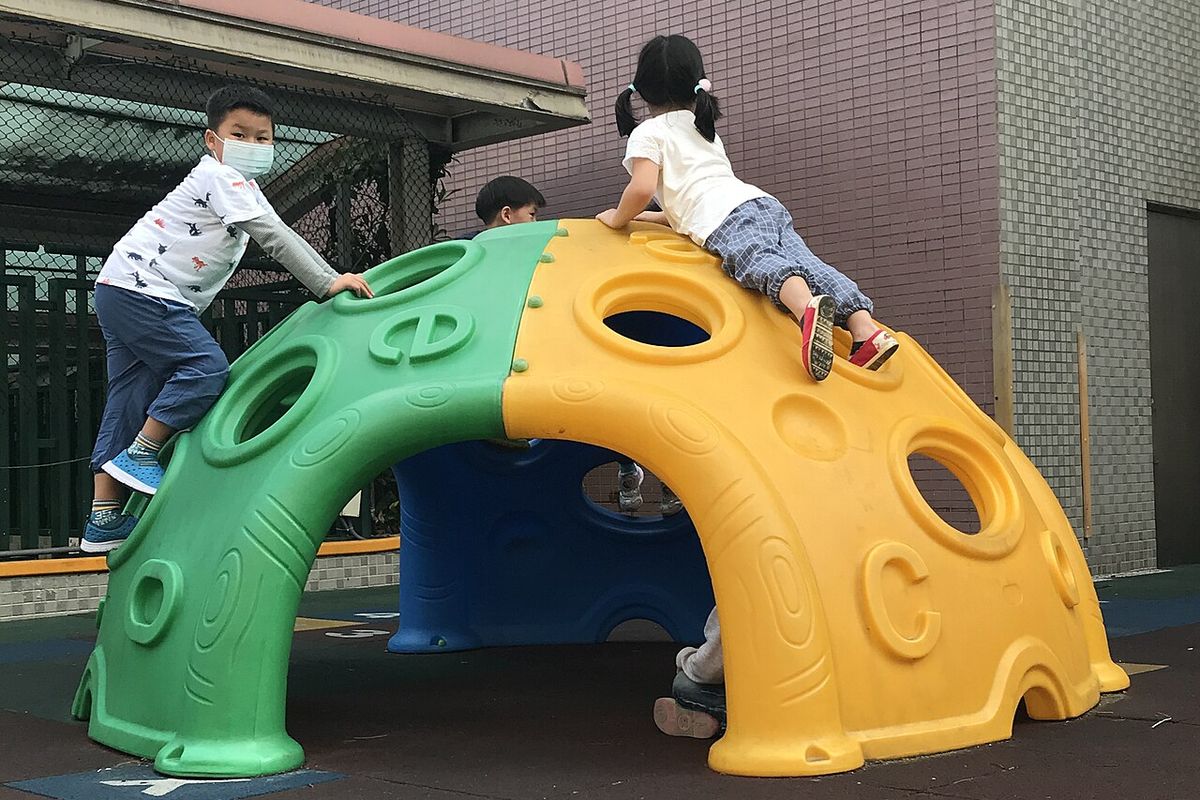
- Children Playing at West Court of Jian-Kang Elementary School (photo)玄史生, via Wikimedia Commons · CC0 image
General information, not medical advice. If your child's eyesight seems to be getting worse, see an optometrist or eye doctor; options to slow myopia exist and are best started early. Don't change a child's diet in the hope of treating short sight.
Analysis by NutroPractic from the sources listed. Written for general readers; it does not replace advice from your own doctor.
Newsfeed for your website
Want this feed on your website?
Add it to any site with one copy-and-paste snippet. No sign-up, and it updates itself every hour.
Start with a virtual consultation
Tell Dr. Triveni what you want to change. You will leave with a clear next step, whether you are in Toronto, London, New York or Chennai.