Sports supplements · October 15, 2026
Freedivers who loaded creatine for a week pedalled a third further on a single breath. Count every diver who started, though, and the edge was no longer statistically clear
Twenty trained breath-hold divers in Athens took 20 g of creatine or a dummy powder a day for seven days, then cycled as far as they could without breathing. The creatine group's gains were bigger, but so were the caveats: the placebo group improved too, the groups started unevenly, and leaving out one diver changed the result.
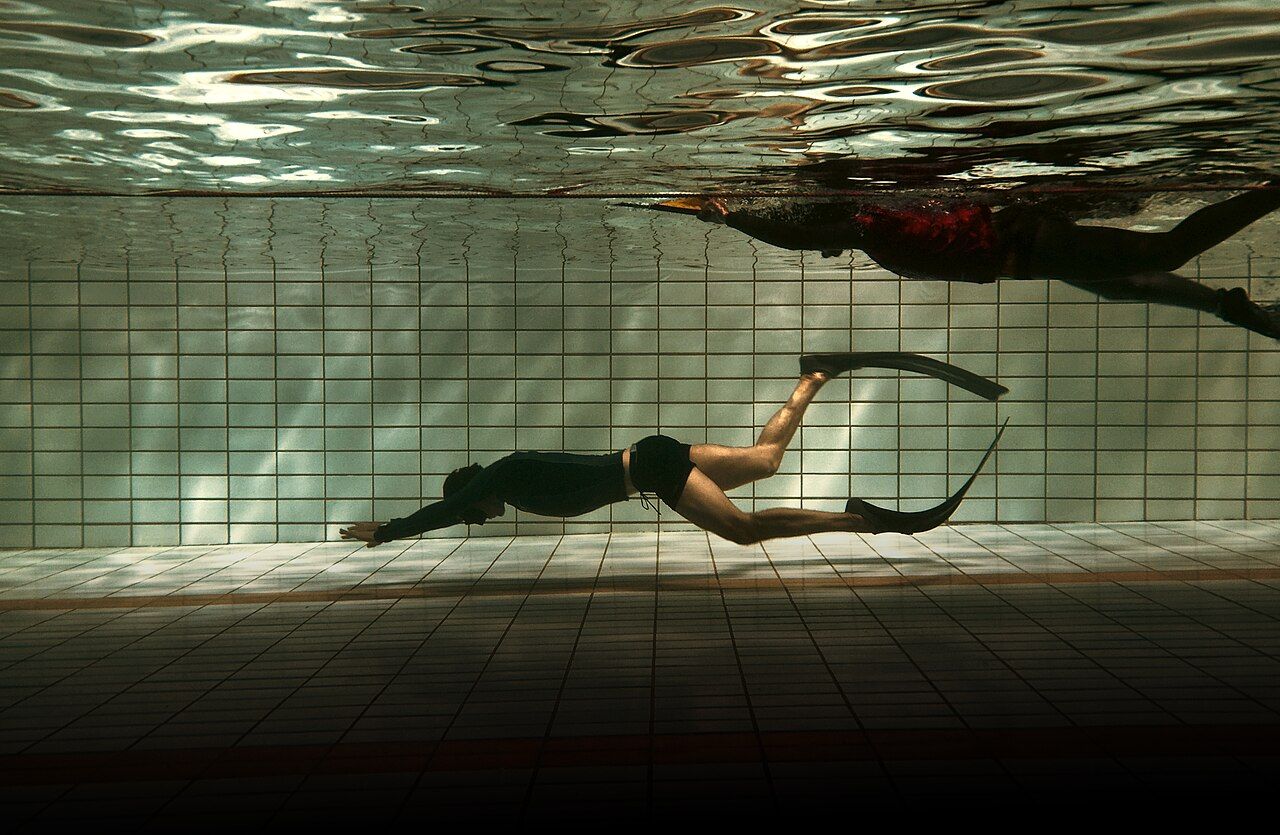
Creatine is one of the most studied supplements in sport. It tops up phosphocreatine in muscle, a quick reserve that rebuilds the cell's fuel, ATP, without needing oxygen. That is usually sold as a sprinter's or weightlifter's edge. A team from the University of Belgrade and Harokopio University in Athens asked whether it might help people whose whole sport is working without any fresh oxygen coming in: breath-hold divers. Their trial was published on 13 October 2026 in the Journal of the International Society of Sports Nutrition.
Twenty trained divers took part, 18 men and 2 women with an average age of about 42 and around four and a half years of breath-hold training. Testing a dive underwater is hard to standardise, so the team built a land version. Each diver first did a maximal dynamic dive with fins in a pool (on average about 116 metres in just under two minutes), and their heart rate on surfacing, around 90 beats a minute, set how hard their exercise bike would be. Then, after a warm-up and a three-minute countdown, they took one full breath, wore a nose clip and pedalled for as long and as far as they could. A mouthpiece linked to a gas analyser would catch any sneaky breath.
After a baseline test, divers were paired on sex, bike resistance, performance, age and build, and one of each pair was given creatine monohydrate, 5 grams four times a day for seven days (20 grams a day, a standard loading dose). The other got the same amount of maltodextrin, a starch powder, in identical unlabelled sachets. Neither the divers nor the testers knew who had what.
In the main analysis (9 on creatine, 10 on placebo), the creatine group went from 724 to 965 metres of ergometer distance on one breath, about 33% further, and kept pedalling on that breath for 149 seconds instead of 119. The placebo group also improved, from 745 to 847 metres (about 14%) and from 90 to 102 seconds. The difference between those two sets of changes was statistically significant for both distance and time. The rise in blood lactate after the effort, a rough marker of anaerobic strain, barely changed on creatine (1.17 to 1.22 mmol/L) but grew from 1.23 to 2.13 in the placebo group.
Several things did not change. The divers rated their breath-hold discomfort the same as before, the CO2 in their exhaled breaths afterwards was not measurably different between groups, and body weight and fat mass stayed put. Fat-free mass went up by about 0.7 kg on creatine. The authors point out that creatine pulls water into muscle, so that may be water rather than new tissue, and when they adjusted the distance result for it, the group difference fell just short of significance (p = 0.063).
The bigger caveat is what happens when nobody is left out. One diver on creatine was dropped from the main analysis for not keeping to the agreed pedalling cadence and not keeping up their usual training that week. Counting all 20 people who were randomised, the gains in distance (p = 0.12) and breath-hold time (p = 0.09) were no longer statistically significant; only the smaller lactate rise held up. The groups were also uneven before the supplement started, with the creatine group already lasting longer on the bike (119 against 90 seconds). There was no sample-size calculation because, as the authors explain, there are not many trained breath-hold divers to recruit. Muscle creatine was never measured, and taking the doses was checked by asking the divers and collecting the empty sachets.
The placebo group's 14% gain matters too. A breath-hold test rewards calm, practice and nerve, and the authors say a learning effect cannot be fully ruled out despite a practice session. During the supplement week the placebo group also ate less, by a one-day food recall, and the two groups shifted their swim and gym training in opposite directions. The creatine was supplied free by Creapure (Alzchem Trostberg), which the authors say had no role in the design, analysis or decision to publish; the study was funded by Serbia's science ministry.
The authors conclude that creatine 'appears to enhance' breath-hold exercise performance and suggest it may interest freedivers, spearfishers and similar athletes. Read alongside the intention-to-treat numbers, a fairer summary is that this is a promising first small trial rather than proof, and it was done on a bike in a lab, not in water. Breath-hold training carries a real risk of blacking out, and no supplement changes the rule of never training alone.
Double-blind, placebo-controlled trial: 20 trained breath-hold divers (18 men, 2 women, mean age 41.6) took creatine monohydrate 20 g/day or maltodextrin placebo for 7 days, then repeated a maximal one-breath cycling test; main analysis 9 creatine vs 10 placebo
+33% vs +14%
Distance pedalled on one breath, creatine (724 to 965 m) vs placebo (745 to 847 m); p = 0.011
+30 s vs +12 s
Breath-hold time on the bike, creatine (119 to 149 s) vs placebo (90 to 102 s); p = 0.028
+0.06 vs +0.90
Change in the post-effort lactate rise (mmol/L) over the week, creatine vs placebo; p = 0.003
+0.7 kg
Fat-free mass on creatine (placebo −0.3 kg); likely partly water drawn into muscle
p = 0.12 / 0.09
Distance and time results when all 20 randomised divers are counted: not statistically significant
20 g × 7 days
Loading dose: 5 g four times a day, dissolved in water
Figures are from Kurmazovic, Nomikos, Adamakis, Forbes, Arnaoutis, Djordjevic, Todorovic and Kritsiligkos, 'Load and breath-hold: impact of 7-day creatine monohydrate loading on breath-hold exercise performance - a double-blind randomized controlled trial', Journal of the International Society of Sports Nutrition 23(sup1):2732743, doi 10.1080/15502783.2026.2732743, published online 13 October 2026 (open access, CC BY 4.0); registered as NCT07233707. Distances are ergometer metres, not metres swum. Means are per-protocol (Table 2); p values are Time × Group interactions from repeated-measures ANOVA. Bonferroni post hoc: distance rose by 240.6 m (95% CI 165.6 to 315.5) on creatine and 101.5 m (30.4 to 172.6) on placebo; time by 30.4 s (18.7 to 42.2) and 12.0 s (0.8 to 23.2); lactate rise by 0.06 (−0.31 to 0.42) and 0.90 (0.55 to 1.25). Intention-to-treat (all 20): distance p = 0.121, time p = 0.093, lactate p = 0.001, fat-free mass p = 0.092. Adjusting the distance result for the change in fat-free mass: Time × Group p = 0.063. Baseline breath-hold time differed between groups (p = 0.034 after adjusting for bike resistance). No significant group differences in exhaled CO2, breath-hold discomfort rating, muscle-fatigue rating, body weight or fat mass. The paper describes one exclusion from the creatine group but in one place refers to 'two previously mentioned participants'; we report the tables as published. The 33% and 14% are our rounding of the table means and match the paper's own '≈33%' and '≈14%'.
- Your body makes creatine itself, from three amino acids (arginine, glycine and methionine), and stores most of it in skeletal muscle.
- In an all-out effort, the phosphocreatine system is the main source for rebuilding ATP for roughly the first 5 to 10 seconds, before other energy systems take over more of the work.
- In dynamic freediving, athletes swim for distance along a pool on one breath; the paper notes a 100 to 300 metre dive typically takes about one to four minutes.
- The divers' heart rates on surfacing from a maximal pool dive averaged about 90 beats a minute, low for hard exercise, which is why the bike workload was set from that number rather than from usual training zones.
- Creatine loading tends to draw water into muscle cells, so a scale or body scan can show a little more lean mass within a week without any new muscle being built.
- Load and breath-hold: impact of 7-day creatine monohydrate loading on breath-hold exercise performance - a double-blind randomized controlled trialJournal of the International Society of Sports Nutrition, published 13 October 2026 (open access, CC BY 4.0) · The study: methods, results tables, intention-to-treat analysis, limitations, funding and disclosure
- Full text on PubMed Central (PMC13665695)US National Library of Medicine · Open-access full text
- PubMed record 42868132US National Library of Medicine · Abstract and publication details
- Load and Hold: Impact of 7-Day Creatine Monohydrate Loading on Breath-Hold Cycling Performance (BREATHE-C), NCT07233707ClinicalTrials.gov · Trial registration
- Freediving Competition Bi-Fins (3643603988)Wikimedia Commons · Image, CC BY 2.0, by Jayhem
General information, not medical advice. This was a small trial of 20 trained divers on an exercise bike, and its main gains were not statistically significant when every randomised diver was counted. Never practise breath-holding alone or in water without a trained buddy. If you have kidney disease, take regular medicines, or are thinking of starting creatine or any supplement, talk to your doctor or a registered dietitian first.
Analysis by NutroPractic from the sources listed. Written for general readers; it does not replace advice from your own doctor.
From our articles
Read, then eat a little better
Plain-language guides on nutrition and wellness, backed by research.

Supplements and vitamins
Spermidine from food or capsules: measured milligrams in wheat germ, soybeans and cheese, and what the one year-long trial found
Wheat germ holds about 22 to 34 mg of spermidine per 100 g, matured cheese about 0.12 mg. The only year-long capsule trial used 0.9 mg a day and found no memory benefit. Measured values, worked doses and safety.
22 Nov 2026

Supplements and vitamins
Zinc carnosine for the gut lining: what the two human trials gave, the zinc in each dose, and the copper catch
Zinc carnosine is only about 22.6% zinc, so 75 mg twice a day is roughly 34 mg of zinc a day. Here are the doses and results of the 10-person NSAID permeability trial and the 20-person aspirin pilot, and the copper cautions.
22 Nov 2026

Women's health
Inositol for PCOS: the 40:1 ratio, trial doses, and food milligrams
Why do randomized trials in polycystic ovary syndrome prioritize the 40:1 myo to D-chiro inositol ratio? Here is the science behind the ovarian epimerase paradox, clinical ovulation and insulin metrics, and why cantaloupe cannot replace 4,000 mg trial powder.
21 Nov 2026
Newsfeed for your website
Want this feed on your website?
Add it to any site with one copy-and-paste snippet. No sign-up, and it updates itself every hour.
Start with a virtual consultation
Tell Dr. Triveni what you want to change. You will leave with a clear next step, whether you are in Toronto, London, New York or Chennai.