Gout and drinks · October 23, 2026
Coffee drinkers had about half the odds of gout in 52 pooled studies. Alcohol and sugary drinks went the other way, for gout and for high uric acid. Coffee made no clear difference to uric acid itself
A team in Beijing pooled 52 studies from 2003 to 2024 on what people drink and two linked problems: high uric acid in the blood and gout, the painful arthritis it can cause. Alcohol and sugar-sweetened drinks went with higher odds of both. Coffee went with lower odds of gout, but only three studies fed that result and they disagreed a lot. Tea was mostly a wash.
Gout starts with uric acid, a waste product the body makes when it breaks down purines. When too much builds up in the blood, a state doctors call hyperuricaemia, it can form crystals in the joints and kidneys, and the result is the sudden, swollen, very painful joint that gout is known for. What you drink is one of the few everyday things that may push uric acid up or down, so a team at the Third Affiliated Hospital of Beijing University of Chinese Medicine set out to pull the evidence together. Their review came out in Frontiers in Nutrition on 22 October.
They searched four databases up to April 2026, screened 19,623 unique records and kept 52 studies, published between 2003 and 2024: 26 cross-sectional surveys, 20 cohort studies that followed people over time and 6 case-control studies, from China, the US, South Korea, the UK, Japan, Singapore, Brazil, Mexico, New Zealand and several European countries. Thirty-one looked at high uric acid and 21 at gout. The drinks were coffee, alcohol, sugar-sweetened drinks and tea.
Alcohol gave the most consistent signal. Across nine studies and 273,282 people, drinkers had about 1.8 times the odds of gout, and the result held whichever single study was left out. In the three cohort studies that reported hazard ratios, drinking went with a 55% higher hazard of developing gout. Across 14 studies and 456,997 people, alcohol went with about 1.5 times the odds of high uric acid, in men and in women. When the team split alcohol by type, only spirits in men reached significance for high uric acid; the beer, wine and spirits splits for gout were all too uncertain to call.
Sugar-sweetened drinks came next. Across four studies with 146,878 people they went with about 1.4 times the odds of gout, though that result lost significance when some single studies were left out. Across 11 studies and 249,882 people they went with about 1.5 times the odds of high uric acid, a little higher in men (1.63) than in women (1.43). Here the funnel plot was lopsided, a hint that small studies with striking results may be over-represented. In the two cohorts that measured amounts, the odds of gout rose in a straight line as intake went up.
Coffee is the result that will get the headlines, and the one to read most carefully. Three studies with 266,268 people put the odds of gout among coffee drinkers at about half (odds ratio 0.54), but the studies disagreed sharply with each other (I² 80%). In two cohorts that recorded amounts, the odds fell steadily with more coffee: about 18% lower at roughly 590 mL a day, two and a half standard 8-ounce cups, and 55% lower at about 1,420 mL. Yet across six studies and 192,056 people, coffee made no measurable difference to high uric acid (odds ratio 0.95). The authors say this is why nobody should claim coffee lowers both.
Tea showed no clear link with gout, based on only two studies, and no clear link with high uric acid overall. Women who drank tea did have about 1.3 times the odds of high uric acid, an extra finding the authors say needs checking.
The limits are large. Every study was observational, so drinks may simply travel with other habits, such as red meat, seafood or exercise, that the original studies handled differently. Heterogeneity was high in most analyses, several results rest on two to four studies, and cup and serving sizes had to be converted between studies. The review shows which drinks go with gout, not that switching drinks will prevent it. For anyone already living with gout or high uric acid, the most solid message is the familiar one: alcohol and sugary drinks are the ones to cut back on.
Drinks and the odds of gout and high uric acid: meta-analysis of 52 observational studies
52
Studies pooled (26 cross-sectional, 20 cohort, 6 case-control), published 2003 to 2024
1.81
Odds ratio for gout among alcohol drinkers (9 studies, 273,282 people; 95% CI 1.37 to 2.39)
1.52
Odds ratio for high uric acid among alcohol drinkers (14 studies, 456,997 people)
1.37 / 1.48
Odds ratios for gout / high uric acid with sugar-sweetened drinks (4 and 11 studies)
0.54
Odds ratio for gout among coffee drinkers (3 studies, 266,268 people; I² 80%)
0.95
Odds ratio for high uric acid among coffee drinkers: no clear link (6 studies, 192,056 people)
Source: Li M, Wang J, Wang Z, Li J, Li W, 'Association between intake of different beverages and risk of hyperuricemia and gout: a risk factor and dose-response meta-analysis', Frontiers in Nutrition 13 (2026), doi 10.3389/fnut.2026.1956907, published 22 October 2026, open access (CC BY). PROSPERO CRD420261279131. Search: PubMed, Embase, Cochrane Library and Web of Science to 11 April 2026; 24,550 records, 19,623 after duplicates, 373 full texts, 52 included (31 hyperuricaemia, 21 gout). Hyperuricaemia: serum uric acid at or above 7.0 mg/dL (420 µmol/L) in men and 6.0 mg/dL (360 µmol/L) in women; gout by ACR criteria or ICD codes. Pooled odds ratios (95% CI): alcohol and gout 1.809 (1.372 to 2.385), I² 97.8%, leave-one-out range 1.660 to 1.943; alcohol and gout, cohort hazard ratio 1.554 (1.237 to 1.953), 3 studies; alcohol and hyperuricaemia 1.524 (1.363 to 1.703), men 1.536, women 1.381; spirits and hyperuricaemia in men 1.320 (1.141 to 1.527); sugar-sweetened drinks and gout 1.371 (1.059 to 1.776), I² 68.7%, not significant in all leave-one-out runs; sugar-sweetened drinks and hyperuricaemia 1.478 (1.342 to 1.627), men 1.627, women 1.426, Egger p = 0.004; coffee and gout 0.543 (0.341 to 0.866), I² 80.2%; coffee and hyperuricaemia 0.950 (0.872 to 1.035); tea and gout 1.307 (0.880 to 1.940), 2 studies; tea and hyperuricaemia 1.119 (0.961 to 1.304), women 1.294 (1.081 to 1.549). Coffee dose-response for gout (2 cohorts, 135,302 people) against none: 592.5 mL/day OR 0.82 (0.71 to 0.94), 1,066.5 mL/day 0.56, 1,422 mL/day 0.45 (0.34 to 0.60); cups are our conversion at 237 mL (8 US fl oz) per cup. No funding received; no conflicts declared. OR = odds ratio; CI = confidence interval; I² = share of variation due to differences between studies.
- In this review 'high uric acid' meant a blood level of at least 7.0 mg/dL (420 µmol/L) in men and 6.0 mg/dL (360 µmol/L) in women, the usual cut-offs in the included studies.
- The authors explain the sugary-drink link through fructose: the liver breaks it down in a way that burns through ATP, the cell's energy molecule, and the leftovers are turned into uric acid. Alcohol drains ATP by a similar route.
- Beer carries an extra load: the review notes it is rich in easily absorbed purines such as guanosine, on top of the alcohol itself.
- Coffee went with lower odds of gout in the pooled studies but not with lower odds of high uric acid. The authors point to work suggesting coffee compounds may also damp the inflammation behind a gout attack, which this review could not test.
- Only three studies fed the headline coffee result and two the tea-and-gout result, so one new large study could shift either a long way.
- Association between intake of different beverages and risk of hyperuricemia and gout: a risk factor and dose-response meta-analysisFrontiers in Nutrition · The review, open access, with forest plots and dose-response curves
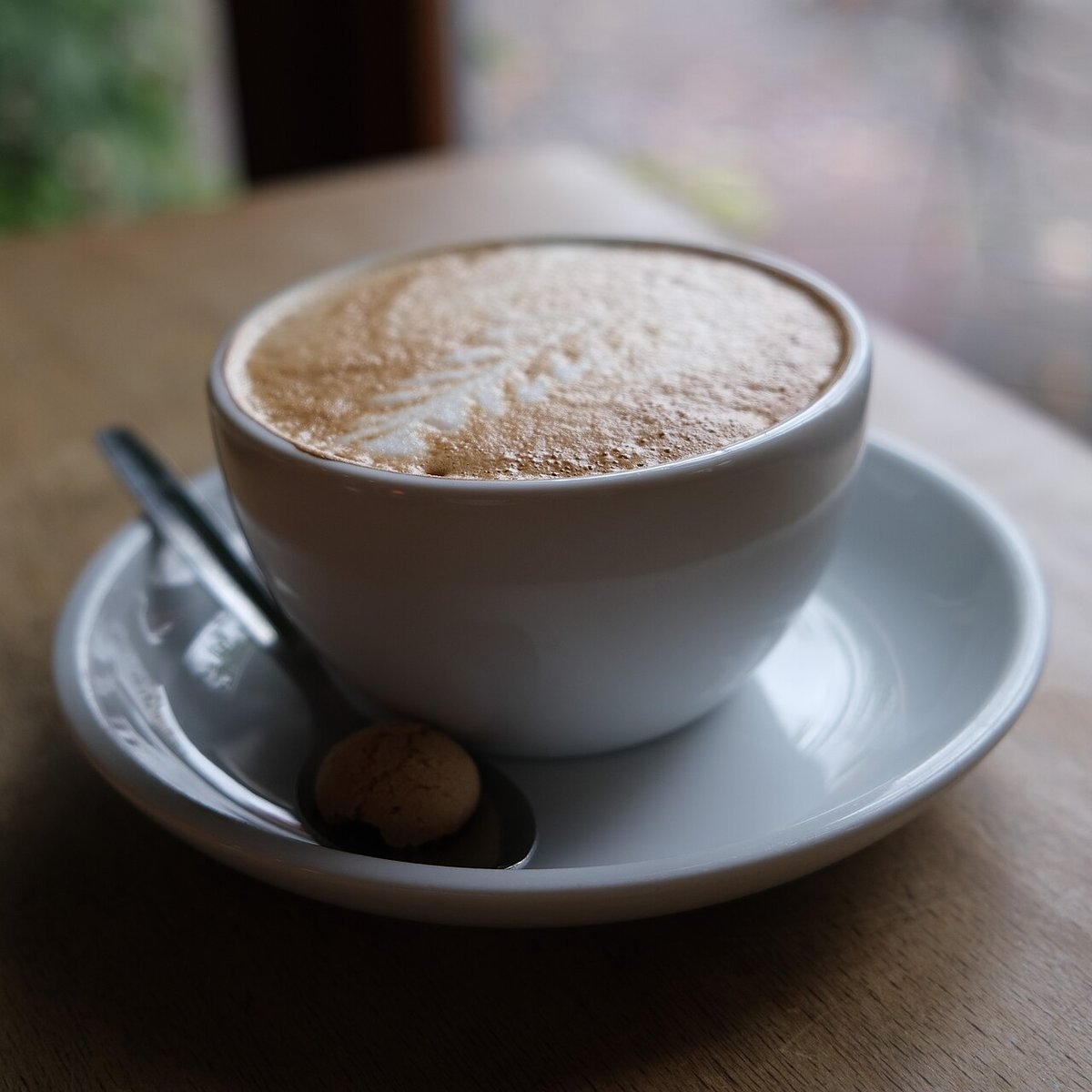
- Cup of coffee in Café Butter - Prenzlauer Berg, BerlinWikimedia Commons · The photo, CC0
General information, not medical advice. This review pooled observational studies that show links, not cause and effect. If you have gout, high uric acid or kidney disease, or take medicine for any of them, talk to your doctor or a registered dietitian before changing what you drink.
Analysis by NutroPractic from the sources listed. Written for general readers; it does not replace advice from your own doctor.
From our articles
Our guides on this subject
Plain-language guides on nutrition and wellness, backed by research.
Women's health
Eating while breastfeeding: extra calories, iodine, caffeine, fish and alcohol, with the actual numbers
Breastfeeding usually adds about 330–400 kcal a day, but the smaller numbers can matter more: 290 mcg iodine, 400 IU vitamin D for baby, 8–12 oz fish a week, and a caffeine total you can actually add up.
6 Nov 2026
Liver health
Fatty liver (MASLD): how much weight loss reverses it, and what coffee and alcohol do
About one adult in three has a fatty liver, and most find out by accident on a scan. Biopsy studies show how much weight loss clears the fat, calms the inflammation and even shrinks scarring. Here are the numbers, what diet and drinks do, the new medicines and the one blood test worth asking for.
30 Oct 2026
Joint health
Gout and uric acid: which foods matter, and how much diet can do
Gout is usually blamed on steak and beer. The studies say food does matter, but less than most people think: here is what lowers uric acid, what sets off a flare, what cherries really showed, and why most people with gout also need a tablet.
30 Oct 2026
Newsfeed for your website
Want this feed on your website?
Add it to any site with one copy-and-paste snippet. No sign-up, and it updates itself every hour.
Start with a virtual consultation
Tell Dr. Triveni what you want to change. You will leave with a clear next step, whether you are in Toronto, London, New York or Chennai.