Coeliac disease · November 3, 2026
Same number of snacks, different snacks: young Finns with coeliac disease had ice cream three times as often and sugary soft drinks half as often
A survey of 353 people aged 16 to 30 found the gluten-free group wasn't snacking more. What changed was what they snacked on, and where lunch happened: 18% ate in a school or workplace canteen every day, against 38% of the others.
The usual worry about a gluten-free diet is the meals: the bread, the pasta, what gets swapped for what. A group of Finnish researchers looked at the gaps between them instead. They sent a web survey to the 1,257 members of the Finnish Celiac Society aged 16 to 30, and to about 6,500 students at a university of applied sciences and a vocational school in Seinäjoki. The analysis compared 210 people with coeliac disease on a gluten-free diet against 143 with no coeliac disease and no special diet.
The first result is a non-result. Snacking was just as common in both groups: 78% of the coeliac group and 75% of the others had one or two snacks a day, and the difference between the groups was nowhere near significant (P = 0.931). Replacing lunch or dinner with a snack didn't differ significantly either. The coeliac group actually reported slightly more meals, 3.4 a day against 3.0, though the authors say that gap is partly down to who answered, since more of that group were women and fewer were students.
The contents of the snacks are where the groups parted. Counted in times per week, the coeliac group had ice cream 0.9 times against 0.3, and low-fibre bread 1.6 times against 0.8. They had sugary soft drinks 0.6 times against 1.2. All three gaps held when the researchers widened the comparison to include people on other special diets, though ice cream became 0.9 against 0.4 and soft drinks 0.6 against 1.0. High-fibre bread barely differed at 2.6 against 2.5, so on these counts the low-fibre bread doesn't look like a straight swap for the high-fibre kind. Nor was there a general sweet tooth: sweets (1.2 vs 1.1), chocolate (1.0 vs 1.3) and biscuits and snack bars (0.8 vs 0.8) showed no significant difference.
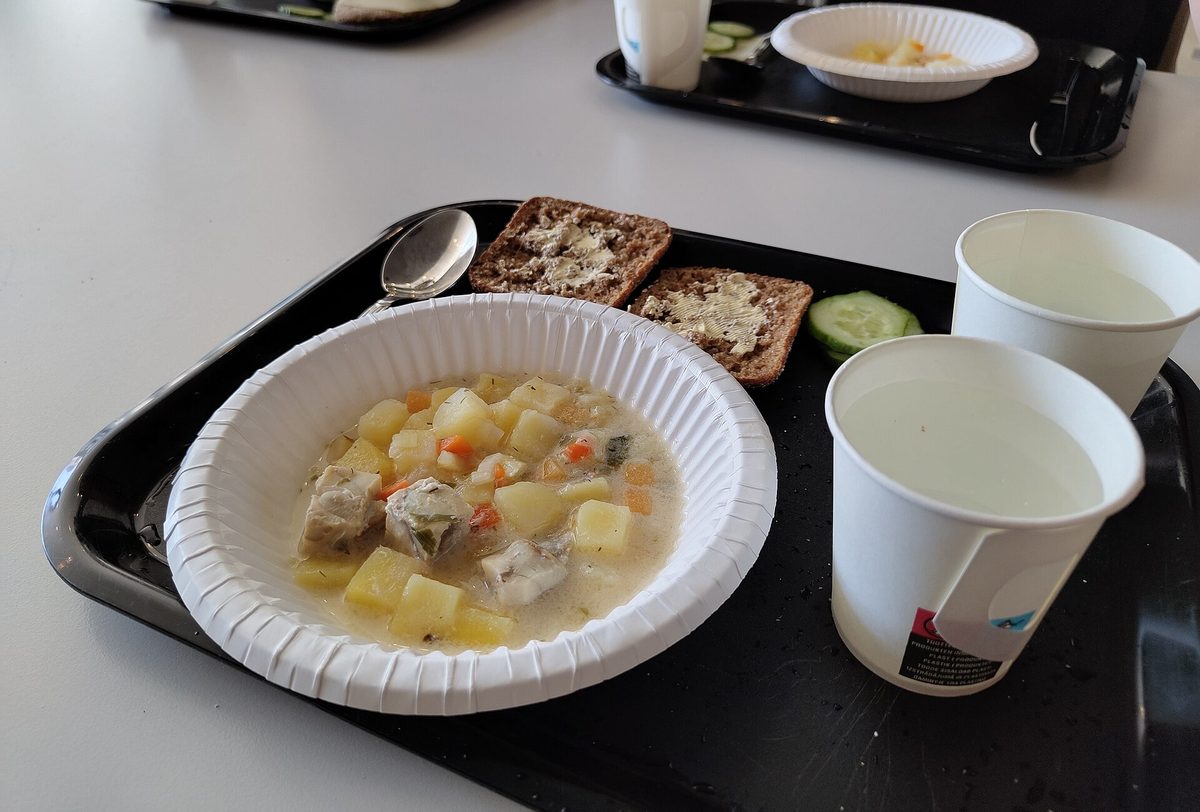
Then there is lunch. Among those who answered the question, 18.3% of the coeliac group ate in a school or workplace canteen every day, against 38.4% of the others, and 23.4% never did, against 11.6%. That difference survived separate adjustments for gender, work or study status and the size of the place they lived. They were also far less likely to get snacks from those canteens (16% vs 43%), and most of the 157 who answered felt the gluten-free snack choice in shops and cafeterias wasn't good enough. There's a Finnish wrinkle here: student lunches are heavily subsidised, and 83% of the comparison group were students against 51% of the coeliac group, so cheap lunches may explain part of the gap as well as the menu.
This is a one-off anonymous survey, and it has real weaknesses. The response rate was about 17% in the coeliac group and 3% in the comparison group, the questionnaire was piloted but not formally validated, and everything is self-reported. It counts how often foods were eaten, not how much, and says nothing about whether people's diets were adequate overall. The groups also differed in ways adjustment may not fully fix, and three snack differences, including soft drinks, disappeared among the men when the sexes were analysed separately. It can't say that coeliac disease or the diet caused any of this. What it does offer is a useful nudge for anyone helping a teenager take over their own gluten-free diet: the conversation about fibre probably shouldn't stop at the dinner table.
Meals and snacks in 210 young people with coeliac disease and 143 without any special diet, Finland (BMC Nutrition, 27 October 2026)
353
People aged 16 to 30 in the analysis: 210 with coeliac disease on a gluten-free diet, 143 comparison; 80% women
18.3% vs 38.4%
Ate lunch in a school or workplace canteen every day, coeliac vs comparison (of 175 and 112 who answered; P < 0.001)
3.4 vs 3.0
Meals per day, coeliac vs comparison (P = 0.003, before adjustment)
78% vs 75%
Had one or two snacks a day (our sum of the paper's two bands; P = 0.931 across all bands)
0.9 vs 0.3
Ice cream as a snack, times per week (adjusted for multiple testing, P = 0.010)
1.6 vs 0.8
Low-fibre bread as a snack, times per week (P = 0.005); high-fibre bread 2.6 vs 2.5, not significant
0.6 vs 1.2
Sugary soft drinks as a snack, times per week (P = 0.045)
17.6% vs 34.3%
Used any tobacco product (P < 0.001)
Figures are from the Article in Press version's abstract, Tables 1 to 3, results text and Supplementary Table 3; the final edited version may change them. The 78% and 75% are our sums of the 'one' and 'two' snack bands in Table 2. Weekly counts are means converted from frequency bands, and not everyone answered each item (about 160 and 90 to 105 per food). The survey dates aren't given in the paper. The authors declare no competing interests; funding came from Finnish research bodies, hospitals and foundations. One author is affiliated with the Finnish Coeliac Society. Published under CC BY.
- Coeliac disease affects about 1% to 3% of people worldwide, the paper notes, and a lifelong gluten-free diet is the only accepted treatment.
- The survey counted everything between main meals except water as a snack. By that definition, the most frequent item in both groups was coffee or tea, at 5.4 and 5.8 times a week.
- A third of the coeliac group (33%) followed another special diet on top of gluten-free, most often lactose-free (14%), vegetarian or vegan (9%) or for a food allergy (8%).
- The median age at coeliac diagnosis in this group was 14, and 41% had a family history of the disease.
- The authors point out that gluten-free products are widely available in Finland and awareness of coeliac disease is high, so the picture could look different elsewhere.
- Taste, ease of carrying and price drove snack buying in both groups. Packaging looks, local production and organic methods mattered least.
- Meal frequency and snacking patterns among adolescents and young adults without any food restrictions or with celiac disease and following a gluten-free dietBMC Nutrition, 27 October 2026 · Original article, Article in Press (open access, CC BY), with Tables 1 to 3 and the supplementary sensitivity analysis quoted here.
- School lunch in Ylästö schoolWikimedia Commons · CC0 photograph, used as a general illustration.
General information, not medical advice. This survey shows associations in one group of young Finns, not that a gluten-free diet causes any particular eating pattern. If you have coeliac disease, keep to your gluten-free diet and talk to your doctor or a dietitian about what suits you.
Analysis by NutroPractic from the sources listed. Written for general readers; it does not replace advice from your own doctor.
From our articles
Our guides on this subject
Plain-language guides on nutrition and wellness, backed by research.
Everyday eating
Food label claims decoded: 'no added sugar', 'multigrain', 'natural' and 'high protein'
A no-added-sugar biscuit with only 13% fewer calories. A 7-grain loaf with refined flour listed first. A 'high protein' bar that clears the legal line at 21%. What each claim legally requires in the EU/UK, US and India, with worked reads of real packs.
2 Nov 2026
Nutrition science
Sweeteners after the WHO advice: aspartame, stevia, erythritol and what the 2023 decisions meant
In 2023 the WHO advised against using sweeteners to control weight, and its cancer agency called aspartame 'possibly carcinogenic' a few weeks later. Neither means your diet drink is dangerous, and neither means it helps. What the reviews found, how much is allowed, why erythritol is the one to watch, and what to do if you have diabetes or simply want less sugar.
18 Oct 2026
Gut health
Probiotic capsules: which ones have trial evidence, what they can do, and when to skip them
Children on antibiotics: 8% got diarrhoea with a probiotic, 19% without. Older hospital patients: 10.8% with, 10.4% without. Which capsules have evidence, what three guidelines say about IBS, what a course costs per case prevented, and who shouldn't take them.
2 Nov 2026
Newsfeed for your website
Want this feed on your website?
Add it to any site with one copy-and-paste snippet. No sign-up, and it updates itself every hour.
Start with a virtual consultation
Tell Dr. Triveni what you want to change. You will leave with a clear next step, whether you are in Toronto, London, New York or Chennai.