Heart and blood · October 13, 2026
Young men from Kilimanjaro villages swapped their home cooking for fried chicken, chips and white rice for two weeks. A blood test then showed their plasma could make about a fifth more of the main clotting enzyme
The same trial reported last year on what a Western-style diet did to inflammation. Now the team has gone back to the frozen blood samples and asked a different question: does two weeks of urban fast food change how readily blood clots? One answer points that way. The others are messier, and a cup of the local banana beer gave a result nobody can quite read yet.
In the villages on the slopes of Kilimanjaro, the heritage diet is built on green vegetables, beans, plantains, cassava and taro, and whole grains such as millet and sorghum. Down in town, many young men eat what researchers call a Western-style diet. Fried chicken, chips, white rice, macaroni, pancakes, refined maize meal.
A team from KCMC University in Moshi and Radboud University Medical Center in the Netherlands ran an experiment around that divide. It recruited 77 healthy men aged 20 to 40. Men from the villages who normally ate the heritage diet were switched to Western-style meals for two weeks. Men from town were switched the other way. A third group kept their usual town diet but drank about a litre a day of Mbege, a fermented drink made from bananas and finger millet, for one week. Meals in the switch groups were cooked centrally and eaten under supervision, three times a day.
The main results came out in Nature Medicine in April 2025. The switch to Western food pushed the men's blood towards a more inflammatory state; the switch to the heritage diet and the banana drink mostly did the opposite. That was the main finding.
The new paper, published online by the American Heart Association journal Arteriosclerosis, Thrombosis, and Vascular Biology on 8 October 2026, looks at the same stored plasma for something else: clotting. Blood clots by producing an enzyme called thrombin, and lab tests can measure how much thrombin a plasma sample is capable of making once clotting is set off. That total is called the endogenous thrombin potential. In research it is read as a measure of how primed the blood is to clot.
In the men who went from village food to Western food, that potential rose. Compared with the change in the small group of men who stayed on their usual diet, it was about 19% higher after the two weeks, when clotting was triggered at the stronger of the two settings the lab used. The statistical margin is thin: the lower end of the confidence interval sits at 1%, and the authors report the p value of 0.037 as nominal, meaning not corrected for the many other things they measured.
Prothrombin, the raw material thrombin is made from, also went up inside that group, from 98.0% to 104.5% of the reference level. That rise survived the correction for multiple tests. But when it was set against the men who did not change their diet, it was no longer clearly different. Something about those two weeks may have nudged it, or it may have drifted on its own.
Going the other way, from Western to heritage food, did little that was consistent.
The banana drink produced the oddest picture. Men drinking Mbege had lower levels of several clotting proteins afterwards, including fibrinogen and factor VIII, and also of antithrombin, one of the body's own brakes on clotting. Yet their thrombin potential at the weaker trigger went up. Those changes pull in different directions, and with no control group in that arm, there is no way to say how much of it was the drink.
The authors are frank about the limits, and they are real. Clotting was a secondary outcome with no ranking of which result mattered most, so they call the whole analysis exploratory. There were only five control men in each switch group. Food was not measured out, so the men ate as much as they wanted. In the original paper, the group switched to Western food put on a median of 2.6 kg in two weeks. A change in clotting could come from what they ate, how much they ate, or the weight itself; this design cannot pull those apart.
And thrombin potential in a test tube is not a clot in a vein. No one in this trial had a thrombosis, and two weeks says nothing about what years of a diet would do. We could read only the summary of the new paper, not the full text, so we have not seen the full list of clotting measures or the size of the other changes.
What the study does add is a mechanism worth a proper test. Diet is usually linked to heart attacks and strokes through cholesterol, blood pressure and weight, all of which take months or years to shift. Here is a hint that blood's readiness to clot may respond within a fortnight. If a larger trial with matched calories finds the same, it would be one more reason the speed of the move from traditional to fast food across much of the world matters.
Open-label dietary-switch trial, Kilimanjaro region, Tanzania: 77 healthy men aged 20 to 40; heritage-to-Western diet for 2 weeks, Western-to-heritage diet for 2 weeks, or about 1 litre a day of the fermented banana drink Mbege for 1 week
1.19
Control-adjusted fold-change in endogenous thrombin potential (stronger trigger) after the switch to Western food; 95% CI 1.01 to 1.41, nominal p = 0.037
98.0% → 104.5%
Prothrombin within the Western-switch group (p = 0.027 after correction), but not different from controls (ratio 1.05, p = 0.443)
2.6 kg
Median weight gained in two weeks by the men switched to Western food (from the 2025 main paper)
77 men
Enrolled across three arms of about 22, with 5 habitual-diet controls in each diet-switch arm
1 week
Mbege arm: about 1 litre a day of the banana and millet drink, with no control group
0
Clinical clotting events measured: every outcome here is a laboratory test
Clotting figures are from the published abstract of the paper in Arteriosclerosis, Thrombosis, and Vascular Biology (doi 10.1161/ATVBAHA.126.325420, online ahead of print 8 October 2026), read on PubMed (PMID 42845249). We could not open the full text. As stated in the abstract: open-label dietary-intervention trial in 77 healthy men aged 20 to 40; three arms (n = 22 per arm) of heritage-to-Western-style diet switch (2 weeks), Western-to-heritage diet switch (2 weeks), or habitual Western-style diet plus 1 L a day of Mbege for 1 week; the two switch arms had 5 habitual-diet controls each; plasma at baseline, after the intervention and at 4-week follow-up; coagulation proteins, thrombin and plasmin generation measured; coagulation analyses were prespecified secondary end points, interpreted as exploratory. Results: heritage-to-Western switch, control-adjusted endogenous thrombin potential at 5 pM recombinant tissue factor fold-change ratio 1.19 (95% CI 1.01 to 1.41), nominal p = 0.037; prothrombin rose within that arm from 98.0% to 104.5% (false-discovery-rate p = 0.027) but not relative to controls (ratio 1.05, 95% CI 0.93 to 1.18, p = 0.443); in the uncontrolled Mbege arm fibrinogen, prothrombin, factor VIII and antithrombin fell while endogenous thrombin potential at 1 pM tissue factor rose; the Western-to-heritage switch showed limited consistent changes. The abstract gives no size for the Mbege-arm changes, so we give none. 'About 19% higher' is our reading of the 1.19 ratio. Trial background (diets, supervised meals three times a day, food offered without limit, not calorie-matched, median 2.6 kg weight gain, IQR 2.0 to 3.4 kg, in the Western-switch group, Mbege alcohol content of 1 to 3%) is from the open-access 2025 Nature Medicine paper on the same trial (ISRCTN15619939), which lists 23 men enrolled in the heritage-to-Western arm with one withdrawal before the start.
- Thrombin is the enzyme that turns fibrinogen, a soluble blood protein, into strands of fibrin, the mesh that holds a clot together. Antithrombin is one of the proteins that switches it off again.
- Mbege is the traditional beer of the Chagga people of Kilimanjaro. It is brewed by fermenting boiled bananas with sprouted finger millet, and the trial's main paper puts its alcohol content at 1 to 3%.
- In the trial's Western-style menu, about 55% of the energy came from carbohydrate, mostly refined: maize meal for ugali, pancakes, chips, white rice, macaroni and fried plantains. Fat supplied about 23%, largely from fried food.
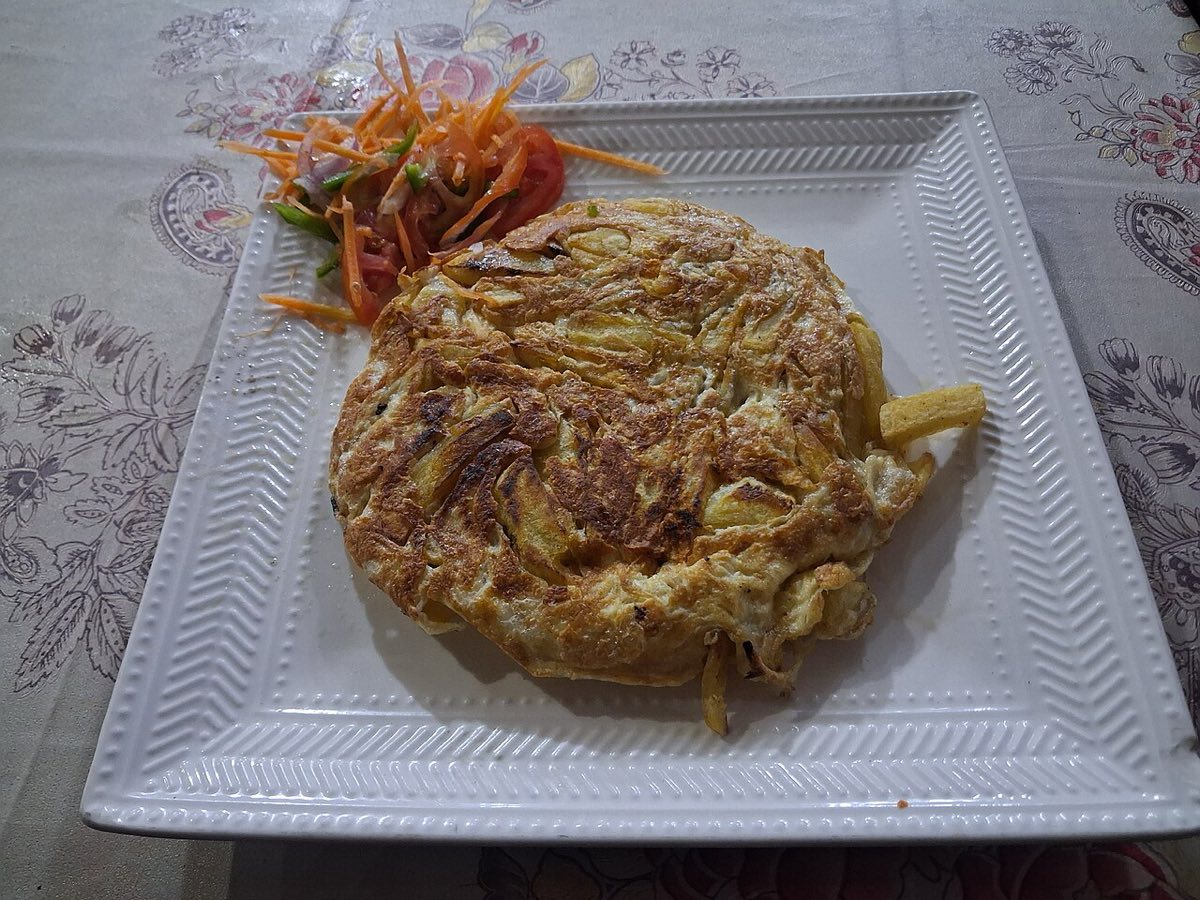
- One of the Western-style dishes on the trial's menu was 'chips mayai', chips cooked into an omelette. It is the dish in the photo above.
- The 2025 main paper found that some immune and metabolic changes from the two-week switch were still visible at the follow-up four weeks later, after the men had gone back to their usual food.
- Short-Term Dietary Exposures and Thrombin Generation in Tanzanian Men: Exploratory Coagulation-Focused Analysis of a Randomized Dietary-Switch TrialArteriosclerosis, Thrombosis, and Vascular Biology, online 8 October 2026 · The study. We read the abstract only
- PubMed record for the study (PMID 42845249)US National Library of Medicine · The abstract as read for this item
- Immune and metabolic effects of African heritage diets versus Western diets in men: a randomized controlled trialNature Medicine, 2025 · Main results of the same trial; open access, full text read for the diets, weight change and Mbege
- Trial registration ISRCTN15619939ISRCTN registry · Registry entry for the trial
- Chipsi mayai en MorogoroWikimedia Commons · Image, CC0, Josefito123
General information, not medical advice. This was a short, small study of laboratory clotting tests in healthy young men. If you have had a blood clot, take blood thinners or have questions about your diet and heart health, speak to your doctor or a registered dietitian.
Analysis by NutroPractic from the sources listed. Written for general readers; it does not replace advice from your own doctor.
From our articles
Read, then eat a little better
Plain-language guides on nutrition and wellness, backed by research.

Global data
Diabetes, obesity, child malnutrition and hunger, 1980 to 2050: what the numbers show
How diabetes, obesity, child malnutrition and hunger have changed since 1980, with sourced figures and a basic projection to 2050. Click a condition to explore the chart and its facts.
5 Oct 2026

Indian kitchen
Rice, roti and blood sugar: building a balanced Indian plate with the ICMR-NIN 2024 guidelines
About one in nine Indian adults has diabetes and many more have prediabetes. You don't have to give up rice or roti. How the ICMR-NIN Dietary Guidelines for Indians (2024) suggest building a plate, plus simple habits that help keep blood sugar steady.
3 Oct 2026

Micronutrients
Vitamin D and B12: two common gaps, from northern winters to vegetarian kitchens
Vitamin D runs low in Canadian and European winters, and surprisingly often in sunny India too. Vitamin B12 is a risk for vegetarians, people over 50 and people on certain medicines. Who is at risk, what the official advice is in North America, Europe and India, and where to get both.
3 Oct 2026
Newsfeed for your website
Want this feed on your website?
Add it to any site with one copy-and-paste snippet. No sign-up, and it updates itself every hour.
Start with a virtual consultation
Tell Dr. Triveni what you want to change. You will leave with a clear next step, whether you are in Toronto, London, New York or Chennai.