Pregnancy · October 11, 2026
Vitamin D came out on top for preventing preeclampsia in a new comparison with a statin and metformin. The authors then spend most of the paper asking readers not to act on it
Eight trials, 4,078 women with high-risk pregnancies, and a headline figure that looks like a 79% cut in risk with 4,000 IU a day. Read past the abstract and that number is measured against a lower dose of vitamin D, not a placebo, and every trial behind it was flagged for possible bias.
Preeclampsia is high blood pressure that appears in the second half of pregnancy, usually with protein in the urine, and it is one of the main reasons mothers and babies end up in serious trouble. The paper puts it at 2% to 8% of pregnancies worldwide. For women at high risk there is one preventive treatment with a recommendation behind it, low-dose aspirin, and the hunt for a second has been going on for years. Three candidates keep coming up: vitamin D, the cholesterol drug pravastatin, and the diabetes drug metformin.
A group from medical faculties in Egypt and Yemen has tried to rank the three against each other. Their review, published in BMC Pregnancy and Childbirth on 2 October 2026, uses a network meta-analysis, a method that lets treatments be compared even when no trial has tested them head to head, as long as they share a common comparison such as placebo. They found eight randomised trials with 4,078 women whose pregnancies were classed as high risk.
The result that will travel is in the abstract. Vitamin D at 4,000 IU a day came with a risk ratio of 0.21 for preeclampsia, and a monthly dose of 60,000 IU with 0.36. Pravastatin made no visible difference (1.03). Metformin's figure pointed the wrong way, 1.98, though with a range so wide it could mean anything from a modest benefit to nearly six times the risk. On the ranking score the method produces, vitamin D came first.
It is worth reading what the 0.21 is measured against. The abstract introduces it with the words 'compared with placebo'. The results section says something different: the 4,000 IU figure comes from a separate set of trials that compared doses of vitamin D with each other, and the reference there is 400 IU a day. So the finding is that women given a high dose had less preeclampsia than women given a low one. The paper says all four trials in that set were at risk of bias, three of them rated high risk and one with some concerns.
The second vitamin D result, the monthly 60,000 IU dose, was tested against placebo, but it rests on one trial. The pravastatin answer comes from two trials and the metformin answer from one. And the two halves of the analysis do not touch. The dose-comparison trials and the placebo trials share no common arm, which the authors acknowledge means nothing in one half can be compared with anything in the other. A ranking that puts a vitamin D dose above a statin is, for the 4,000 IU dose, not something this data can support, and the paper says as much: rankings 'are valid only within each specific connected network'.
There is also the question of which trials were looked for. The search covered five years only, from September 2020 to September 2025. The authors say this keeps the evidence current, and they accept that it may have left out older trials that still matter. Trials where the comparison group took aspirin were left out too, which is awkward, because aspirin is what a high-risk woman would normally be offered. Nobody tested vitamin D on top of it here.
To the authors' credit, the caution is theirs before it is ours. They rate the certainty of the evidence as low to very low. They call the findings hypothesis-generating, say they 'should not inform current clinical decision-making', and note that 4,000 IU a day is the level an Institute of Medicine panel set as the safe upper limit in pregnancy, with no evidence of safety above it. What is odd is how the paper reads as a whole: a confident-sounding number in the abstract, followed by page after page of warnings about it.
Our reading: this does not show that a high dose of vitamin D prevents preeclampsia, and it does not show that it fails to. It shows that a handful of recent trials, most with weaknesses, lean that way, and that the women who seemed to gain most were those who were short of vitamin D to begin with. That is a good reason to have your level checked if your doctor suggests it, and to take the supplement you have been prescribed. It is not a reason to raise the dose yourself. For pravastatin and metformin there is nothing here to suggest either prevents preeclampsia.
Vitamin D, pravastatin and metformin for preventing preeclampsia in high-risk pregnancies: systematic review and network meta-analysis of 8 randomised trials (4,078 women)
RR 0.21
Preeclampsia with vitamin D 4,000 IU a day. 95% confidence interval 0.06 to 0.72. The reference in the results is vitamin D 400 IU a day, not placebo; all four trials in this dose network were rated at risk of bias
RR 0.36
Preeclampsia with vitamin D 60,000 IU a month against placebo. 95% confidence interval 0.19 to 0.70. One trial, rated as having some concerns of bias
RR 1.03
Preeclampsia with pravastatin 20 mg against placebo. 95% confidence interval 0.77 to 1.37, which includes no effect. Two trials
RR 1.98
Preeclampsia with metformin 2,500 mg against placebo. 95% confidence interval 0.69 to 5.73, which includes no effect. One trial: 3.8% of women on metformin against 1.9% on placebo
8 trials
Randomised trials included, all published between September 2020 and September 2025. Risk of bias: three high, three some concerns, two low
Low to very low
The authors' own judgement of the certainty of the evidence for most outcomes. A formal certainty assessment was not carried out because the network was too sparse
Figures are from the full open-access paper (BMC Pregnancy and Childbirth 26, article 1101), read on PubMed Central. It was received on 28 November 2025, accepted on 28 August 2026 and published on 2 October 2026. RR is the risk ratio: below 1 means fewer cases than in the comparison group. The paper's tables and figures are in supplementary files that we did not read, so everything here is from the main text. The abstract gives approximate absolute risk differences of 8% for 4,000 IU a day and 6% for 60,000 IU a month. The observation that the abstract describes the 4,000 IU result as 'compared with placebo' while the results give vitamin D 400 IU as the reference is our reading of the two sections, not a statement by the authors. Other outcomes for 60,000 IU a month against placebo, from the same single trial: preterm birth RR 0.51 (0.33 to 0.79) and low birth weight RR 0.43 (0.28 to 0.68). Metformin: preterm birth 1.40 (0.77 to 2.55), low birth weight 1.76 (0.79 to 3.92), gestational hypertension 1.14 (0.65 to 2.01). Pravastatin: gestational hypertension 0.92 (0.45 to 1.89), admission to neonatal intensive care 0.64 (0.35 to 1.16), respiratory distress syndrome 0.55 (0.27 to 1.12); none is statistically clear. Preeclampsia rates the paper quotes from individual trials: 2.1% with 4,000 IU against 5.7% in the control group in one, 6.9% against 24% in another whose control group took 500 IU, and for pravastatin 14.6% against 13.6% in one trial and 20% against 50% in a second. The text is not consistent about which trial tested which dose: one passage names the same trial for the 4,000 IU group and another names it as the only source for 60,000 IU a month. It is also not consistent about the two pravastatin trials, described as low risk of bias in the results and as 'some concerns' and 'high risk' in the discussion. The paper counts 2,281 women in intervention groups and 1,741 in comparison groups, which is 56 short of 4,078; the authors list this as unexplained. Women's vitamin D blood levels at the start ranged from 7.2 to 39.9 ng/mL across trials, and only five of the eight trials reported them. Heterogeneity was reported as I² 0%, which the authors attribute to too few trials to detect it. No test for publication bias was done. The protocol was registered with PROSPERO (CRD420251156323) on 10 September 2025, the day before the search was run. The authors report no funding and no competing interests.
- The review set out to include omega-3 as well, alone or with vitamin D. Not one eligible trial turned up, so it dropped out of the analysis.
- The search returned 262 records from five databases. After duplicates were removed 164 were screened, and eight trials made it through.
- The ranking score used in the paper is called SUCRA. Vitamin D at 4,000 IU a day scored 0.89 out of 1. The authors point out that in a small network the score can look more certain than the results underneath it.
- The paper notes that guidelines in Europe and North America still advise 600 IU of vitamin D a day in pregnancy, well below the doses that ranked highest here.
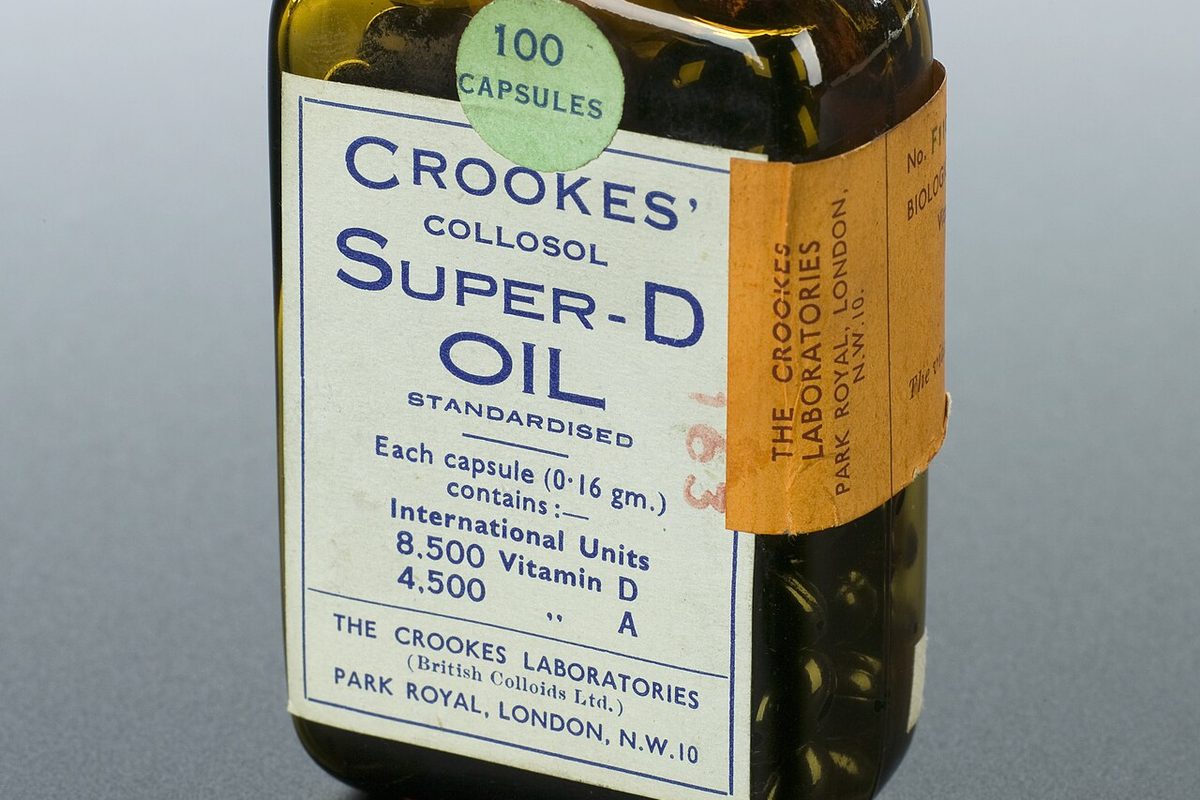
- The bottle in the photo was made in London during the Second World War, when meat, eggs and milk were rationed. Its label is marked 'War emergency packaging', according to the Wellcome Collection, and lists both vitamin D and vitamin A in each capsule.
- Comparative effectiveness of statins, metformin, and vitamin D, for prevention of preeclampsia: a systematic review and network meta-analysis of randomized trialsBMC Pregnancy and Childbirth, 2 October 2026 · The review
- Full text on PubMed Central (PMC13632318)US National Library of Medicine · Read in full: main text; supplementary tables and figures not read
- PubMed record (PMID 42827236)US National Library of Medicine · Abstract and dates
- Bottle of Super-D oil capsules, London, England, 1940-1945 (Wellcome L0057855)Wikimedia Commons · Image, CC BY 4.0
General information, not medical advice. Preeclampsia needs medical care: if you are pregnant and have a severe headache, changes in your vision, sudden swelling or pain under the ribs, contact your doctor or midwife straight away. Do not start, stop or change the dose of vitamin D, aspirin, a statin or metformin in pregnancy without talking to the doctor looking after you. High doses of vitamin D can be harmful.
Analysis by NutroPractic from the sources listed. Written for general readers; it does not replace advice from your own doctor.
From our articles
Our guides on this subject
Plain-language guides on nutrition and wellness, backed by research.
Micronutrients
Vitamin D and B12: two common gaps, from northern winters to vegetarian kitchens
Vitamin D runs low in Canadian and European winters, and surprisingly often in sunny India too. Vitamin B12 is a risk for vegetarians, people over 50 and people on certain medicines. Who is at risk, what the official advice is in North America, Europe and India, and where to get both.
3 Oct 2026
Global data
Diabetes, obesity, child malnutrition and hunger, 1980 to 2050: what the numbers show
How diabetes, obesity, child malnutrition and hunger have changed since 1980, with sourced figures and a basic projection to 2050. Click a condition to explore the chart and its facts.
5 Oct 2026
Indian kitchen
Rice, roti and blood sugar: building a balanced Indian plate with the ICMR-NIN 2024 guidelines
About one in nine Indian adults has diabetes and many more have prediabetes. You don't have to give up rice or roti. How the ICMR-NIN Dietary Guidelines for Indians (2024) suggest building a plate, plus simple habits that help keep blood sugar steady.
3 Oct 2026
Newsfeed for your website
Want this feed on your website?
Add it to any site with one copy-and-paste snippet. No sign-up, and it updates itself every hour.
Start with a virtual consultation
Tell Dr. Triveni what you want to change. You will leave with a clear next step, whether you are in Toronto, London, New York or Chennai.