Vitamin D · October 11, 2026
The health records of nearly half a million Israelis say people very low in vitamin D died sooner, and that buying the pills went with up to 28% fewer deaths. Two large trials that handed out the pills found no difference at all
A new study from Israel and the US went through the medical records of hundreds of thousands of adults and found that people with severely low vitamin D had more heart attacks, strokes, dementia and amputations, and died sooner. People who bought vitamin D from their health fund's pharmacy did better too. The authors say it points to a cheap way to age better. The way the supplement numbers behave, and two big trials that tested the pills directly, suggest the records may be telling us more about the people than about the vitamin.
Few questions in nutrition have been asked as often, or answered as unhelpfully, as this one: does vitamin D do anything for people beyond their bones? Studies that measure people's blood levels keep finding that those with the least vitamin D are sicker and die sooner. Trials that give people vitamin D or a dummy pill and wait mostly find nothing. The usual explanation is that low vitamin D is a sign of poor health, not a cause of it. People who are ill, overweight, housebound or rarely outdoors make less of it from sunlight.
The new study, published in Aging Cell on 8 October 2026, tries to get past that with sheer size and some careful modelling. Researchers at Tel Aviv University, Leumit Health Services and colleagues in Israel and the US used the electronic records of Leumit, one of Israel's four national health funds: more than 1.67 million vitamin D blood tests from over 468,500 adults between 2009 and 2020. They took 12,352 people whose level was severely low (below 10 ng/mL, or 25 nmol/L, after correcting for the season) and paired each with someone of the same age group, sex, smoking status, weight band, blood pressure, community and income level whose level was above 30 ng/mL (75 nmol/L). Then they followed both groups for up to ten years. They repeated the comparison in TriNetX, a US network of records from more than 70 healthcare organisations, with 223,175 matched pairs.
The results look dramatic. In the Israeli records, about 14% of the severely deficient group had died within eight years against about 8% of their matched partners, a risk 2.57 times higher after adjustment. The US records gave 1.59 times. Amputation of a foot or toe was 3.59 times as likely in Israel, and heart attack, stroke, dementia, diabetic eye disease and dialysis were all more common in both countries. The one outcome that went the other way was skin cancer, which was rarer in the deficient group, most likely because they spent less time in the sun.
The second half of the paper is the part the authors lean on. Because Leumit runs its own pharmacies, the team could see who bought vitamin D and how much, and estimate how much each purchase would lift that person's blood level. Over 247,848 members aged 30 and over, people whose purchases worked out to more than 10 ng/mL of extra vitamin D had a 28% lower risk of dying over time (hazard ratio 0.72), and the result held up in a second, more elaborate statistical method. Diabetes and heart attacks were less common too. From these models the authors estimate that treating only 10 or so people over 70 with very low levels for ten years would prevent one death, and they conclude that severe deficiency is a 'potentially modifiable determinant' of ageing.
This is where we would slow down. Even in the matched pairs, the deficient group was already far sicker on the day of their first test: four times as likely to have had a foot or toe amputated, nearly twice as likely to have dementia and 1.8 times as likely to have had a stroke. Matching on age, weight and smoking did not make the two groups alike in health, and the follow-up differences may partly be the same illness carrying on. The supplement figures have a pattern of their own. The smallest category of purchases, enough to raise blood levels by under 5 ng/mL, went with 19% fewer deaths, nearly as much as the largest. A nudge that small doing most of the work looks less like a vitamin effect and more like a portrait of the people who pick up a prescription and keep taking it. The paper uses skin cancer as a check: supplements didn't lower it, so, the authors argue, sun and healthy habits can't explain the rest. But the one skin result they report for supplement buyers is a modest rise in non-melanoma skin cancer, which is what you would expect from people who see doctors more often and have more moles looked at. The authors themselves list the main weakness: supplement use 'may also co-occur with other unmeasured health-promoting behaviors'.
Then there are the trials. VITAL gave 25,871 older Americans (men from 50, women from 55) 2,000 IU of vitamin D a day or a placebo for a median of 5.3 years: no fewer cancers, no fewer heart attacks or strokes, and deaths from any cause level (hazard ratio 0.99). The D-Health trial gave 21,315 Australians aged 60 and over a 60,000 IU capsule or a dummy every month for five years: 562 deaths in the vitamin D group, 538 with placebo. The authors' answer is fair as far as it goes. Those trials took everyone, and most of their participants weren't deficient (D-Health's placebo group averaged 77 nmol/L, about 31 ng/mL), so a benefit confined to the severely deficient could have been missed. That is a reason to run a trial in people who are severely low, not a reason to treat the records as if they were one. Our reading: if a blood test shows a severely low level, correcting it is already standard care, for bones if nothing else. This study does not show that vitamin D adds years for people whose levels are normal, and its numbers needed to treat come from a model, not from anyone who was randomly given the pills. The work was funded internally by Leumit Health Services, whose records it uses, and the authors declare no conflicts of interest.
Severe vitamin D deficiency, supplement purchases and later health in Israeli and US medical records
12,352 pairs
Israeli adults with severely low vitamin D (below 10 ng/mL) each matched with someone above 30 ng/mL; mean age 54, 67% women. The US check used 223,175 pairs
14% vs 8%
Deaths within eight years in the severely deficient group and their matched partners in the Israeli records (adjusted hazard ratio 2.57; US records 1.59)
4.01 times
Odds that the deficient group had already had a foot or toe amputated on the day of their first test, despite the matching (dementia 1.89, stroke 1.79)
19% vs 28%
Lower risk of death over time with the smallest and the largest supplement purchases (hazard ratios 0.81 and 0.72), in 247,848 members aged 30 and over
0.99
Hazard ratio for death from any cause in VITAL, a randomised trial of 2,000 IU a day in 25,871 Americans over 5.3 years. D-Health, 60,000 IU a month in 21,315 Australians: 1.04
20.4% vs 9.9%
Share of women and men in the Israeli records whose season-corrected level counted as severely deficient
Figures are from the full open-access paper (Aging Cell, published 8 October 2026): abstract, methods, results, tables 1 to 3, the figure legends, discussion, funding and conflict statements. The supplementary tables, including the skin cancer subtype results (Table S7) and the lag sensitivity analyses, were not read; the rise in non-melanoma skin cancer with supplements is as described in the main text, which calls it modest. Levels in the paper are in ng/mL (1 ng/mL = 2.5 nmol/L). Each level was corrected to its expected February low point using a seasonal model, so 'below 10 ng/mL' means below 10 at the winter trough. Israeli hazard ratios are adjusted for age, sex, smoking, income level, BMI, kidney function, albuminuria, diabetes, hypertension and systolic blood pressure, with events in the first six months excluded; US hazard ratios come from propensity-matched groups. The supplement categories are the modelled rise in blood level from pharmacy purchases (0.2 to 5, 5 to 10 and above 10 ng/mL) against none, in models that also included baseline level; the middle category's hazard ratio was 0.78. In the weighted 'marginal structural' model the three figures were 0.77, 0.74 and 0.65. The comparison of the smallest and largest categories and its interpretation are ours. The numbers needed to treat (about 10 for people over 70 starting below 5 ng/mL, 142 to 159 for everyone over 30 at that level) are model projections, not trial results. VITAL and D-Health figures are from the trials' published abstracts (New England Journal of Medicine 2019; Lancet Diabetes and Endocrinology 2022). The judgement that the study does not show benefit for people with normal levels is our own.
- Vitamin D levels in the Israeli records rose and fell with the seasons like a tide, lowest in mid-February and highest in late August. The same blood result means something different in winter and summer, which is why the researchers converted every test to its expected February value before sorting people into groups.
- More than half of the people in the US comparison were Black. Darker skin makes less vitamin D from the same sunlight, so severe deficiency in American records is concentrated among Black patients, and the matched comparison group followed suit.
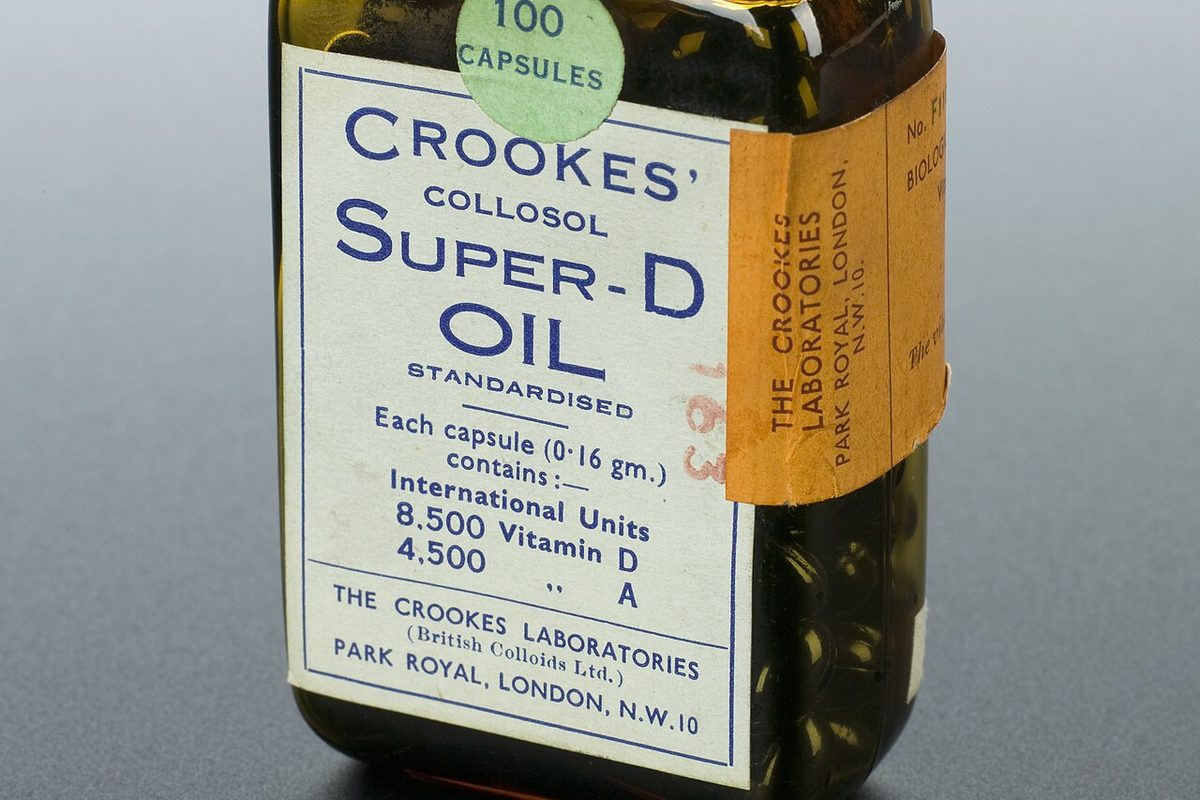
- The bottle in the picture, made in London during the Second World War, held capsules of 8,500 IU of vitamin D each, more than four times VITAL's daily dose. In Britain then, the vitamin's job was preventing rickets in children while meat, eggs and milk were rationed.
- The authors float an unusual idea for why low vitamin D might matter: that it weakens the immune system's hold on long-lasting hidden infections, and they name Toxoplasma gondii, a parasite many adults carry without knowing it, as one example. It is a hypothesis from their earlier work, not something this study tested.
- D-Health's per-protocol analysis, counting only people who kept taking their capsules, leaned slightly the wrong way for vitamin D (odds ratio 1.18, p = 0.06), and its authors suggested that monthly high doses might not suit people whose levels are already adequate.
- Vitamin D Deficiency, Supplementation, and Aging-Related Morbidity and Mortality Across Two Longitudinal Population CohortsAging Cell (Wiley), 8 October 2026 · The study (open access, CC BY); main text, tables, figure legends, funding and conflict statements read in full. Supplementary files not read
- Full text on PubMed Central (PMC13650182)PubMed Central · The full text used for the figures
- PubMed record and abstract (PMID 42850752)PubMed · Abstract and publication details
- Vitamin D Supplements and Prevention of Cancer and Cardiovascular Disease (the VITAL trial)New England Journal of Medicine, 2019 · Randomised trial of 2,000 IU a day in 25,871 US adults; figures from the abstract
- The D-Health Trial: a randomised controlled trial of the effect of vitamin D on mortalityThe Lancet Diabetes & Endocrinology, 2022 · Randomised trial of 60,000 IU a month in 21,315 older Australians; figures from the abstract
General information, not medical advice. This is an observational study of health records and cannot show that vitamin D supplements prevent disease or death. Very high doses of vitamin D can be harmful. If you think your vitamin D may be low, ask your doctor whether a blood test makes sense for you before starting or changing supplements.
Analysis by NutroPractic from the sources listed. Written for general readers; it does not replace advice from your own doctor.
From our articles
Our guides on this subject
Plain-language guides on nutrition and wellness, backed by research.
Micronutrients
Vitamin D and B12: two common gaps, from northern winters to vegetarian kitchens
Vitamin D runs low in Canadian and European winters, and surprisingly often in sunny India too. Vitamin B12 is a risk for vegetarians, people over 50 and people on certain medicines. Who is at risk, what the official advice is in North America, Europe and India, and where to get both.
3 Oct 2026
Global data
Diabetes, obesity, child malnutrition and hunger, 1980 to 2050: what the numbers show
How diabetes, obesity, child malnutrition and hunger have changed since 1980, with sourced figures and a basic projection to 2050. Click a condition to explore the chart and its facts.
5 Oct 2026
Indian kitchen
Rice, roti and blood sugar: building a balanced Indian plate with the ICMR-NIN 2024 guidelines
About one in nine Indian adults has diabetes and many more have prediabetes. You don't have to give up rice or roti. How the ICMR-NIN Dietary Guidelines for Indians (2024) suggest building a plate, plus simple habits that help keep blood sugar steady.
3 Oct 2026
Newsfeed for your website
Want this feed on your website?
Add it to any site with one copy-and-paste snippet. No sign-up, and it updates itself every hour.
Start with a virtual consultation
Tell Dr. Triveni what you want to change. You will leave with a clear next step, whether you are in Toronto, London, New York or Chennai.