Type 2 diabetes · October 12, 2026
Twenty-five adults with type 2 diabetes went low-fat vegan for 16 weeks with no calorie limit. Liver fat fell by a third and HbA1c by a full point. They also lost 6 kg, and nobody was there to compare them with
No meals were supplied and nobody counted calories, yet people ate about 350 kcal a day less. Liver fat, visceral fat, cholesterol and blood sugar all came down, and of the sixteen metformin users who finished, seven had cut the dose or stopped it. The muscle fat the study was sized to detect did not clearly move, and the paper itself says it cannot tell the diet from the weight loss.
Fat stored in the wrong places, inside the liver and inside muscle cells, is one of the better-supported explanations for why insulin stops working properly in type 2 diabetes. Strict low-calorie diets clear it out, and blood sugar improves when they do. The catch is that they mean counting, weighing and going hungry. A team from the Physicians Committee for Responsible Medicine in Washington, DC, working with Yale School of Medicine, asked whether a change in what people eat, with no limit on how much, would do something similar. Their paper came out in BMJ Open Diabetes Research & Care on 8 October 2026.
They phoned 1,244 people to find 25 who fitted and were willing: adults with type 2 diabetes managed by diet or by tablets other than sulfonylureas, an HbA1c between 6.5% and 10.5% and a BMI between 26 and 40. People on insulin or on weight-loss drugs such as the GLP-1 medicines were not taken. For 16 weeks the 25 were asked to eat a low-fat vegan diet of vegetables, grains, beans and fruit, with no animal products and no added fats, aiming for roughly 75% of energy from carbohydrate, 15% from protein and 10% from fat. No food was provided. They cooked at home or ate out, met weekly as a group, saw a dietitian, took a vitamin B12 tablet and were told to eat until full.
Twenty-four finished. Their weight was down by an average of 6.0 kg, 6.6% of where they started. Fat inside the liver, measured by magnetic resonance spectroscopy at Yale, was down by 33%. Visceral fat, the kind packed around the organs, fell by 290 cubic centimetres. HbA1c dropped by a full percentage point, LDL cholesterol by 22 mg/dL, and the fasting measure of insulin resistance fell. From blood samples taken over three hours after a standard liquid breakfast, the team also calculated that the insulin-producing cells of the pancreas were responding better to rising glucose.
The medication detail is the one that will make people sit up. Seventeen people were on metformin at the start. One dropped out. Of the other sixteen, nine stayed on the same dose, five had it reduced and two came off it. Nobody started or increased a glucose-lowering drug. So the one-point fall in HbA1c happened while the tablets were, on balance, going down. Those changes were made by the participants' own doctors, not by the study.
Now for what the study cannot say, and the authors say it first. There was no comparison group. Everyone got the diet, the weekly meetings and the dietitian, and everyone knew what they were eating. And although nobody was told to eat less, they did: their food diaries showed about 346 kcal a day less than before. A third less liver fat alongside a 6.6% weight loss is roughly what weight loss by any route tends to bring. The paper puts it plainly: the changes 'cannot be attributed specifically to dietary composition independent of the accompanying reduction in energy intake and weight loss'. Whether there is anything particular about vegan food here, beyond the fact that a plate of beans and rice is hard to overeat, is a question this design cannot answer.
Two more things are worth knowing. The number of participants was worked out from the expected fall in fat inside muscle cells. That fell by 13%, with a margin of error running from a 30% fall to a 3% rise, so it could be chance. The paper's discussion nonetheless speaks of 'comparable reductions' in liver and muscle fat. And of the 6 kg lost, about 2.4 kg was lean tissue, around 40% of the total, on a diet where protein intake went down and in a group asked not to change their exercise habits. The authors flag this themselves and suggest future trials add resistance training or pay attention to protein. For people in middle age and beyond, lost muscle is not a small footnote.
Who ran the study matters too. The Physicians Committee is a non-profit that campaigns for plant-based eating; it part-funded the work and paid five of the ten authors for it, and its president, a co-author, earns royalties from books on nutrition. US National Institutes of Health grants supported the Yale side, and the statistician was not told what the diet was. None of that makes the scans wrong. It does mean the natural next step, a randomised trial against another diet that produces the same weight loss, ought to be run by people with no stake in the answer. The 25 volunteers were also, in the authors' words, 'health conscious and willing to make substantial changes to their diet', picked from more than a thousand callers.
Our reading: this is a small, careful before-and-after study showing that people with type 2 diabetes who switch to a low-fat vegan diet and lose 6 kg see their liver fat and blood sugar improve, without being told to count anything. That is useful. For some people, a rule about what is on the plate is easier to live with than a rule about how much. It does not show that a vegan diet beats any other way of losing the same weight, and it ran for only 16 weeks. If you take diabetes medication, a big change in diet can bring your blood sugar down faster than you expect, so plan it with your doctor rather than adjusting tablets yourself. And a fully vegan diet needs a reliable source of vitamin B12, which is why the trial handed one out.
Single-arm trial: 25 adults with type 2 diabetes in Washington, DC, asked to follow a low-fat vegan diet with no calorie target for 16 weeks. Change from start to week 16, no comparison group
−33%
Fat inside the liver, by magnetic resonance spectroscopy (95% CI −48.7 to −17.3, p<0.001). A relative fall, not percentage points
−6.0 kg
Body weight, 6.6% of starting weight (95% CI −7.0 to −5.1 kg). Fat mass −4.2 kg, lean mass −2.4 kg by DXA scan
−1.0 point
HbA1c, in percentage points (95% CI −1.5 to −0.5, p<0.001), about 11 mmol/mol by our conversion
7 of 16
People who finished on less metformin than they started: five on a reduced dose, two off it. Nine unchanged. Nobody started or increased a glucose-lowering drug
−13%, p = 0.11
Fat inside muscle cells, the measure the sample size was calculated on (95% CI −29.6 to +3.4). Not statistically significant
−346 kcal
Self-reported energy intake a day, from 3-day food diaries (95% CI −641 to −50, p = 0.02), with no instruction to eat less
Figures are from the paper in BMJ Open Diabetes Research & Care (2026;14(5):e006472, published 8 October 2026), read on the journal's site: abstract, key messages, methods, results text, discussion, funding and competing-interest statements. The two tables (baseline demographics and the full list of changes) and the supplementary files did not load for us and were not read, so we give no ages, sex split or starting values. The study ran from January 2024 to November 2025. Flow: 1,244 screened by phone, 108 screened in person, 59 had baseline tests, 26 met the criteria, 25 started, 1 dropped out, 24 finished; a laboratory error lost the meal-test data for 3, leaving 21 for the insulin sensitivity and beta-cell results. The paper prints completion as '24/26 (92%)'; 24 of the 25 who started is 96%. Analysis was of completers only, with paired t-tests and no adjustment for the number of outcomes tested, which the authors state. Other results: visceral fat −290 cm3 (95% CI −467 to −114, p = 0.003); total cholesterol −32.3 mg/dL (−47.4 to −17.1); LDL cholesterol −22.0 mg/dL (−35.1 to −9.0, p = 0.002), about 0.57 mmol/L by our conversion; HOMA-IR −2.5 (−4.1 to −0.9, p = 0.004); PREDIM insulin sensitivity +1.3 mg/min/kg (+0.6 to +2.1, p = 0.002); OGIS +92.5 mL/min/m2 (+51.3 to +133.6); skin-fluorescence AGE score −0.4 (−0.6 to −0.2, p = 0.002). Fat outside muscle cells (−2.5%, p = 0.77) and under the skin of the leg (−2.4%, p = 0.71) did not change, nor did resting or after-meal energy expenditure. Reported physical activity fell by 346 MET-minutes a week (p = 0.004). The fat and lean mass losses add up to 6.6 kg against 6.0 kg on the scale; the paper describes the split as about 60% fat and 40% lean. The sample size calculation assumed a fall in muscle-cell fat of 0.26 percentage points (SD 0.3), needing 16 completers. 'Seven of sixteen' is our count from the paper's metformin figures. The remark that a similar fall in liver fat is what weight loss by other routes tends to bring is our reading, based on the calorie-restriction studies the paper itself cites (one reported an 81% fall in liver fat with about 8 kg lost on roughly 1,200 kcal a day). The description of the Physicians Committee as campaigning for plant-based eating is ours; the paper calls it a non-profit providing educational, research and medical services related to nutrition. Funding: the Physicians Committee for Responsible Medicine and US National Institutes of Health grants R01 DK135645 and P30 DK045735; the paper states the funders had no role in design, analysis, writing or the decision to publish. Trial registration NCT06106035.
- Liver fat in this study was not estimated from a blood test. Participants travelled to Yale's Magnetic Resonance Research Center, where a 4-tesla scanner read the fat signal from three separate spots in the liver, timed to the end of each breath out.
- The AGE score is read by shining ultraviolet light on the skin. Advanced glycation end products, formed when sugars stick to proteins, glow faintly in response, and the reader measures the glow.
- It took 1,244 phone calls to enrol 25 people, about 50 calls for each participant. Being on insulin, a sulfonylurea or a GLP-1 weight-loss drug ruled people out, as did claustrophobia, because of the scanner.
- The target of 10% of energy from fat is very low. Typical Western diets get about a third of their energy from fat, and most dietary guidelines allow 20% to 35%.
- To test the pancreas, the team gave everyone the same 720 kcal liquid breakfast and tracked C-peptide, a fragment released one-for-one with insulin. Unlike insulin, it is not removed by the liver on the way round, so it gives a truer count of how much insulin was made.
- Changes in ectopic lipids, insulin sensitivity, and beta cell function after a low-fat vegan diet in adults with type 2 diabetes: a 16-week single-arm clinical trialBMJ Open Diabetes Research & Care, 8 October 2026 · The study
- Full text on the journal's siteBMJ Group · Read: main text, funding and competing interests. Tables and supplements not read
- PubMed record (PMID 42850024)US National Library of Medicine · Abstract, authors and declarations
- Trial registration NCT06106035ClinicalTrials.gov · Registration cited in the paper; not read for this item
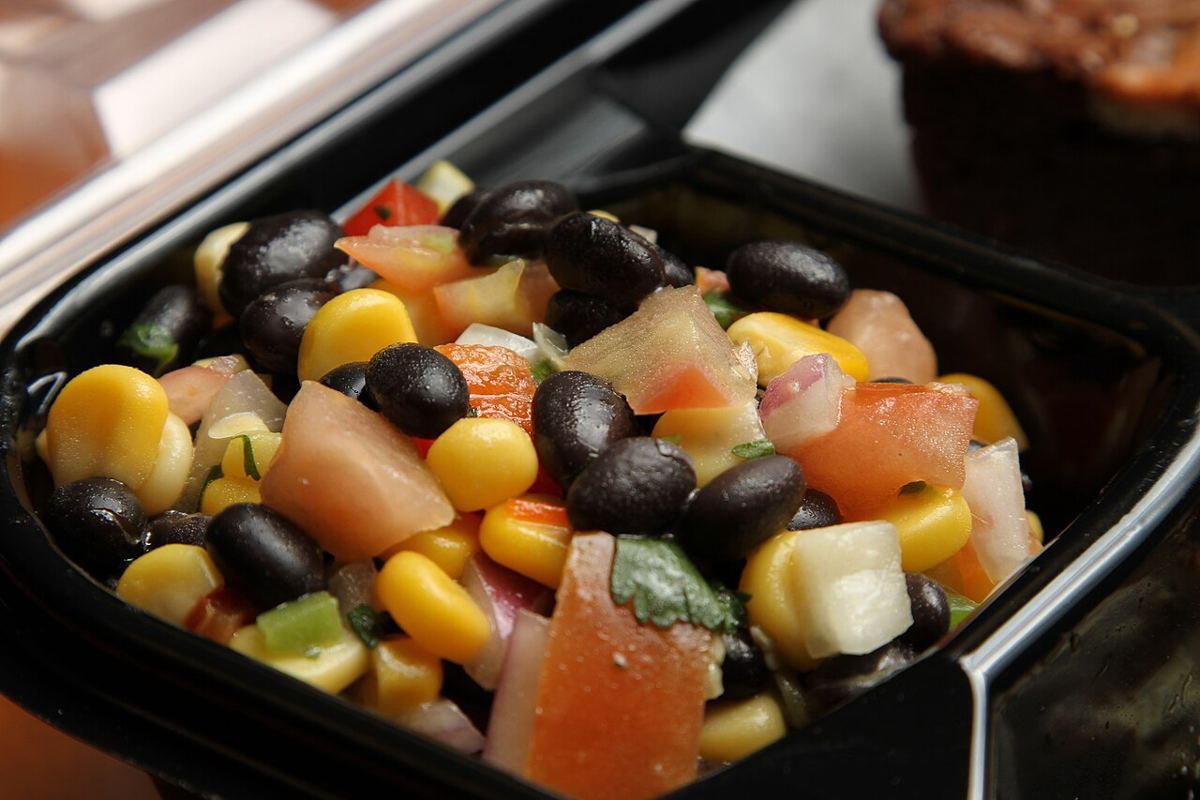
- Corn and black bean saladWikimedia Commons · Image, public domain, Daniel Sone, National Cancer Institute
General information, not medical advice. This was a small study with no comparison group, and its results do not show what will happen for any one person. If you have diabetes, do not change or stop your medication yourself; a large change in diet can lower blood sugar quickly, so talk to your doctor or a registered dietitian first. A vegan diet needs a reliable source of vitamin B12.
Analysis by NutroPractic from the sources listed. Written for general readers; it does not replace advice from your own doctor.
From our articles
Our guides on this subject
Plain-language guides on nutrition and wellness, backed by research.

Global data
Diabetes, obesity, child malnutrition and hunger, 1980 to 2050: what the numbers show
How diabetes, obesity, child malnutrition and hunger have changed since 1980, with sourced figures and a basic projection to 2050. Click a condition to explore the chart and its facts.
5 Oct 2026

Indian kitchen
Rice, roti and blood sugar: building a balanced Indian plate with the ICMR-NIN 2024 guidelines
About one in nine Indian adults has diabetes and many more have prediabetes. You don't have to give up rice or roti. How the ICMR-NIN Dietary Guidelines for Indians (2024) suggest building a plate, plus simple habits that help keep blood sugar steady.
3 Oct 2026

Micronutrients
Vitamin D and B12: two common gaps, from northern winters to vegetarian kitchens
Vitamin D runs low in Canadian and European winters, and surprisingly often in sunny India too. Vitamin B12 is a risk for vegetarians, people over 50 and people on certain medicines. Who is at risk, what the official advice is in North America, Europe and India, and where to get both.
3 Oct 2026
Newsfeed for your website
Want this feed on your website?
Add it to any site with one copy-and-paste snippet. No sign-up, and it updates itself every hour.
Start with a virtual consultation
Tell Dr. Triveni what you want to change. You will leave with a clear next step, whether you are in Toronto, London, New York or Chennai.