Sports nutrition · October 13, 2026
Basketball players swallowed about 38 g of baking soda a day for four weeks and jumped higher than those on the usual dose. Nobody tested their blood, and not one reported a stomach ache
A Chinese trial put 40 club players through a month of sprint training with capsules of sodium bicarbonate or a dummy. The bigger dose won on all seven fitness tests. But there were ten men to a group, the side effects were checked by asking around at training, and the paper never mentions how much sodium that dose carries.
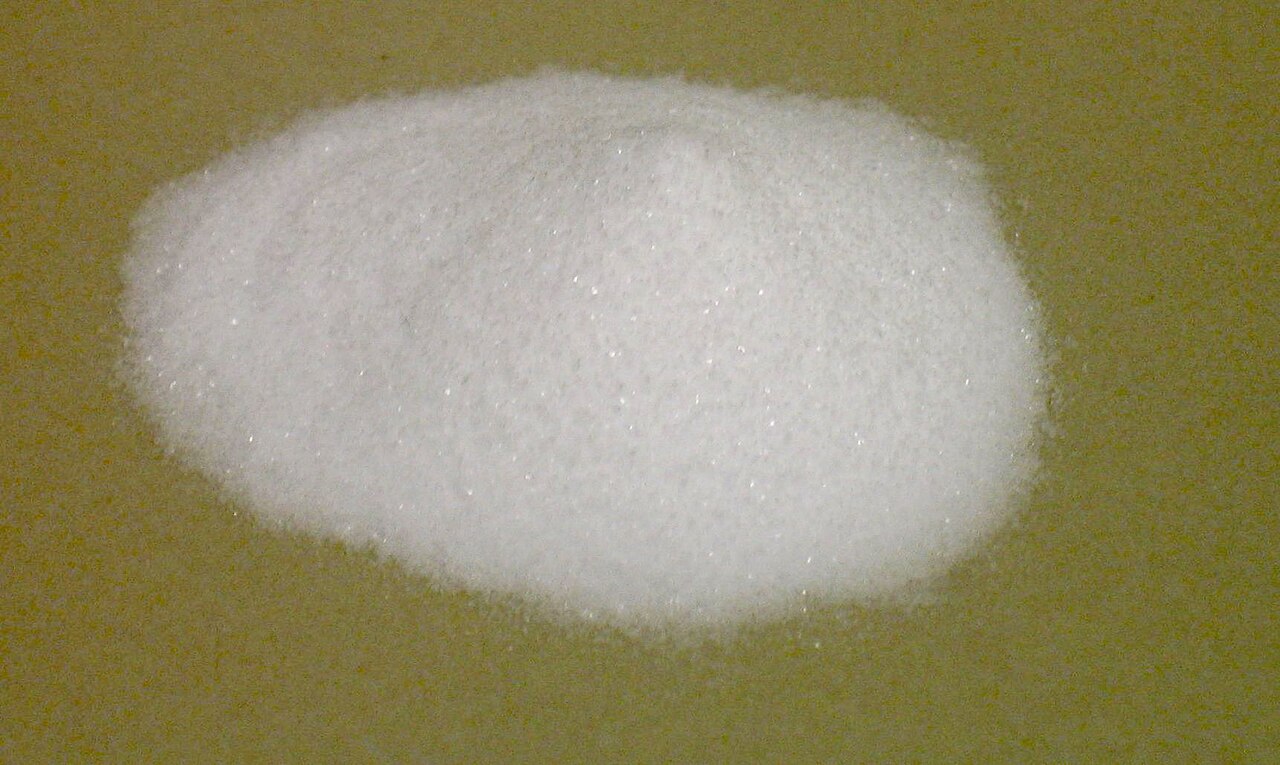
Sodium bicarbonate, the baking soda in the kitchen cupboard, is one of the oldest legal performance aids in sport. Hard sprinting floods muscle with acid, bicarbonate in the blood mops some of it up, and athletes who load up beforehand can often hold a flat-out effort a little longer. The usual dose is 0.3 g for every kilo of body weight. A trial published on 9 October 2026 in the Journal of the International Society of Sports Nutrition asked what happens if players take half as much again, every day, through a month of training.
Two researchers at universities in Huzhou and Ningbo recruited 40 male club basketball players, average age about 22, and split them at random into four groups of ten. Three groups added sprint sessions to their normal practice three times a week: four sets of ten all-out five-second sprints. One of those groups took 0.3 g per kilo of bicarbonate a day, one took 0.45 g per kilo, and one took maltodextrin as a placebo. The fourth group just carried on with basketball.
The daily amount was split into five servings, at 8 am, noon, 4 pm, 8 pm and midnight, in opaque capsules. For a player of average weight in the high-dose group, 0.45 g per kilo works out at about 38 g a day, or roughly 7.6 g each time. The paper says players took 'about five' of the largest standard capsules per serving.
After four weeks, everyone who sprinted had improved and the basketball-only group had not. Among the sprinters the order was the same on every test: high dose first, standard dose second, placebo third. Vertical jump rose by 2.5 cm on the high dose, 1.7 cm on the standard dose and 1.1 cm on placebo. On the Yo-Yo shuttle test, the three groups ran 170, 122 and 76 metres further than before. The 20-metre sprint got faster by 0.17, 0.12 and 0.08 of a second.
The final tests were run 72 hours after the last capsule, so the bicarbonate itself should have left the blood. The claim, then, is that the players had trained themselves into better shape, perhaps because the buffer let them push harder in each session. That fits a line in the sports nutrition society's own 2021 position paper, which says long-term use before training 'may enhance training adaptations'.
Here is what the trial did not do. Nobody took blood. There are no readings of bicarbonate, acidity or lactate, so there is no evidence the capsules changed anything in the players' bodies, let alone that the bigger dose changed more. Nor is there any record of how hard each man actually sprinted in training. The authors say all this themselves and call their result 'suggestive of a possible additive effect rather than definitive evidence'.
Then there is the stomach. Bicarbonate is known for bloating, nausea and worse, and the 2021 position paper says doses of 0.4 or 0.5 g per kilo bring more of it than 0.3. In this trial, 20 men took 25 to 38 g a day and not one complaint was recorded. The way complaints were collected was to ask at training sessions. The authors admit no proper symptom questionnaire was used and that mild trouble may have gone unreported. Splitting the dose five ways may well have helped. It is still a surprising zero.
One thing the paper leaves out entirely is the sodium. A little over a quarter of sodium bicarbonate by weight is sodium, so 38 g of it carries about 10 g. The World Health Organization advises adults to stay under 2 g of sodium a day from all food. Four weeks at five times that, on top of normal meals, in young fit men, may do no harm. The trial did not measure blood pressure or anything else that would tell us, and the words do not appear in the paper.
So this is a small, short study with a tidy result and thin checks, in young male players only. Its own conclusion suggests coaches could use the higher dose in a four-week pre-season. That is further than ten men per group can carry. For anyone with high blood pressure, kidney or heart trouble, or a doctor's instruction to watch their salt, large doses of baking soda are not a training experiment to try at home.
Randomised, double-blind, placebo-controlled trial in China: 40 trained male basketball players (mean age 21.6, mean weight 84.1 kg) in four groups of ten for four weeks: sprint interval training with 0.3 g/kg or 0.45 g/kg of sodium bicarbonate a day, sprint training with placebo, or basketball training only
40
Players, ten per group; all 40 finished and no one dropped out
≈25 g and ≈38 g
Sodium bicarbonate a day for a player of average weight on 0.3 and 0.45 g per kilo, split into five servings (our arithmetic)
+2.5, +1.7, +1.1 cm
Gain in vertical jump on the high dose, the standard dose and placebo (basketball only: +0.2 cm)
+170, +122, +76 m
Extra distance on the Yo-Yo shuttle test: high dose, standard dose, placebo (basketball only: +20 m)
0
Stomach complaints recorded among the 20 men on bicarbonate, by asking at training rather than by questionnaire
≈10 g vs under 2 g
Sodium in the high daily dose (our arithmetic) and the WHO's advised daily limit for adults
Figures are from the full open-access paper in the Journal of the International Society of Sports Nutrition (doi 10.1080/15502783.2026.2735090, published online 9 October 2026), read in the PubMed Central copy. Gains are our subtraction of the paper's before and after group averages in its Tables 2 and 3 (for example vertical jump 41.9 to 44.4 cm on the high dose; Yo-Yo distance 1,466 to 1,636 m). The paper reports the same comparisons as percentages: jump up 5.9% on the high dose against 4.1% on the standard dose, Yo-Yo distance up 11.7% against 8.3%, with about 5% on placebo. Daily grams are the dose multiplied by each group's average weight (84.1 kg and 84.6 kg); sodium is 27.4% of sodium bicarbonate by weight, which gives about 6.9 g and 10.4 g. The paper does not give these gram figures or discuss sodium. It is not clear from the methods whether capsules were taken every day or only on training days; we have assumed every day. The abstract gives the rest between sprint sets as two minutes and the methods as three. Asked to guess what they had been given, 6 of 10, 7 of 10 and 6 of 10 players guessed right, which the authors read as blinding holding up. The paper mentions no trial registration. Funding was a Huzhou city philosophy and social sciences grant for a project on sport, culture and tourism.
- The sports nutrition society's 2021 position paper says the benefit of sodium bicarbonate is mostly established for all-out efforts lasting between 30 seconds and 12 minutes.
- The same paper says part of the effect 'seems to be placebo-driven': athletes who believe they have taken it tend to do a little better.
- For a single dose before an event, that paper puts the best amount at 0.3 g per kilo and says 0.4 or 0.5 g adds side effects without adding benefit.
- One gram of table salt contains about 400 mg of sodium, according to the WHO. Its advised limit of 2 g of sodium a day equals just under a teaspoon of salt.
- In the Yo-Yo test used here, players run 20-metre shuttles to a beep that keeps speeding up, with ten seconds of rest between each. It ends when they miss the line twice in a row.
- Dose-dependent effects of sodium bicarbonate supplementation combined with sprint interval training on performance adaptations in basketball players: a randomized placebo-controlled trialJournal of the International Society of Sports Nutrition, 9 October 2026 (open access) · The new paper, read in full: methods, tables, limitations and funding
- PubMed record 42853711US National Library of Medicine · Abstract and publication details
- International Society of Sports Nutrition position stand: sodium bicarbonate and exercise performanceJournal of the International Society of Sports Nutrition, 2021 (open access) · Usual doses, side effects and the placebo point; we read the published summary of its conclusions
- Sodium reductionWorld Health Organization fact sheet · Adults: less than 2,000 mg of sodium a day; 1 g of salt is 400 mg of sodium
- Sodium bicarbonateWikimedia Commons · Image, public domain, by Thavox
General information, not medical advice. This was a small, four-week trial in young male athletes and it did not measure safety. Sodium bicarbonate in these amounts carries a large load of sodium and can upset the stomach. Do not take it as a supplement without talking to a doctor or sports dietitian first, especially if you have high blood pressure, heart or kidney disease, or have been told to limit salt.
Analysis by NutroPractic from the sources listed. Written for general readers; it does not replace advice from your own doctor.
From our articles
Read, then eat a little better
Plain-language guides on nutrition and wellness, backed by research.

Global data
Diabetes, obesity, child malnutrition and hunger, 1980 to 2050: what the numbers show
How diabetes, obesity, child malnutrition and hunger have changed since 1980, with sourced figures and a basic projection to 2050. Click a condition to explore the chart and its facts.
5 Oct 2026

Indian kitchen
Rice, roti and blood sugar: building a balanced Indian plate with the ICMR-NIN 2024 guidelines
About one in nine Indian adults has diabetes and many more have prediabetes. You don't have to give up rice or roti. How the ICMR-NIN Dietary Guidelines for Indians (2024) suggest building a plate, plus simple habits that help keep blood sugar steady.
3 Oct 2026

Micronutrients
Vitamin D and B12: two common gaps, from northern winters to vegetarian kitchens
Vitamin D runs low in Canadian and European winters, and surprisingly often in sunny India too. Vitamin B12 is a risk for vegetarians, people over 50 and people on certain medicines. Who is at risk, what the official advice is in North America, Europe and India, and where to get both.
3 Oct 2026
Newsfeed for your website
Want this feed on your website?
Add it to any site with one copy-and-paste snippet. No sign-up, and it updates itself every hour.
Start with a virtual consultation
Tell Dr. Triveni what you want to change. You will leave with a clear next step, whether you are in Toronto, London, New York or Chennai.