Taste and smell · October 13, 2026
Blue bowls, a sad Chopin waltz and clover-shaped snacks: none of them changed how food tasted to people who had lost their sense of smell. What they reach for at home is chilli, cumin and crunch
For people with a working nose, the colour of a bowl or the music in the room can shift how sweet or salty a snack seems. Psychologists in Portsmouth tried those tricks on people living with smell loss, who often say food has stopped being a pleasure. Not one of them made a measurable difference. The more useful part of the study is the short list of things these people had already worked out for themselves.
Most of what we call the taste of food is smell. The tongue handles sweet, salty, sour and bitter; nearly everything else, the difference between a strawberry and a raspberry, arrives through the nose from the back of the mouth. People who lose their sense of smell often describe the same thing: food turns into texture and temperature, and eating becomes a chore. Some lose weight because they stop caring about meals. Others gain it, possibly by eating more in search of the pleasure that has gone missing.
Meanwhile, a separate line of research has spent twenty years showing that flavour can be nudged from outside the mouth. In a well-known Oxford experiment, potato crisps were judged crisper and fresher when the sound of the bite was played back louder through headphones. In another, popcorn was rated differently for sweetness and saltiness depending on the colour of the bowl it was eaten from. So a team led by Lorenzo Stafford at the University of Portsmouth, with co-authors from the charity SmellTaste and the University of East Anglia, asked an obvious question that nobody seems to have tested: could those tricks give something back to people who cannot smell? Their paper was published in PLOS One on 1 October 2026.
They recruited 33 adults who said they were living with smell loss, most of them reached through the university's website or the charity. The average age was about 64. Six traced the loss to COVID-19 and three to a head injury; eighteen did not know the cause, and three had been born without a sense of smell. A standard sniff test with a diluted alcohol called n-butanol confirmed the problem: the group's average score was 4.2 on a scale where students given the same test had averaged 10.
Each person then ate nine small portions. Oat biscuits came in a green, a blue and a yellow bowl. Cheese-flavoured savoury snacks came as circles, triangles and clover shapes, eaten blindfolded so the only clue was the feel of the shape. Tinned pineapple chunks were eaten, also blindfolded, during 45 seconds of headphone music chosen to be neutral (Holst's 'Neptune'), sad (a Chopin waltz nicknamed 'Farewell') or frightening (Liszt's first Mephisto Waltz). After each portion they marked on 100 mm lines how pleasant, sweet, salty, sour, bitter and intensely flavoured it was.
Nothing moved. The biscuits scored 59, 61 and 58 out of 100 for pleasantness in the green, blue and yellow bowls. The snack shapes scored 50, 51 and 46. The pineapple scored 62 with neutral music, 53 with the sad waltz and 59 with the Liszt, and although that nine-point dip looks like something, the scatter between people was far wider than the gap and it did not reach statistical significance. Nor did any difference in sweetness, saltiness or the other ratings once the analysis was corrected for the number of tests run. How much smell a person had left made no clear difference either.
The authors are candid about why this may say more about the experiment than about the idea. Only one food was used for each trick. There was no plain white bowl to compare the colours against. The two contrasting pieces of music were both gloomy, and they now think a cheerful one would have been the better test. Hearing was not checked, in a group whose average age was in the sixties, and taste on the tongue was not tested at all. Twenty-nine people were left in the analysis once the three born without smell and one outlier were set aside, which is few for the number of comparisons made. They call the study preliminary in its title, and it is.
The part worth keeping is a questionnaire the same people filled in about what they do at home. Twenty of the 33 said they add extra herbs and spices, naming cumin, paprika, chilli flakes and chilli most often. Eighteen said they lean on texture: crunchy things, fruit, salads. Far fewer used the tricks the lab had tested: seven put music on while eating and six paid attention to how the plate looked, with 'avoids beige dinners' among the examples recorded. Some also reported a preference for very salty or very sweet food, which is worth knowing about for other reasons. And two wrote that they eat because they need to, not because they want to.
Chilli makes sense. Its burn is not a smell or a taste but a signal carried by a different nerve, the trigeminal. A 2023 study at the Monell Chemical Senses Center in Philadelphia, also of 33 people with smell loss, found that adding capsaicin, the hot compound in chilli, to tomato soup made it seem both more flavourful and saltier. That hints at a way to keep food interesting without reaching for the salt shaker, though the effect on how much people liked the food varied from one food to another. For now the evidence for heat and crunch is mostly what people report doing, not what trials have proved. A sudden or unexplained loss of smell is a reason to see a doctor, not just to restock the spice rack.
A taste test in 33 UK adults living with smell loss: same food, different bowl colour, shape or background music, and what they do at home to enjoy eating
33
Adults with self-reported smell loss who took part; average age about 64
59, 61, 58
Pleasantness out of 100 for the same biscuit from a green, blue and yellow bowl: no real difference
62, 53, 59
Pleasantness of pineapple eaten to neutral, sad and frightening music: not a statistically significant difference
20 of 33
Said they add extra herbs and spices to enjoy food; cumin, paprika and chilli were named most
18 of 33
Said they use texture, such as crunchy foods, fruit and salads
7 and 6
Said they play music while eating, or pay attention to how the food looks
Figures are from the open-access paper in PLOS One (doi 10.1371/journal.pone.0358651, published 1 October 2026, CC BY), read in full on PubMed Central: methods, results, Tables 1 to 3, discussion, limitations and funding. Within-subjects design; 33 recruited between 1 July and 18 August 2023 through the University of Portsmouth website and the charity SmellTaste (formerly Fifth Sense), 19 women and 14 men, mean age 63.5 (range 19 to 85), paid 15 pounds. Smell loss was self-identified; an n-butanol threshold test (16 dilution steps) gave a mean score of 4.2 (SD 3.9), against 10.0 in an undergraduate sample on the same test. Food ratings were analysed in 29 people after excluding three with congenital smell loss and one multivariate outlier (28 for some ratings because of missing data). Mean pleasantness on a 100 mm visual analogue scale: biscuits in green, blue and yellow bowls 59.3, 61.4 and 57.9; savoury snacks as circle, triangle and clover 50.1, 51.3 and 45.6; pineapple with neutral, sad and fear music 62.2, 53.2 and 58.7 (standard deviations 17 to 25). Repeated-measures ANCOVA with smell threshold as covariate and Holm correction: no significant effect of colour, shape or music on pleasantness (Holm-adjusted P 0.95 to 1.00) or on any sensory rating; analyses without the correction are in the paper's supplement, which we did not read. We rounded the means to whole numbers. Home strategies are counts from a questionnaire the researchers wrote for this study, which has not been validated: extra herbs or spices 20, different textures 18, other practices 17 (including a preference for very salty or very sweet foods), music 7, visual presentation 6, watching programmes or films 5. Weight since smell loss: no change 23, gained 5, lost 3, unclear 2. Funded by a British Psychological Society undergraduate research assistantship; the authors declare no competing interests; one co-author is from SmellTaste. Background figures are from abstracts: Zampini and Spence 2004 (crisps), Harrar and colleagues 2011 (popcorn bowls), Hunter and colleagues 2023 (capsaicin in soup; liking differed by food type), Aschenbrenner and colleagues 2008 and Mullol and colleagues 2012.
- In the 2004 Oxford crisp experiment, people bit into potato crisps while the sound of the bite was altered. Turning up the volume, or boosting only the high-pitched part of the sound, made the crisps seem crisper and fresher.
- In a German smell and taste clinic study of 176 patients, 39% said they used more spices since their smell problems began, 29% said they ate less and 47% said they went to restaurants less often.
- When a newspaper in Catalonia sent four scratch-and-sniff odours to its readers in 2003 and more than 9,000 replies were analysed, about one in five could not detect all four, but only 0.3% could detect none of them.
- The Monell study that tested chilli in soup also measured salt intake from 24-hour urine collections. People with smell loss took in about 2,900 mg of sodium a day: above the recommended limit of 2,300 mg, but no more than the general population.
- In the Portsmouth study, the three people born without a sense of smell reported the least disruption to their daily lives. Those who had lost a sense they once had scored worse on the same questionnaire.
- Crossmodal influences on food perception in those with smell and taste disorders: A preliminary studyPLOS One, 1 October 2026 · The study. Open access, read in full
- Full text on PubMed Central (PMC13630209)US National Library of Medicine · Version read for this item, including Tables 1 to 3 and the limitations
- More spice, less salt: How capsaicin affects liking for and perceived saltiness of foods in people with smell lossAppetite, 2023 · Capsaicin in tomato soup, 33 people with smell loss, and their sodium intake; abstract read
- The role of auditory cues in modulating the perceived crispness and staleness of potato chipsJournal of Sensory Studies, 2004 · The crisp-sound experiment; abstract read
- There's more to taste in a coloured bowlPerception, 2011 · Popcorn rated for sweetness and saltiness from four bowl colours; abstract read
- The influence of olfactory loss on dietary behaviorsThe Laryngoscope, 2008 · Diet changes in 176 patients tested at a smell and taste clinic in Dresden; abstract read
- Furthering the understanding of olfaction, prevalence of loss of smell and risk factors: a population-based survey (OLFACAT study)BMJ Open, 2012 · Newspaper smell survey in Catalonia, 9,348 replies analysed; abstract read
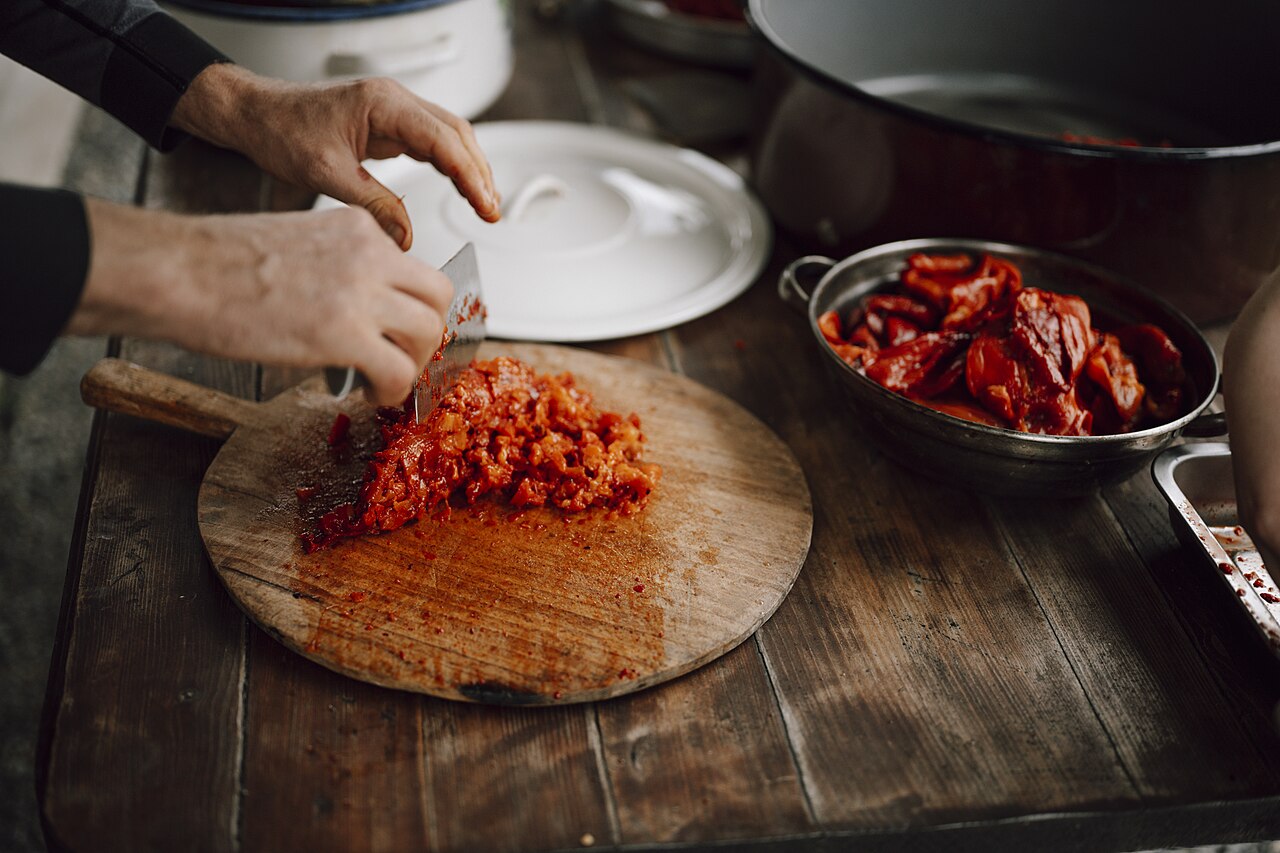
- Chopping vegetables and preparing spices for a traditional mealWikimedia Commons · Image, CC BY 2.0, photo by Shixart1985
General information, not medical advice. This was a small, preliminary study and its findings about spices and texture come from what people said they do, not from a trial. If you lose your sense of smell or taste, especially suddenly or without a cold, see a doctor. Go easy on added salt and sugar if you are using them to make up for lost flavour, and take care with gas and spoiled food, which you may not be able to smell.
Analysis by NutroPractic from the sources listed. Written for general readers; it does not replace advice from your own doctor.
From our articles
Read, then eat a little better
Plain-language guides on nutrition and wellness, backed by research.

Global data
Diabetes, obesity, child malnutrition and hunger, 1980 to 2050: what the numbers show
How diabetes, obesity, child malnutrition and hunger have changed since 1980, with sourced figures and a basic projection to 2050. Click a condition to explore the chart and its facts.
5 Oct 2026

Indian kitchen
Rice, roti and blood sugar: building a balanced Indian plate with the ICMR-NIN 2024 guidelines
About one in nine Indian adults has diabetes and many more have prediabetes. You don't have to give up rice or roti. How the ICMR-NIN Dietary Guidelines for Indians (2024) suggest building a plate, plus simple habits that help keep blood sugar steady.
3 Oct 2026

Micronutrients
Vitamin D and B12: two common gaps, from northern winters to vegetarian kitchens
Vitamin D runs low in Canadian and European winters, and surprisingly often in sunny India too. Vitamin B12 is a risk for vegetarians, people over 50 and people on certain medicines. Who is at risk, what the official advice is in North America, Europe and India, and where to get both.
3 Oct 2026
Newsfeed for your website
Want this feed on your website?
Add it to any site with one copy-and-paste snippet. No sign-up, and it updates itself every hour.
Start with a virtual consultation
Tell Dr. Triveni what you want to change. You will leave with a clear next step, whether you are in Toronto, London, New York or Chennai.