Shift work · October 13, 2026
Do night-shift nurses snack more than day nurses, or less? A new paper on 408 Italian nurses says both, and the reason turns out to be a division sum
The summary of a new nursing study says half of night-shift nurses snack between meals against fewer than a quarter of day nurses. The table inside the same paper says 68% against 83%, the other way round. Both sets of numbers come from the same 408 answers. Working out how is a small lesson in why the headline figure of a study is worth checking against its own tables.
Ask most people who snacks more, the nurse on days or the nurse on nights, and they will say nights. Long hours, a closed canteen, a vending machine down the corridor. A good deal of earlier research says the same. So a paper published online on 30 September 2026 in the journal Nursing Open, comparing the two groups among Italian nurses, looked at first like one more confirmation. Its summary reports 'a higher frequency of snacking' among nurses who work nights: 49.8%, against 22.3% of those who work days only.
Then you read on. Two sentences later, still in the summary, the paper says that nurses working daytime shifts reported higher snack consumption than their night-shift colleagues. The results section agrees with that second version and gives quite different numbers: 83% of day nurses said they ate between main meals, against 68% of nurses who also worked nights. The conclusion repeats it. One paragraph of the discussion, though, goes back to explaining 'higher snacking frequency among night shift nurses' with appetite hormones and disturbed body clocks.
So which is it? The paper's own table settles it, and shows where the confusion came from.
The study is a survey. In May 2022 a questionnaire was shared on Facebook and Instagram pages for Italian nurses, and 408 filled it in. Of those, 109 worked only mornings and afternoons, and 299 also worked nights, defined as 8 pm to 8 am. One question asked whether they ate snacks between their main meals, yes or no. In the day group 91 said yes. In the night group 203 said yes.
Ninety-one out of 109 is 83%. Two hundred and three out of 299 is 68%. Those are the figures in the table, and they are the right way to compare two groups of different sizes: each group against itself.
Now divide the same two counts by everybody who answered. Ninety-one out of 408 is 22.3%. Two hundred and three out of 408 is 49.8%. Those are the figures in the summary, to the decimal. They are not snacking rates at all. They mostly record that there were nearly three times as many night-shift nurses in the survey as day nurses, so there were more of them saying yes to almost anything.
The same slip appears in the figures on work experience. The summary says 8.1% of day nurses and 25.7% of night nurses had been in the job five years or less. The table has 33 and 105 nurses in those boxes, which is 30% and 35% of their own groups, a far smaller gap. Thirty-three and 105 out of 408 give exactly 8.1% and 25.7%.
Taking the table as the record, here is what the survey found. Day-only nurses were more likely to say they snack between meals (83% against 68%), and that difference was statistically clear. The number of meals a day did not differ between the groups. Regular mealtimes were a little more common among day nurses, 62% against 52%, which fell just short of the usual statistical threshold. Body weight did not differ clearly either, although 13% of the night group had a body mass index in the obese range against 6% of the day group. Scores on a questionnaire about how flexible people are around food, exercise and body shape were about the same.
Even the corrected finding is thin. 'Do you eat between main meals, yes or no' says nothing about what was eaten, how much, or when. An apple at 4 pm and a packet of biscuits at 4 am both count as a yes, and a night-shift nurse whose whole eating day is upside down may not think of anything as 'between meals'. The nurses chose to answer a social-media post, so they are not a cross-section of Italian nursing. Height and weight were self-reported. The paper reports no results adjusted for age or years in the job, and the night group included both fixed and rotating schedules, which the authors themselves list as a weakness. They call the work a preliminary contribution, and it is.
None of this is a scandal. The table is there in the open-access paper for anyone to check, and the conclusion follows it. But a reader who stops at the summary, as most readers and most search tools do, comes away with a result that points the wrong way and looks twice as big. The practical lesson is cheap and it applies well beyond nursing journals: when a study compares two groups, find the table, find the count and the group size, and do the division yourself.
Online cross-sectional survey of 408 Italian nurses recruited through Facebook and Instagram in May 2022, comparing 109 who worked day shifts only with 299 who also worked nights
408
Nurses who answered: 109 (26.7%) on day shifts only and 299 (73.3%) who also worked nights. Three in four were women and 36% were aged 30 or under
83% vs 68%
Said they eat between main meals, day-only nurses against night-shift nurses, from the paper's table (91 of 109 and 203 of 299; p = 0.002)
22.3% vs 49.8%
The snacking figures in the paper's summary, day against night. They match the same counts divided by all 408 nurses: 91 of 408 and 203 of 408
62% vs 52%
Said they eat their meals at regular times, day against night (68 of 109 and 155 of 299; p = 0.059, not statistically significant)
6% vs 13%
Had a body mass index of 30 or more, day against night (7 of 109 and 40 of 299). Across all four weight bands the groups did not differ significantly (p = 0.125)
139 vs 142
Average total score on the 36-item eating flexibility questionnaire, day against night (p = 0.167). None of its three sub-scores differed either
Figures are from the full open-access paper (doi 10.1002/nop2.70884, published online 30 September 2026), read in full through PubMed Central. Percentages given here for each group were recalculated from the counts in the paper's Tables 1 and 2, because some percentages printed in the tables do not match their own counts (for example, 18 of 109 day nurses who did not snack is printed as 7%, and 84 of 109 women as 92%). The observation that the summary's figures equal the counts divided by the whole sample of 408 is our own arithmetic, not something the paper states. The paper also gives two different p values for meals per day (0.122 in the results, 0.286 in the discussion) and for meal regularity (0.059 and 0.072); the results-section values are used here. Its conclusion mentions physical activity, which is not among the questions listed in the methods. Weight and height were self-reported. Snacking was a single yes or no question with no detail on food, amount or timing. The eating flexibility questionnaire was translated into Italian by the authors and checked for clarity with 30 nurses. The data are a second analysis of a survey first reported in 2022. Funding came from Taiwan's National Science and Technology Council and China Medical University. The authors declare no conflicts of interest.
- The paper opens by noting that nurses are the largest professional group in the health workforce worldwide, citing the World Health Organization.
- The corrected result runs against some earlier work. The authors point to a study of nurses in Lebanon that linked night shifts to irregular mealtimes and more high-fat, sugary snacks during the shift.
- A 2019 review the authors cite found that night-shift nurses often skip breakfast and lunch and snack more during the night. A yes or no question about eating 'between main meals' may miss exactly that pattern.
- In this survey a night shift meant working between 8 pm and 8 am. Nearly three-quarters of the nurses who answered did so at least some of the time.
- When two groups differ in size, a count divided by the whole sample will nearly always make the bigger group look as if it does more of everything. Dividing each count by its own group removes that effect.
- How Shift Work Impacts on Eating Behaviours Among Nurses: A Cross-Sectional StudyNursing Open, 13(10), e70884, published online 30 September 2026 (open access) · The new paper: who answered, the questions asked, the summary, tables 1 to 3, limitations, funding
- Full text in PubMed Central (PMC13627888)US National Library of Medicine · Free full text, read in full for this item, including the tables the percentages were recalculated from
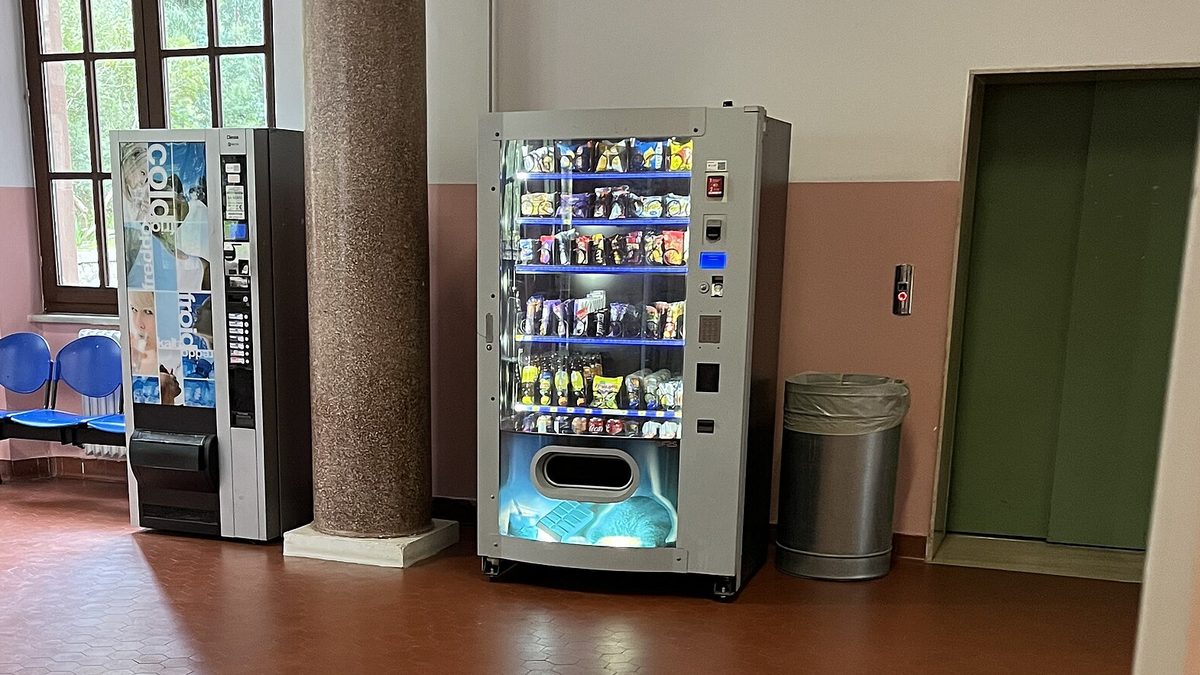
- Distributori automatici padiglione B Ospedale ZonchelloWikimedia Commons · Image, CC0, by Air fans
General information, not medical advice. This was a one-off online survey with a single yes or no question about snacking; it cannot show that any shift pattern causes a change in eating or weight. If shift work is making it hard to eat well or you are worried about your weight or health, talk to your doctor or a registered dietitian.
Analysis by NutroPractic from the sources listed. Written for general readers; it does not replace advice from your own doctor.
From our articles
Read, then eat a little better
Plain-language guides on nutrition and wellness, backed by research.

Global data
Diabetes, obesity, child malnutrition and hunger, 1980 to 2050: what the numbers show
How diabetes, obesity, child malnutrition and hunger have changed since 1980, with sourced figures and a basic projection to 2050. Click a condition to explore the chart and its facts.
5 Oct 2026

Indian kitchen
Rice, roti and blood sugar: building a balanced Indian plate with the ICMR-NIN 2024 guidelines
About one in nine Indian adults has diabetes and many more have prediabetes. You don't have to give up rice or roti. How the ICMR-NIN Dietary Guidelines for Indians (2024) suggest building a plate, plus simple habits that help keep blood sugar steady.
3 Oct 2026

Micronutrients
Vitamin D and B12: two common gaps, from northern winters to vegetarian kitchens
Vitamin D runs low in Canadian and European winters, and surprisingly often in sunny India too. Vitamin B12 is a risk for vegetarians, people over 50 and people on certain medicines. Who is at risk, what the official advice is in North America, Europe and India, and where to get both.
3 Oct 2026
Newsfeed for your website
Want this feed on your website?
Add it to any site with one copy-and-paste snippet. No sign-up, and it updates itself every hour.
Start with a virtual consultation
Tell Dr. Triveni what you want to change. You will leave with a clear next step, whether you are in Toronto, London, New York or Chennai.