Children's health · October 11, 2026
A new review of 21 studies says children with ADHD have lower iron stores and should be screened and given iron. Its own table has two rows of 630 children with identical numbers, and eight studies where the gap all but vanishes
The pooled figure is a blood ferritin level about 10 points lower in children with ADHD than in children without it, across 8,591 children. That sounds like a lot of evidence. Read the list of studies behind it and the picture changes: a handful of small studies with enormous gaps, a long row of studies with almost none, and no study at all that tested whether giving iron helps.
The idea that iron might matter in ADHD is not a fringe one. Iron is needed by the enzyme that sets the pace of dopamine production, and dopamine is the brain chemical that the main ADHD medicines act on. In 2004 a small French study found much lower ferritin, the blood marker of stored iron, in children with ADHD than in other children. Ever since, researchers in more than a dozen countries have repeated the comparison, and they have not agreed with each other.
A team at Woldia University in Ethiopia has now pooled those comparisons. Their review, published in PLOS One on 5 October 2026, searched four databases up to June 2026 and kept 21 studies that measured ferritin in children with a formal ADHD diagnosis and in children without one: 4,058 with ADHD and 4,533 without. Pooled, ferritin was 9.74 ng/ml lower in the ADHD groups, with a confidence interval of 2.98 to 16.50. The authors conclude that screening and 'enhanced iron supplementation protocols' are warranted.
We read the table of the 21 studies line by line, and the average hides more than it shows. In eight of them the two groups are less than 3 ng/ml apart, which is nothing: in several the difference is about a tenth of the normal spread between one child and the next. In one American study the children with ADHD had the higher ferritin. Then there are a few very large gaps. A study of 25 children in India reports 6 against 49. One of 40 in Egypt reports 16 against 89. One of 25 in Indonesia reports 43 against 122. Averaging findings this different produces a number, but not one that describes any of them. The paper's own measure of disagreement between studies is 99%, about as high as the scale goes.
Two rows stopped us. A 2014 study listed under Qatar and a 2015 study listed under Turkey, both with a first author named Bener (spelled Berner in one row), each have 630 children with ADHD and 630 without, and the ferritin values match to the second decimal: 36.26 against 38.14, with the same spreads. We cannot tell from the paper whether these are two reports of the same children. If they are, 630 cases and 630 controls have been counted twice. The review does not comment on it.
The breakdowns the authors ran to explain the disagreement mostly weaken the headline. Split by region, the gap is not statistically clear in Africa, in Asia or in North America, where it is 1.4 ng/ml. In the studies with 200 or more children it is not clear either. In studies from before 2015 the gap is 1.9 ng/ml; in those from 2016 on it is 19.4, and the paper has no firm explanation for the jump. One study from China supplies 1,565 of the 4,058 children with ADHD and reports a gap of 35.
Even taking the pooled number as given, it cannot carry the conclusion placed on it. Every study here measured ferritin once, in children who already had the diagnosis. That cannot show which came first. The paper itself notes that ferritin moves with inflammation and with what a child has been eating, and that whether a blood test reflects iron in the brain is 'debatable'. None of the 21 studies gave anyone iron. The authors do ask for long-term studies to work out the direction of cause, in the same paragraph that recommends supplements.
Our reading: there may well be something to the iron and ADHD question, and the small treatment trials the paper mentions in its introduction are the kind of evidence that could answer it. This review is not. What it supports is modest and already standard: if a child eats poorly, is tired or pale, or has other reasons to suspect low iron, a doctor can check with a blood test, and a real deficiency is worth treating for its own sake. It does not support giving iron to a child because of an ADHD diagnosis. Iron is one of the supplements where more is not harmless, and tablets meant for adults are dangerous to small children.
Serum ferritin in children with ADHD against children without: systematic review and meta-analysis of 21 studies (8,591 children)
-9.74 ng/ml
Pooled difference in serum ferritin, children with ADHD against controls, 21 studies (4,058 with ADHD, 4,533 without). 95% confidence interval -16.50 to -2.98
99.16%
I², the share of the variation between study results that is not explained by chance. The paper treats 75% as high
8 of 21
Studies in which the two groups' mean ferritin differed by less than 3 ng/ml (our count from the paper's table 1). In one further study the ADHD group was higher: 50.8 against 38.2
-1.94 vs -19.43
Pooled difference in studies published before 2015 (95% CI -2.31 to -1.58) against those from 2016 on (95% CI -34.37 to -4.49)
-7.64
Pooled difference in studies with 200 or more children. 95% confidence interval -17.33 to 2.05, which includes no difference. Smaller studies: -12.12 (-21.91 to -2.34)
630 + 630, twice
Two rows in table 1 (2014, Qatar; 2015, Turkey) list 630 children with ADHD and 630 controls with identical ferritin values: 36.26 ± 5.39 against 38.14 ± 5.61
Figures are from the full open-access paper (PLOS One, e0359790), read on PubMed Central. It was received on 7 July 2026, accepted on 16 September and published on 5 October. Ferritin is in ng/ml, the unit in the paper's table 1. The count of eight studies with a gap under 3 ng/ml, the remark on the two identical rows and the share of cases from the Chinese study (1,565 of 4,058, mean ferritin 36.63 against 71.66) are our own reading of table 1, not statements made by the authors. Regional subgroups: Africa -19.28 (95% CI -40.73 to 2.17), Asia -15.03 (-36.56 to 6.50), North America -1.42 (-6.98 to 4.13). By design: case-control -1.95 (-2.31 to -1.59), comparative cross-sectional -14.85 (-27.07 to -2.63). The paper labels some of these as mean differences and others as standardised mean differences, and reports an overall 'standardised' difference of -10.4 (-16.17 to -4.64); a standardised difference of that size is not plausible, so we have used the mean difference throughout. The funnel plot showed 'some asymmetry'; Egger's test did not indicate publication bias (P = 0.2987). Leaving out any single study did not change the pooled result much, according to the authors. All 21 studies were rated high quality (7 to 10 out of 10) on the Joanna Briggs Institute checklist. Only English-language studies were included. The review was registered on PROSPERO (CRD420261420475). The authors report no specific funding and no competing interests.
- Ferritin is a protein that stores iron inside cells. A little of it circulates in the blood, and that is what the test measures. It also rises with infection and inflammation, so a child with a cold can show a normal ferritin with low iron stores.
- The 2004 French study that started this line of research had 53 children with ADHD and 27 without. Mean ferritin was 23 against 44 ng/ml. Most of the larger studies since have found a much smaller gap.
- The review checked what explains the differences between studies and found two factors that were highly significant: the ferritin level of the ADHD group and the ferritin level of the control group. Since the result is one minus the other, that could hardly come out otherwise.
- The paper puts ADHD at 5 to 10% of school-aged children, with 30 to 50% of them still affected as teenagers and adults.
- The search returned 7,643 records. Thirty-seven were read in full and 21 kept.
- Serum ferritin in children with Attention Deficit Hyperactivity Disorder (ADHD): A systematic review and meta-analysisPLOS One, 5 October 2026 · The review
- Full text on PubMed Central (PMC13637864)US National Library of Medicine · Read in full: text, tables 1 to 3
- PubMed record (PMID 42832553)US National Library of Medicine · Abstract and dates
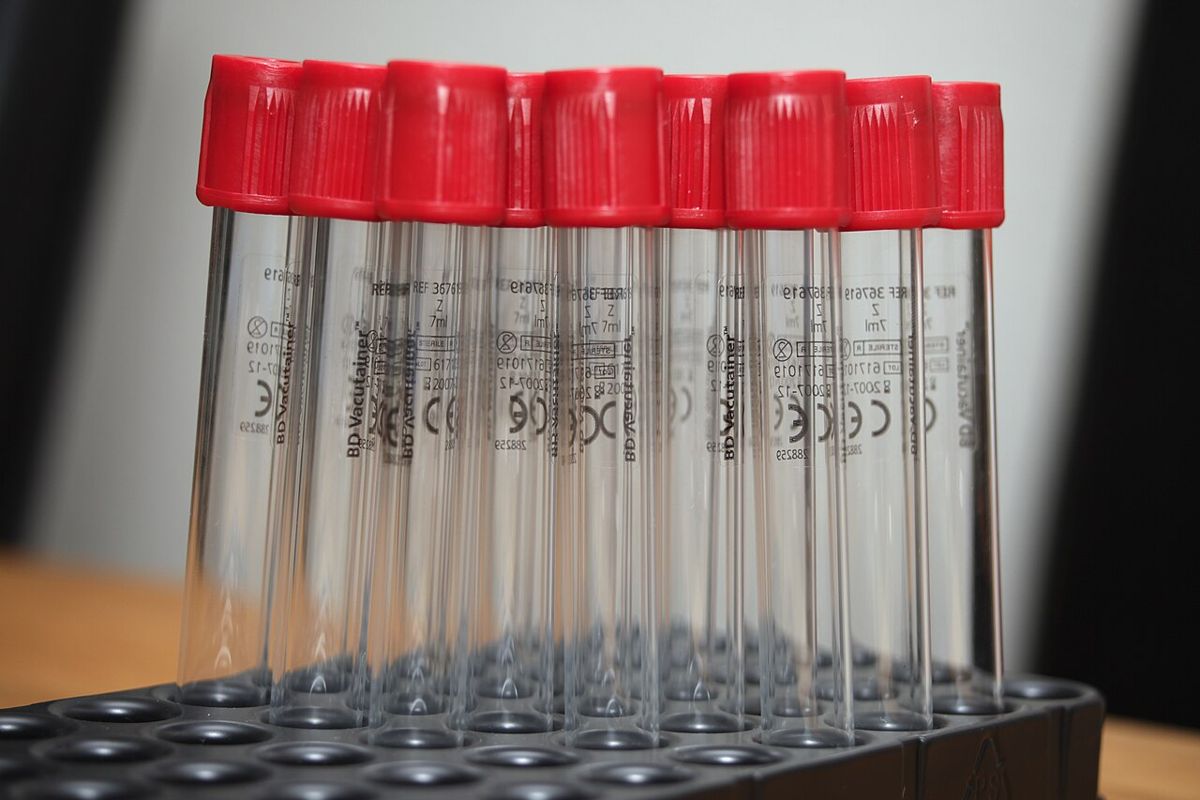
- Vacutainer tubes (photo by Håkan Dahlström)Wikimedia Commons · Image, CC BY 2.0
General information, not medical advice. The studies compared blood ferritin in children with and without ADHD at one point in time; they did not test iron as a treatment. Do not give a child iron supplements without a blood test and a doctor's advice: too much iron is harmful, and iron tablets are a known cause of poisoning in young children. Questions about ADHD diagnosis or treatment belong with your child's doctor.
Analysis by NutroPractic from the sources listed. Written for general readers; it does not replace advice from your own doctor.
From our articles
Read, then eat a little better
Plain-language guides on nutrition and wellness, backed by research.

Global data
Diabetes, obesity, child malnutrition and hunger, 1980 to 2050: what the numbers show
How diabetes, obesity, child malnutrition and hunger have changed since 1980, with sourced figures and a basic projection to 2050. Click a condition to explore the chart and its facts.
5 Oct 2026

Indian kitchen
Rice, roti and blood sugar: building a balanced Indian plate with the ICMR-NIN 2024 guidelines
About one in nine Indian adults has diabetes and many more have prediabetes. You don't have to give up rice or roti. How the ICMR-NIN Dietary Guidelines for Indians (2024) suggest building a plate, plus simple habits that help keep blood sugar steady.
3 Oct 2026
Micronutrients
Vitamin D and B12: two common gaps, from northern winters to vegetarian kitchens
Vitamin D runs low in Canadian and European winters, and surprisingly often in sunny India too. Vitamin B12 is a risk for vegetarians, people over 50 and people on certain medicines. Who is at risk, what the official advice is in North America, Europe and India, and where to get both.
3 Oct 2026
Newsfeed for your website
Want this feed on your website?
Add it to any site with one copy-and-paste snippet. No sign-up, and it updates itself every hour.
Start with a virtual consultation
Tell Dr. Triveni what you want to change. You will leave with a clear next step, whether you are in Toronto, London, New York or Chennai.