Food safety · October 12, 2026
Eight in ten Thais in a new survey knew raw freshwater fish can make you ill. Seven in ten had eaten it anyway, and in Vietnam the people who knew the risk ate it more
Researchers asked 6,021 adults in six Southeast Asian countries about dishes made from river fish that never meets heat: salads, pastes, pickles. Most people knew the danger, most ate the dishes, and under-40s ate them more than their elders. The survey was done online, and one of the 'freshwater' dishes it counted is made from a sea fish.
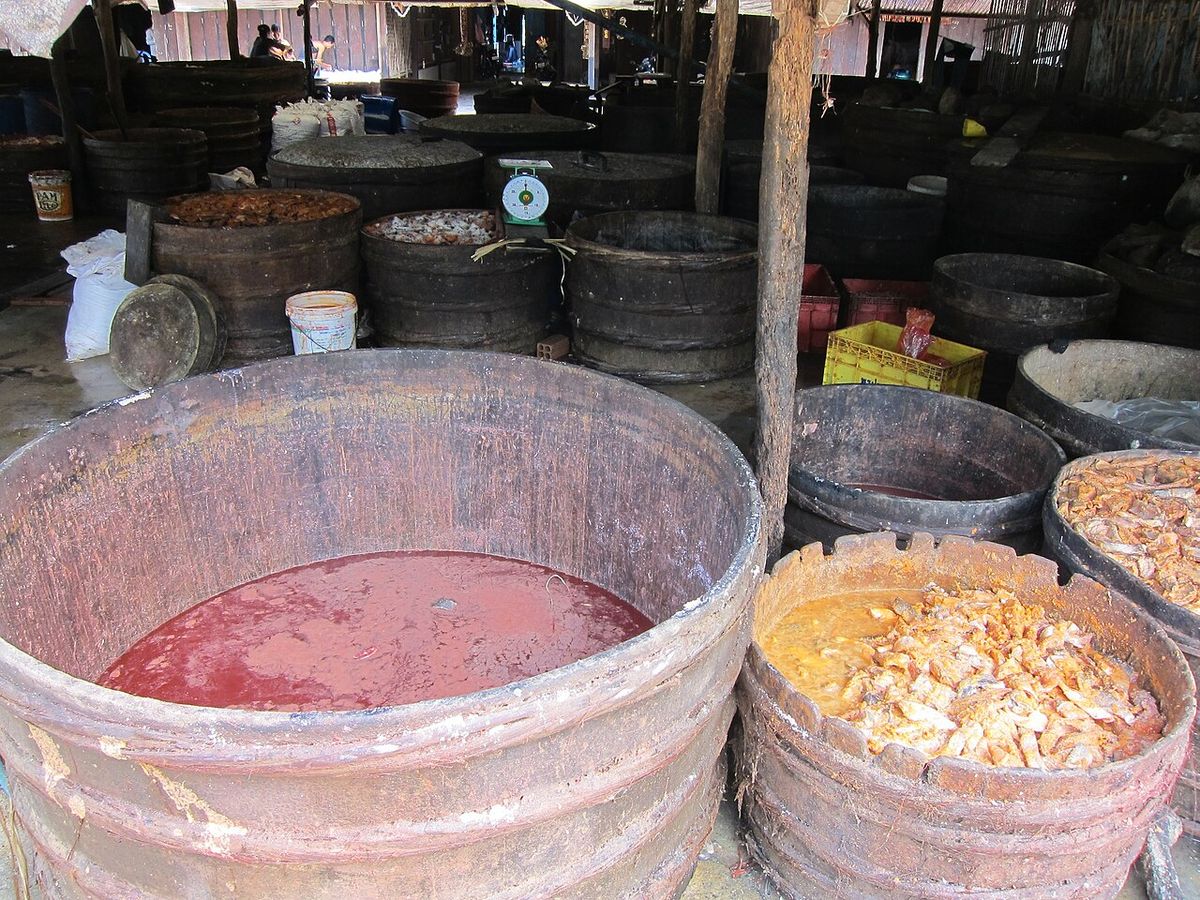
Along the Mekong, some of the best-loved dishes are made from river fish that is never cooked. Koi pla in Thailand and its Lao twin koi pa are minced raw fish salads sharpened with lime and herbs. Pa-daek in Laos, pla-ra in Thailand and prahok in Cambodia are fish fermented with salt, eaten as a paste or a sauce. They are old and they taste of home. They can also carry liver flukes, small parasitic worms linked to disease of the liver and bile ducts, and bacteria that can cause invasive infections. A team led from the National University of Singapore wanted to know how many people still eat these dishes and whether knowing the danger changes anything. Their paper came out in BMJ Public Health on 5 October 2026.
Between October 2022 and February 2024 they surveyed 6,021 adults aged 21 and over in Cambodia, Laos, Malaysia, Singapore, Thailand and Vietnam, about a thousand in each. Everyone was shown four to six local dishes and asked how often they ate each one. The researchers sorted the dishes into high risk (no heat at all in the preparation) and low risk (some heat, but possibly not enough). People were also asked where they ate the dishes, where the fish came from, and whether they knew that eating raw fish can make you ill.
The eating first. In Vietnam 98.7% said they had eaten at least one high-risk dish, in Laos 96.9%, in Cambodia 95.5%, in Malaysia 83.7% and in Thailand 72.4%. Singapore, which banned raw freshwater fish in ready-to-eat dishes after an outbreak in 2015, was far lower at 31.9%. For many people this is everyday food, not a festival dish: half the Lao participants (50.7%) said they ate pa-daek at least once a week, and about one in five Cambodians ate each of four uncooked dishes that often.
Now the knowing. In Thailand 79.2% agreed that raw fish can cause sickness, in Vietnam 77.5%, in Singapore 74.2%, in Laos 71.1%, in Cambodia 59.7% and in Malaysia 43.0%. Put the two lists side by side and they barely relate. Thailand has run national campaigns against koi pla for decades, and the paper credits them with cutting liver fluke infection from over 15% of people in 1996 to 2.2% in 2019. Yet about 40% of the Thai participants still said they eat koi pla, and about 90% of the Lao participants eat koi pa although seven in ten of them knew the risk.
Two results went against what you would expect. Only in Singapore did not knowing go with more eating: people unaware of the risk were about 1.6 times as likely to eat a high-risk dish. In Vietnam it ran the other way, and strongly. People who did not know the risk were far less likely to eat these dishes (adjusted odds ratio 0.18), which means those who knew were the ones eating them. And in four countries, people aged 40 and over were less likely to eat high-risk dishes than younger adults. The authors had expected tradition to sit with the old, and say so.
Why would people who know keep eating? The authors lean on earlier research from Thailand and Laos: these dishes are part of who people are, elders have objected that giving up koi pla goes against tradition, and some men tie raw fish to strength and virility. In this survey men were about twice as likely as women to eat high-risk dishes in Vietnam and Laos. Most of the eating happens at home (between 47% and 89% of participants, depending on the country), where no inspector goes, and a quarter of Lao participants and a sixth of Cambodians caught some of the fish themselves.
The cautions matter here, and the authors raise the main one. This was an online survey, through a market research panel in five countries and social media adverts in Singapore, so it leans young, urban and educated even after weighting. The rural Mekong communities where flukes are most common were under-represented. Nobody was tested for infection, so the study says nothing about who actually got ill. 'Ever eaten' includes people who have the dish once or twice a year. Some of the odds ratios rest on small groups: the finding that university-educated Lao participants were seven times as likely to eat high-risk dishes has a confidence interval running from 2.3 to 29.
Two things we noticed ourselves. The paper's summary says between 70% and 90% had eaten high-risk dishes in the four Mekong countries, while its own results give over 95% for three of them. And the high-risk list is broader than 'raw river fish' suggests: Malaysia's includes budu, which the paper's table describes as fermented anchovies, and anchovies are sea fish. Counting long-fermented pastes and dried fish alongside freshly minced raw fish may be the cautious choice, but it lifts the totals. Our reading: the headline percentages are soft, and the gap between knowing and doing is the solid finding. For anyone eating or travelling in the region, the paper's practical point is simple. Heat is what makes freshwater fish safe. Lime juice, salt, pickling and fermenting are not cooking, and freezing at −20°C or below for one to seven days kills the flukes but not the bacteria.
Online cross-sectional survey of 6,021 adults aged 21 and over in Cambodia, Laos, Malaysia, Singapore, Thailand and Vietnam, October 2022 to February 2024: how often they eat raw or undercooked freshwater fish dishes and whether they know the risk
98.7%
Vietnamese participants who had ever eaten at least one 'high-risk' dish (no heat in the preparation). Laos 96.9%, Cambodia 95.5%, Malaysia 83.7%, Thailand 72.4%, Singapore 31.9%
79.2%
Thai participants who knew that eating raw fish can cause sickness. Vietnam 77.5%, Singapore 74.2%, Laos 71.1%, Cambodia 59.7%, Malaysia 43.0%
50.7%
Lao participants who eat pa-daek, a fermented fish paste, 'often', meaning at least once a week
0.18
Adjusted odds of eating high-risk dishes in Vietnam for people who did not know the risk, against those who did (95% CI 0.09 to 0.35). In Singapore the same comparison gave 1.62 (1.16 to 2.26)
0.12 to 0.63
Adjusted odds of eating high-risk dishes at age 40 and over, against under 40, in Cambodia (0.12), Vietnam (0.40), Singapore (0.47) and Thailand (0.63)
47% to 89%
Participants, by country, who mainly eat these dishes at home
Figures are from the open-access paper in BMJ Public Health (doi 10.1136/bmjph-2025-004669, published online 5 October 2026, CC BY-NC 4.0), read in full on PubMed Central: introduction, methods, results, Tables 1 to 4, discussion, limitations, funding and competing interests. The four supplementary files (questionnaire, recruitment details, unweighted demographics, unadjusted models, regional breakdowns) were not read. Recruitment: convenience sampling through TGM Research's online panel in Cambodia, Laos, Malaysia, Thailand and Vietnam, and through adverts on Meta's platforms in Singapore, 23 October 2022 to 7 February 2024; residents aged 21 and over. Weighted sample sizes: Cambodia 1,198, Laos 1,048, Malaysia 796, Singapore 862, Thailand 1,057, Vietnam 1,060. Data were weighted by sex, age (under 40 or 40 and over) and ethnicity against national census figures; the authors say the sample stayed biased towards young, urban and educated people. University or professional education: 30.5% (Laos) to 72.3% (Vietnam). 'High risk' means no heat treatment in the preparation; 'low risk' means some heat that may not be enough. 'Often' means once a week or more; 'sometimes' means once or twice a month or once or twice a year; 'ever' is the two combined. Dishes classed high risk: raw prahok, raw fish salad, pa'ork and maam (Cambodia); pa-daek, pa-som and koi-pa (Laos); budu, bosou, fish hinava and umai (Malaysia); tilapia sushi (Singapore); jao bong with pla-ra and koi-pla (Thailand); fermented fish paste, dried fish and raw fish salad (Vietnam). Lap pa (Laos) and larb pla (Thailand) were high risk only when uncooked. Singapore's yusheng, made with raw salmon, was classed low risk because of the country's food-handling rules. Koi-pla in Thailand: 14.1% often and 25.4% sometimes. Koi-pa in Laos: 21.0% often and 68.9% sometimes. Regression: multivariable logistic models per country, adjusted for age, sex, ethnicity, religion, education and knowledge of the risk. Age 40 and over: Cambodia 0.12 (95% CI 0.05 to 0.29), Singapore 0.47 (0.34 to 0.64), Thailand 0.63 (0.47 to 0.85), Vietnam 0.40 (0.19 to 0.82); Laos 0.78 and Malaysia 0.82 were not significant. Men against women: Vietnam 2.16 (1.11 to 4.42), Laos 2.32 (1.05 to 5.52), Cambodia 1.82 (0.97 to 3.57, not significant); the paper's text highlights Vietnam only. University education in Laos: 7.28 (2.30 to 29.0); in Malaysia 1.79 (1.12 to 2.87). Not aware of the risk: Laos 0.45 (0.21 to 1.01), Cambodia 1.04, Malaysia 1.11, Thailand 0.88, none significant. Source of fish: local markets for 70% to 90% outside Singapore; own fishing 25% in Laos and 17% in Cambodia. The abstract gives 'between 70% and 90%' for ever eating high-risk dishes in Cambodia, Laos, Thailand and Vietnam and '60% to 80%' for awareness; the results section and tables give the figures used here. The Thai infection figures (over 15% in 1996, 2.2% in 2019) and the freezing guidance are the paper's, from work it cites. The remark that anchovies are sea fish is ours. No infections were measured. Funding: PREPARE, Ministry of Health Singapore, and Tan Tock Seng Hospital, Singapore. Competing interests: none declared.
- Singapore banned raw freshwater fish in all ready-to-eat dishes in 2015, after the first documented foodborne outbreak of an invasive strain of group B Streptococcus, known as ST283. The paper says this strain has since been found in people and in tilapia across much of Southeast Asia and is rarely seen elsewhere in the world.
- Three in ten Singapore participants said they still eat tilapia sushi at least occasionally. Since it can't be sold there, the authors suspect people make it at home or cross to Johor Bahru in Malaysia, a bus ride away, where raw fish porridge is easy to find.
- Two liver flukes, Clonorchis sinensis and Opisthorchis viverrini, are on the World Health Organization's list of neglected tropical diseases. Long-running infection with either is linked to bile duct cancer, and the paper notes that Thailand has the highest reported rate of that cancer in the world.
- A review cited in the paper pooled studies from the Greater Mekong region and put liver fluke infection at about one in three people studied in Laos, one in five in Thailand and Vietnam, and one in ten in Cambodia.
- The authors expected older people to be the keepers of these dishes. Finding the opposite, they suggest campaigns aimed at the young, who may hold tradition more loosely, and at men, to take on the idea that raw fish builds strength. They also allow that the result could come from having surveyed too many young people.
- Consumption of raw or undercooked freshwater fish and awareness of risks of associated bacterial and parasitic infections in Southeast Asia: an online multicountry cross-sectional surveyBMJ Public Health, 5 October 2026 · The study. Open access, read in full; supplementary files not read
- Full text on PubMed Central (PMC13646980)US National Library of Medicine · Version read for this item
- PubMed record (PMID 42851743)US National Library of Medicine · Abstract, authors and competing interests
- Prahoc market (8198458075)Wikimedia Commons · Image, CC BY 2.0, Cristina Bejarano
General information, not medical advice. If you have eaten raw or undercooked freshwater fish and have ongoing stomach pain, fever, jaundice or other symptoms, see a doctor and mention what you ate. Pregnant women, older adults and people with weak immune systems should avoid raw fish dishes.
Analysis by NutroPractic from the sources listed. Written for general readers; it does not replace advice from your own doctor.
From our articles
Read, then eat a little better
Plain-language guides on nutrition and wellness, backed by research.

Global data
Diabetes, obesity, child malnutrition and hunger, 1980 to 2050: what the numbers show
How diabetes, obesity, child malnutrition and hunger have changed since 1980, with sourced figures and a basic projection to 2050. Click a condition to explore the chart and its facts.
5 Oct 2026

Indian kitchen
Rice, roti and blood sugar: building a balanced Indian plate with the ICMR-NIN 2024 guidelines
About one in nine Indian adults has diabetes and many more have prediabetes. You don't have to give up rice or roti. How the ICMR-NIN Dietary Guidelines for Indians (2024) suggest building a plate, plus simple habits that help keep blood sugar steady.
3 Oct 2026

Micronutrients
Vitamin D and B12: two common gaps, from northern winters to vegetarian kitchens
Vitamin D runs low in Canadian and European winters, and surprisingly often in sunny India too. Vitamin B12 is a risk for vegetarians, people over 50 and people on certain medicines. Who is at risk, what the official advice is in North America, Europe and India, and where to get both.
3 Oct 2026
Newsfeed for your website
Want this feed on your website?
Add it to any site with one copy-and-paste snippet. No sign-up, and it updates itself every hour.
Start with a virtual consultation
Tell Dr. Triveni what you want to change. You will leave with a clear next step, whether you are in Toronto, London, New York or Chennai.