Pregnancy and infancy · October 13, 2026
Babies who cried inconsolably and also had eczema were more often born to mothers who ate little fish in pregnancy. Babies with colic alone showed no such link
A Boston study went back to the pregnancy food diaries of 1,324 mothers and lined them up with how their babies fared at six months. Diet quality made no difference to colic on its own, or to eczema on its own. It mattered only for the smaller group of babies who had both, and that detail may say more about colic than about the diet.
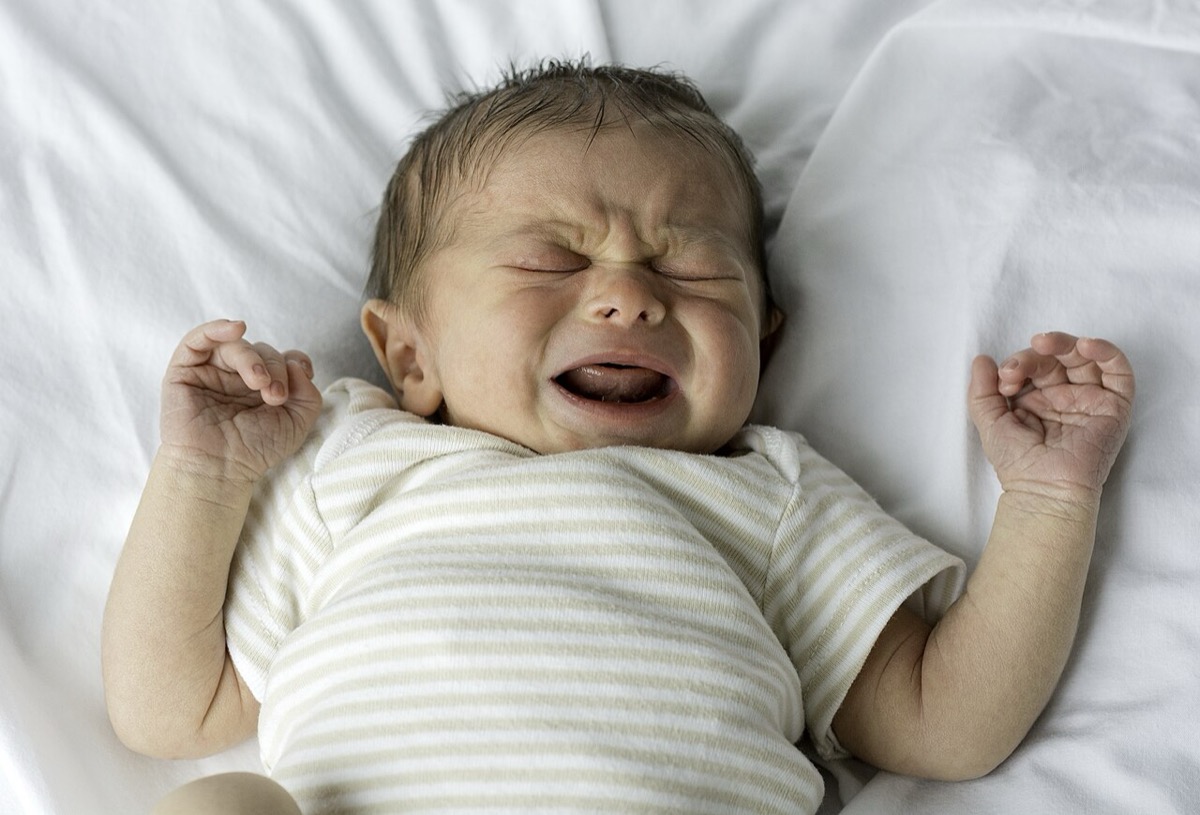
Colic is one of the oldest puzzles in baby care. A healthy, well-fed infant cries for hours, draws up its legs, and nothing settles it. Doctors now describe it as a disorder of the conversation between gut and brain, which is a polite way of saying nobody is sure what causes it. Most of the diet research has looked at what happens after birth: breast milk, formula, the mother's diet while breastfeeding. A paper published online on 12 October 2026 in JAMA Network Open looks further back, at what mothers ate while they were pregnant.
The data come from Project Viva, a long-running study that enrolled pregnant women at practices in eastern Massachusetts between 1999 and 2002 and has followed their children since. The mothers were not picked for any family history of allergy. In early pregnancy, at about ten weeks, and again at about 28 weeks, they filled in a detailed food questionnaire. From those answers the researchers built two scores: a Mediterranean diet score from 0 to 9, and a dietary inflammatory index, where a higher number means a diet richer in foods linked with inflammation. They also counted weekly servings of the foods most often behind allergies: fish and shellfish, nuts and peanuts, dairy and eggs.
When the babies were about six months old, the mothers answered two questions. Had the baby ever had times when it seemed to be in agony, screaming, drawing its legs up and could not be calmed? If that had happened sometimes or often, the study counted it as colic. And had a health professional ever said the baby had eczema? Of the 1,324 mother and baby pairs with answers to both the diet and the baby questions, 273 babies had colic only, 152 had eczema only, 61 had both, and 838 had neither.
Here is the result that the headline numbers tend to blur. For colic on its own, neither diet score made any measurable difference. For eczema on its own, the same. The link appeared only in the 61 babies who had both. Each extra point on the Mediterranean score went with about 15% lower odds of a baby being in that group. Each extra point on the inflammatory index went with about 34% higher odds. Every weekly serving of seafood went with about 25% lower odds. These figures were adjusted for the mother's age, education, race and ethnicity, earlier births, smoking and her own history of allergy, asthma or eczema.
Dairy and eggs showed nothing either way. Nuts and peanuts gave a small surprise: a little more colic without eczema among mothers who ate more of them, about 5% higher odds per weekly serving, with the lower edge of the confidence range sitting exactly at no effect. The authors had expected the opposite and say so.
Why would diet matter for colic plus eczema but not for colic alone? The authors' suggestion is that colic is not one condition but several, which all look like the same inconsolable crying. In some babies it may be the first sign of an allergic, inflamed type of immune system, the kind that also shows up in the skin. If that is right, a mother's diet could plausibly nudge that type and leave the others alone. The omega-3 fats in fish are the obvious candidate, and trials of omega-3 supplements in pregnancy have hinted at less eczema and wheeze in the children. This study cannot test that idea. It only shows that the pattern fits it.
There are reasons for caution, and the paper names most of them. Both colic and eczema were reported by the mothers, not checked in medical records. The colic question is broad: one baby in four in this study met it, far more than would meet a strict clinical definition. Food questionnaires are rough tools. The families all had prenatal care and health insurance, and the pregnancies took place a quarter of a century ago, when advice on fish, peanuts and allergy was different. Many families dropped out before the six-month questions, and an observational study can never fully rule out that healthier eating simply travels with other things that protect babies.
One more detail is worth a careful reader's attention. The paper's key points box says the link between diet and colic was stronger in babies whose mothers had allergies themselves. Its results section, describing the same analyses in more detail, says the nut and seafood links with colic did not notably differ by the mother's allergy history. The breakdown sits in an online supplement. It is a small inconsistency, but it is the kind that gets repeated in summaries.
So what can a pregnant reader take from this? Nothing that changes current advice, and nothing that contradicts it either. Health bodies in the United States, the UK and Europe already encourage eating fish that is low in mercury, two to three servings a week in the US advice, during pregnancy, mostly for the baby's brain and eyes. This study adds a modest, unproven hint that the same habit might also go with fewer babies who have both colic and eczema. It gives no reason to cut out nuts, dairy or eggs, and no reason for a parent of a crying baby to look back at their pregnancy menu with guilt.
Prospective cohort study (Project Viva, eastern Massachusetts): pregnancy diet from food questionnaires at about 10 and 28 weeks, and mother-reported colic and eczema at about 6 months, in 1,324 mother and baby pairs enrolled in 1999 to 2002
1,324
Mother and baby pairs analysed, out of 2,128 babies born in the study. 227 had no pregnancy diet data and 549 had no answers on the baby at six months
273 / 152 / 61
Babies with colic only (20.6%), eczema only (11.5%) and both (4.6%). The other 838 (63.3%) had neither
0.75
Odds ratio for colic plus eczema per weekly serving of seafood (95% CI 0.58 to 0.97). Mothers ate on average 1.6 servings of seafood a week
0.85
Odds ratio for colic plus eczema per extra point on the 0 to 9 Mediterranean diet score (95% CI 0.74 to 0.98). The average score was 4.6
1.34
Odds ratio for colic plus eczema per point on the dietary inflammatory index, where higher means a more inflammatory diet (95% CI 1.12 to 1.61)
None
Link between either diet score and colic alone or eczema alone. Dairy and egg intake were not linked with any of the outcomes
Figures are from the paper (doi 10.1001/jamanetworkopen.2026.38472, published online 12 October 2026, open access) and its PubMed abstract. Odds ratios are from the fully adjusted model (mother's age, race and ethnicity, education, earlier births, smoking and her own history of allergic disease) and compare babies with each outcome against babies with neither. Odds ratios describe relative odds within this group, not a baby's absolute risk. Diet scores and servings are the average of the two pregnancy questionnaires. Colic was counted when mothers said episodes of inconsolable screaming with legs drawn up happened 'sometimes' or 'often'; a stricter 'often only' definition gave stronger associations, according to the authors. Eczema was the mother's report that a health professional had diagnosed it. The paper's key points say diet links with colic were stronger in babies of mothers with allergies, while its results text says the nut and seafood links did not notably differ by maternal allergy; the detailed breakdown is in an online supplement we could not check. Project Viva is funded by the US National Institutes of Health; this analysis was also supported by an anonymous gift to the Harvard T.H. Chan School of Public Health. Two authors report industry ties outside the submitted work, including one with an infant formula maker.
- Doctors have long described colic with a 'rule of threes': crying for more than three hours a day, on more than three days a week, for more than three weeks, in an otherwise healthy baby. Current definitions are looser and focus on crying that cannot be prevented or soothed.
- Colic usually peaks at around six weeks of age and fades by three to four months, which is one reason so many remedies appear to work.
- Eczema is often the first allergic condition to show up in a child, and doctors have long noticed that it tends to run with food allergy, hay fever and asthma later on.
- Health authorities that recommend fish in pregnancy also ask women to avoid high-mercury species such as shark, swordfish and king mackerel, and to choose options like salmon, sardines, trout or cod.
- Project Viva has followed the same Massachusetts families for more than 25 years, and the children enrolled before birth are now adults.
- Maternal Prenatal Diet and Colic and Eczema Among InfantsJAMA Network Open, 9(10), e2638472, published online 12 October 2026 (open access) · The new paper: methods, colic and eczema questions, results, limitations, funding and disclosures
- PubMed record 42862557US National Library of Medicine · Structured abstract with the main odds ratios
- Advice about eating fish: for those who might become or are pregnant or breastfeeding and children ages 1 to 11 yearsUS Food and Drug Administration · Current US advice on fish in pregnancy and which fish to choose
- Human-Male-White-Newborn-Baby-Crying.jpgWikimedia Commons · Image, public domain, by Evan-Amos
General information, not medical advice. This was an observational study based on mothers' reports; it cannot show that any food in pregnancy causes or prevents colic or eczema. If you are pregnant and have questions about your diet, or your baby cries a great deal or has a rash, talk to your doctor, midwife or a registered dietitian.
Analysis by NutroPractic from the sources listed. Written for general readers; it does not replace advice from your own doctor.
From our articles
Read, then eat a little better
Plain-language guides on nutrition and wellness, backed by research.

Global data
Diabetes, obesity, child malnutrition and hunger, 1980 to 2050: what the numbers show
How diabetes, obesity, child malnutrition and hunger have changed since 1980, with sourced figures and a basic projection to 2050. Click a condition to explore the chart and its facts.
5 Oct 2026

Indian kitchen
Rice, roti and blood sugar: building a balanced Indian plate with the ICMR-NIN 2024 guidelines
About one in nine Indian adults has diabetes and many more have prediabetes. You don't have to give up rice or roti. How the ICMR-NIN Dietary Guidelines for Indians (2024) suggest building a plate, plus simple habits that help keep blood sugar steady.
3 Oct 2026

Micronutrients
Vitamin D and B12: two common gaps, from northern winters to vegetarian kitchens
Vitamin D runs low in Canadian and European winters, and surprisingly often in sunny India too. Vitamin B12 is a risk for vegetarians, people over 50 and people on certain medicines. Who is at risk, what the official advice is in North America, Europe and India, and where to get both.
3 Oct 2026
Newsfeed for your website
Want this feed on your website?
Add it to any site with one copy-and-paste snippet. No sign-up, and it updates itself every hour.
Start with a virtual consultation
Tell Dr. Triveni what you want to change. You will leave with a clear next step, whether you are in Toronto, London, New York or Chennai.