Potassium · October 12, 2026
Raising blood potassium helped people with heart defibrillators. Tablets, a heart drug or both looked about the same, but nobody was randomised to one of them
A Danish trial of 1,200 people with an implanted defibrillator had already shown fewer dangerous heart rhythms when potassium was nudged up. The follow-up asks which way of nudging worked best. The honest answer is that it can't say, and the food advice everyone got was never measured.
Potassium is one of the things that keeps a heartbeat regular. Too little in the blood and the heart muscle becomes electrically twitchy; too much and it can stop. For years, records of heart patients have hinted that the safest place to be is not the middle of the normal range but the upper part of it. In 2025 a Danish trial called POTCAST put that to a proper test in 1,200 people who all had an implantable cardioverter-defibrillator, a device under the skin that shocks the heart out of a dangerous rhythm. Half had their potassium deliberately pushed up towards 4.5 to 5.0 mmol/L. They had fewer bad events than the half who got usual care. On 6 October 2026 the same team, from Rigshospitalet in Copenhagen and two other Danish hospitals, published a follow-up in the journal Europace asking the obvious next question: does it matter how you get the potassium up?
There were three ways. Everyone in the potassium group got counselling on a potassium-rich diet. On top of that, the protocol started with a mineralocorticoid receptor antagonist, a class of heart-failure drug (spironolactone or eplerenone) that makes the kidneys hold on to potassium. If that was not enough, not tolerated or not wanted, potassium tablets were added or used instead, up to 4,500 mg a day. Doses were adjusted over a median of 85 days, mostly by phone after a local blood test. When that phase ended, 73 people were on the drug alone, 148 on potassium tablets alone and 326 on both. Another 25 were on neither and are left out of the paper.
All three routes raised potassium. After six months it had gone from 4.12 to 4.27 mmol/L on the drug alone, from 3.99 to 4.24 on tablets alone and from 3.98 to 4.34 on both. Then the outcome that matters: a sustained dangerous rhythm, a justified shock or pacing from the device, a hospital stay for arrhythmia or heart failure, or death from any cause, over a median of about three years. That happened to 29% of the usual-care group, and to 22%, 21% and 22% of the three potassium groups. Between the three there was no detectable difference (p = 0.8).
It is tempting to read that as 'potassium tablets work as well as the heart drug'. The paper does not let you. Nobody was randomly assigned to a route. Who ended up on what depended on what they were already taking, what side effects they got and what they preferred. More than a third of the people on tablets alone were there because the drug had given them side effects, and another third because they chose it. The groups were also different to begin with: the drug-only group started with higher potassium, and the tablets-only group had more people with reduced kidney function. And 73 people is a small group to compare anything in. The authors say plainly that the results 'should not be interpreted as demonstrating comparative efficacy, safety, or equivalence'.
There is a second detail worth knowing. The target was 4.5 to 5.0 mmol/L, and most people never got there. Only 44% had reached it when the dose-adjusting phase ended, and the average in all three groups stayed below 4.5 throughout. So the benefit in the main trial came with a fairly small upward shift, a quarter of a millimole or so. The authors suggest that part of what helped was simply having fewer dips: potassium fell below 3.5 mmol/L at some point in 13% of the usual-care group and 6% of the potassium group.
The trade-off ran the other way too. A reading of 5.5 mmol/L or more turned up in one person on usual care and in 18 people in the potassium group, 3% of them, all on tablets or on both. None of those ended in a hospital stay for high potassium, and most were handled with a repeat blood test and a lower dose. That is reassuring, with a condition attached. These people had blood tests every two weeks after each dose change and every six months after that, and anyone with poor kidney function was kept out of the trial from the start. The authors call it a possible 'best-case scenario'.
And the food? This is a nutrition site, so we looked for it. Diet advice was given to everyone in the potassium group, which means it cannot be separated from the pills, and the paper reports nothing about what people actually ate. Nothing here tells you whether eating more beans, potatoes, greens or bananas would do for a heart patient what the trial's regimen did. It may help. This study is not where the evidence for that would come from.
Our reading: the main POTCAST result stands as good randomised evidence that carefully raising potassium helps this particular group of patients. This follow-up adds that it can be done with either kind of pill, under close monitoring, and that tablets alone moved the blood level about as much as the drug. It does not show the routes are equally good. The authors add that tablets should not replace the heart drug in someone who has a reason to be on it. For anyone reading with a heart condition, the practical point is short. Potassium supplements are not a do-it-yourself project. The same dose that helps one person can be dangerous for someone with weak kidneys or on certain blood pressure medicines, and you cannot feel your potassium level. This is a blood test and a conversation with your cardiologist.
Prespecified observational analysis of the open-label randomised POTCAST trial, Denmark: 600 people with an implanted defibrillator on usual care, and 572 whose blood potassium was raised with a heart drug (73), potassium tablets (148) or both (326)
29% vs 22%, 21%, 22%
People who had a sustained dangerous rhythm, a justified device therapy, a hospital stay for arrhythmia or heart failure, or died: usual care (175 of 600) against drug alone (16 of 73), tablets alone (31 of 148) and both (72 of 326). No difference between the three (p = 0.8)
+0.15, +0.25, +0.36
Rise in blood potassium at six months, in mmol/L: drug alone (4.12 to 4.27), tablets alone (3.99 to 4.24), both (3.98 to 4.34). Groups were not randomised and started at different levels
44%
Participants who had reached the target of 4.5 to 5.0 mmol/L when dose adjustment ended (249 of 572). Average potassium stayed below the target in all three groups
13% → 6%
People with at least one potassium reading below 3.5 mmol/L during follow-up, usual care against the potassium group (relative risk 0.45, 95% CI 0.30 to 0.66)
1 vs 18
People with at least one reading of 5.5 mmol/L or more: usual care (0.2%) against the potassium group (3%). None on the drug alone, 5 on tablets alone, 13 on both. No hospital stays for high potassium
0
Measurements of what participants ate reported in this paper. Everyone in the potassium group got advice on a potassium-rich diet, so diet cannot be told apart from the pills
Figures are from the accepted manuscript in Europace (doi 10.1093/europace/euag272, published online 6 October 2026, open access, CC BY), read in full as the publisher's PDF: abstract, text, Table 1, the graphical abstract legend, funding and disclosures. The supplementary tables and figures were not read, and the figures in the PDF were not legible in our copy. Tables 2 to 5 came out of the PDF scrambled, so we give only numbers that also appear in the running text, with one exception: the hazard ratios for the main outcome against usual care, which we read from Table 5 as 0.81 (95% CI 0.49 to 1.35) for the drug alone, 0.69 (0.47 to 1.01) for tablets alone and 0.78 (0.59 to 1.03) for both, unadjusted, and 0.80 (0.48 to 1.35), 0.66 (0.44 to 0.98) and 0.69 (0.53 to 0.92) after adjustment. Treat those six as our best reading of a damaged table and check the paper before quoting them. Percentages of 22%, 21% and 22% are the paper's; the fractions are its event counts over its group sizes. The trial: 1,200 adults at three Danish centres with any heart disease, an implanted defibrillator, potassium of 4.3 mmol/L or less and kidney filtration (eGFR) above 30, enrolled March 2019 to September 2024 and followed to 31 March 2025. In the potassium group the mean age was 62.7 and 20% were women. 572 of the 600 completed dose adjustment (28 did not start); 73 ended on the drug alone, 148 on tablets alone, 326 on both and 25 on neither (73 + 148 + 326 + 25 = 572). Maximum daily doses: spironolactone 100 mg, eplerenone 50 mg, potassium supplements 4,500 mg; the paper's text does not say which potassium salt. At the start, 48% were taking neither, 30% the drug, 14% potassium supplements and 9% both. Reasons for being on tablets alone: side effects of the drug 39%, preference 36%. Reasons for being on the drug alone: reached target without tablets 45%, side effects of the tablets 34%. Baseline potassium: usual care 4.01, drug alone 4.12, tablets alone 3.99, both 3.98 mmol/L. Kidney filtration below 60 at baseline: 14.2% of usual care, 6.8% drug alone, 25.7% tablets alone, 15.3% both. Median follow-up 3.3 years (usual care), 3.2 (drug alone), 3.3 (tablets alone), 3.0 (both). The potassium rise was larger on both than on tablets alone (difference 0.11 mmol/L, 95% CI 0.03 to 0.18) or the drug alone (0.22, 0.12 to 0.32). Between 31% and 41% of each group switched regimen at least once, spending 16 to 25% of follow-up on another one. High potassium: relative risk 19.7 (95% CI 2.6 to 147.1), readings from 5.50 to 6.20 mmol/L, 12 of the 18 followed by a dose reduction; one admission at 6.2 turned out to be a faulty measurement. Hospital stays for potassium disturbances or kidney failure: 17 people (3%) in the potassium group, cause-specific hazard ratio 1.98 against usual care (95% CI 0.90 to 4.32), not statistically significant. Creatinine at six months rose 3.5 µmol/L in the potassium group and 1.5 in usual care. Deaths: 41 on usual care, 2 on the drug alone, 11 on tablets alone, 15 on both; one sensitivity analysis found more deaths on tablets alone than on both, which the authors put down to people stopping the drug as their illness advanced (three such cases, none of the deaths caused by high potassium). No treatment-related deaths. The paper defines high potassium as a reading at 5.5 mmol/L; the 'or more' is our reading, as the symbol was lost in our copy. The main trial's result is described here only as this paper describes it; we did not re-read the 2025 report. The sentences on diet are ours: the paper mentions diet counselling twice and reports no dietary data in the parts we read. Limitations the authors state: regimen not randomised, baseline imbalances, residual confounding, small groups (especially the drug alone), people with potassium above 4.3 or eGFR below 30 excluded, adults only, and closer monitoring than routine care. Funding: Independent Research Fund Denmark, the Novo Nordisk Foundation and the Danish Heart Foundation. Disclosures: several authors report conference support from device makers (Abbott, Biotronik, Medtronic); one sits on an endpoint committee for Biotronik and reports consulting fees from Johnson & Johnson and Abbott; one reports lecture fees from Amgen, MSD, BMS, Sanofi and GE; four report none.
- An implantable cardioverter-defibrillator sits under the skin near the collarbone with a wire into the heart. It watches every beat and, if a dangerous fast rhythm starts, paces or shocks the heart back. It also keeps a record, which is how the trial could count rhythm events so precisely.
- Only a small share of the body's potassium is in the blood. Nearly all of it is inside cells, which is why a blood test is a narrow window and why small shifts in the reading can matter for the heart.
- Most of the dose adjustment in this trial was done by telephone. Participants booked their own blood test locally, and a short call covered blood pressure, side effects and the next dose. Bloods were repeated two weeks after each change.
- The heart-failure drugs used here have been known since the 1990s to raise potassium by about 0.1 to 0.3 mmol/L. That rise was long treated as a side effect to watch. The Danish team's argument is that it may be part of why the drugs work.
- For the general population, the World Health Organization suggests adults get at least 3,510 mg of potassium a day from food. That advice is about blood pressure in healthy people and has nothing to do with the tablets in this trial.
- Potassium-Increasing Regimens in Patients at High Risk of Ventricular Arrhythmias: A Prespecified Observational Analysis of the Randomized POTCAST TrialEuropace, 6 October 2026 · The study. Accepted manuscript read in full; supplements not read
- PubMed record (PMID 42834820)US National Library of Medicine · Abstract and authors
- Increasing the Potassium Level in Patients at High Risk for Ventricular ArrhythmiasNew England Journal of Medicine, 2025 · The main POTCAST trial, cited in the paper; not re-read for this item
- Guideline: Potassium intake for adults and childrenWorld Health Organization, 2012 · The 3,510 mg a day figure for the general population
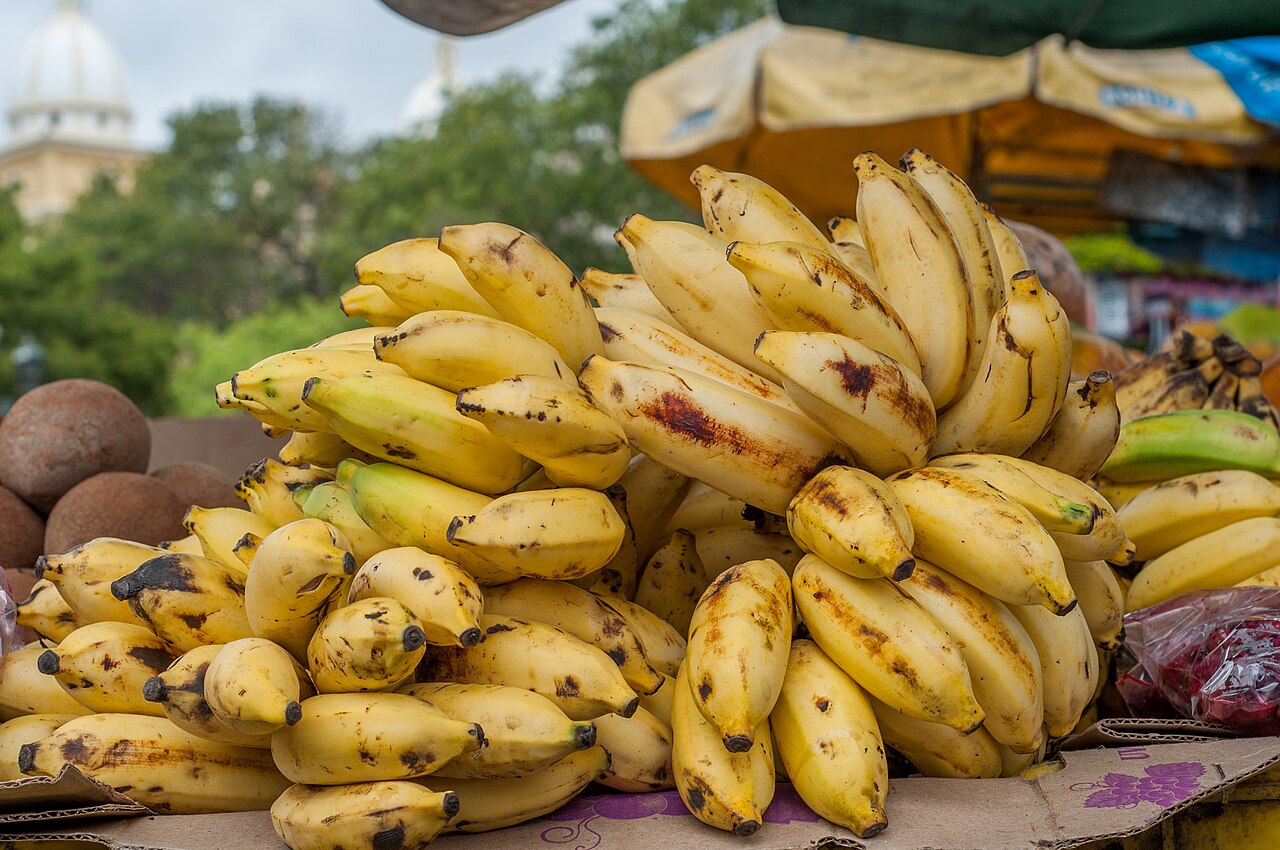
- Bunch of bananas on saleWikimedia Commons · Image, CC0, Wilfredor
General information, not medical advice. Do not start potassium supplements, salt substitutes or a high-potassium diet on the strength of this study, especially if you have heart or kidney disease or take blood pressure or heart medicines: too much potassium can be dangerous and needs blood tests to monitor. Never stop or change a prescribed medicine without talking to your doctor.
Analysis by NutroPractic from the sources listed. Written for general readers; it does not replace advice from your own doctor.
From our articles
Read, then eat a little better
Plain-language guides on nutrition and wellness, backed by research.

Global data
Diabetes, obesity, child malnutrition and hunger, 1980 to 2050: what the numbers show
How diabetes, obesity, child malnutrition and hunger have changed since 1980, with sourced figures and a basic projection to 2050. Click a condition to explore the chart and its facts.
5 Oct 2026

Indian kitchen
Rice, roti and blood sugar: building a balanced Indian plate with the ICMR-NIN 2024 guidelines
About one in nine Indian adults has diabetes and many more have prediabetes. You don't have to give up rice or roti. How the ICMR-NIN Dietary Guidelines for Indians (2024) suggest building a plate, plus simple habits that help keep blood sugar steady.
3 Oct 2026

Micronutrients
Vitamin D and B12: two common gaps, from northern winters to vegetarian kitchens
Vitamin D runs low in Canadian and European winters, and surprisingly often in sunny India too. Vitamin B12 is a risk for vegetarians, people over 50 and people on certain medicines. Who is at risk, what the official advice is in North America, Europe and India, and where to get both.
3 Oct 2026
Newsfeed for your website
Want this feed on your website?
Add it to any site with one copy-and-paste snippet. No sign-up, and it updates itself every hour.
Start with a virtual consultation
Tell Dr. Triveni what you want to change. You will leave with a clear next step, whether you are in Toronto, London, New York or Chennai.