Food access · October 13, 2026
More than half of LGBTQ+ adults in a Massachusetts survey ran short of food in 2024, up from 44% two years earlier. Their use of food pantries didn't move
Three yearly surveys of about 3,000 Massachusetts adults each found food insecurity rising for everyone, and sitting about 20 points higher among LGBTQ+ adults every time. Among those who hadn't signed up for food benefits, nearly half didn't know whether they qualified, and almost as many worried they'd be taking help from someone who needed it more. The catch: this is an online panel in one state, asked once a year, and it can't say why.
Running short of food is usually counted by household income, by race, by postcode. It is counted far less often by who people are. A study published on 8 October 2026 in JAMA Network Open did that count in Massachusetts, a state with more food help and more legal protection for LGBTQ+ people than most of the United States, and found a gap that has been there every year the survey has looked.
The numbers come from the Massachusetts Statewide Food Access Survey, run each year by the Greater Boston Food Bank with researchers at Mass General Brigham. The team behind the new paper, from Dana-Farber Cancer Institute, Harvard and the food bank itself, pooled three rounds: 3,024 adults in 2022, 3,014 in 2023 and 3,136 in 2024, 9,174 in all. People were recruited online through research panels, with low-income households deliberately over-represented, and the answers were then weighted to match the state's adult population. Between 10% and 13% of respondents each year were LGBTQ+, meaning they gave a sexual orientation other than straight or a gender other than only man or only woman.
Food insecurity was measured with the US Department of Agriculture's standard 10 questions about the past year: worrying food would run out, skipping meals, going hungry because there wasn't money. By that measure, 43.7% of LGBTQ+ adults were food insecure in 2022, 50.9% in 2023 and 54.9% in 2024. For everyone else the figure went from 29.8% to 33.3%. Both rises were statistically real, and they were about the same size, so the gap neither closed nor widened. It just stayed.
Some of that gap is about money and age. The LGBTQ+ adults in the survey were much younger (43% were under 35, against 15% of the others) and more than a quarter lived on less than $25,000 a year. But when the researchers accounted for age, race, where people lived, education, income and employment, LGBTQ+ adults were still 26% more likely to be food insecure in 2024. When the group was split up, bisexual adults had the highest rate, 60.9%, though the subgroups were too small to compare with any confidence.
The part worth a second look is what happened to food help. While need among LGBTQ+ adults rose by about 11 points, the share using a food pantry in the past year didn't change: 32.6%, 31.5%, 32.8%. Use of SNAP, the federal grocery benefit once known as food stamps, went from 37.3% to 43.9%, a change the authors count as stable. Either way, by 2024 more than half were food insecure, and neither programme was reaching half of them.
The survey asked people what got in the way. Among LGBTQ+ adults who weren't on SNAP in 2024, 45.6% said they didn't know if they were eligible (against 25.7% of others), 44.6% worried about taking benefits from someone who needed them more (28.6%), and 38.2% feared being identified as a SNAP user (20.7%). Among those who didn't use a pantry, 37.4% said they would feel embarrassed and 29.1% said it was hard to travel to. Those already using pantries complained mostly about what every pantry user complains about: long lines, limits on how often you can come, shelves that run out. One answer is worth noting because it didn't differ: about one in six pantry users said they didn't feel welcome, and that share was much the same for LGBTQ+ adults (17.2%) and everyone else (15.1%).
Asked what would bring them to a pantry more often, LGBTQ+ adults picked the options with the least queueing and the least visibility: grocery gift cards (42.5%, against 25.7% of others), home delivery (42.4% against 26.0%) and online ordering (34.0% against 21.0%).
There are limits to what this can tell us. The survey reaches people through online panels and fills quotas, which is not a random sample, however carefully it's weighted. That may be one reason even the comparison group's rate, about one in three, is high next to other US estimates; the paper itself notes these range from 10.5% to 36.0% depending on how you ask. Each round is a fresh set of people, so nobody was followed over time. The barrier questions were general ones put to everyone, not questions about treatment as an LGBTQ+ person, so the study shows that embarrassment and uncertainty are more common in this group without showing where they come from. Only about 420 LGBTQ+ adults answered in 2024, which leaves wide margins on every figure. And it is one state. The authors say the picture may not carry over to places with weaker food programmes or fewer protections, and there is little reason to expect it to look better there.
The practical point is a modest one. In this survey the gap wasn't mainly about pantries turning people away. It was about people not knowing whether they qualified, not wanting to be seen, and deciding someone else needed it more. Those are things an eligibility checker, a delivery slot or a gift card can address, and the authors say such approaches now need to be tested properly.
Repeat cross-sectional online survey of 9,174 Massachusetts adults (Massachusetts Statewide Food Access Survey, 2022 to 2024), weighted to the state population; food insecurity over the past year by the USDA 10-item adult measure, compared between LGBTQ+ and non-LGBTQ+ adults
43.7% → 54.9%
LGBTQ+ adults who were food insecure, 2022 to 2024 (non-LGBTQ+ adults: 29.8% → 33.3%)
1.26×
How much more likely LGBTQ+ adults were to be food insecure in 2024 after accounting for age, race, rurality, education, income and employment (95% CI 1.11 to 1.42)
32.6% → 32.8%
LGBTQ+ adults who used a food pantry in the past year, 2022 to 2024: flat while need rose
45.6% vs 25.7%
Not on SNAP and didn't know if they were eligible, 2024, LGBTQ+ vs non-LGBTQ+ adults
44.6% vs 28.6%
Not on SNAP and worried about taking benefits from someone who needs them more, 2024
42.5% vs 25.7%
Would use a food pantry more often if it offered grocery gift cards, 2024
Figures are from the full open-access paper in JAMA Network Open (doi 10.1001/jamanetworkopen.2026.38129, published 8 October 2026), read in PubMed Central. Percentages are weighted to the Massachusetts adult population; the 2024 LGBTQ+ group was 420 people, so the 95% confidence intervals are wide (food insecurity in 2024: 48.5% to 61.1%). The 2023 figure for LGBTQ+ adults was 50.9%. SNAP use among LGBTQ+ adults was 37.3%, 44.4% and 43.9% across the three years, which the authors describe as stable. After adjustment the prevalence ratios for food insecurity were 1.22 in 2022, 1.18 in 2023 and 1.26 in 2024. Barrier and strategy questions were not all asked every year. The survey is run by the Greater Boston Food Bank, one of whose staff is an author; the analysis was funded by The Boston Foundation, with the surveys funded by Stop & Shop, The Hunger to Health Collaboratory, a state education department grant from the USDA and Massachusetts General Hospital. The authors report no conflicts of interest.
- The US government's standard food security measure for adults is 10 questions long and asked in three stages, so that people who answer no to the first few aren't put through the rest.
- SNAP stands for Supplemental Nutrition Assistance Program. Until 2008 it was called the Food Stamp Program, and many people, including this survey's own question, still say food stamps.
- In this survey the most common reason for not using a food pantry, in both groups, wasn't distance or opening hours. It was 'I want to support myself'.
- Estimates of how many Americans are food insecure run from about 10% to 36%, the paper notes, depending on who is asked, how, and how comfortable they feel saying so. Anonymous online surveys tend to come out at the high end.
- Among LGBTQ+ adults who already used a food pantry in 2024, 61% named long lines and waiting as a problem. So did 63% of everyone else.
- LGBTQ+ Disparities in Food Insecurity, Food Assistance Use, and Barriers to Food AssistanceJAMA Network Open, 8 October 2026 (open access) · The new paper: survey design, results tables, limitations and funding
- Full text in PubMed Central (PMC13650663)US National Library of Medicine · Free full text, read in full for this item
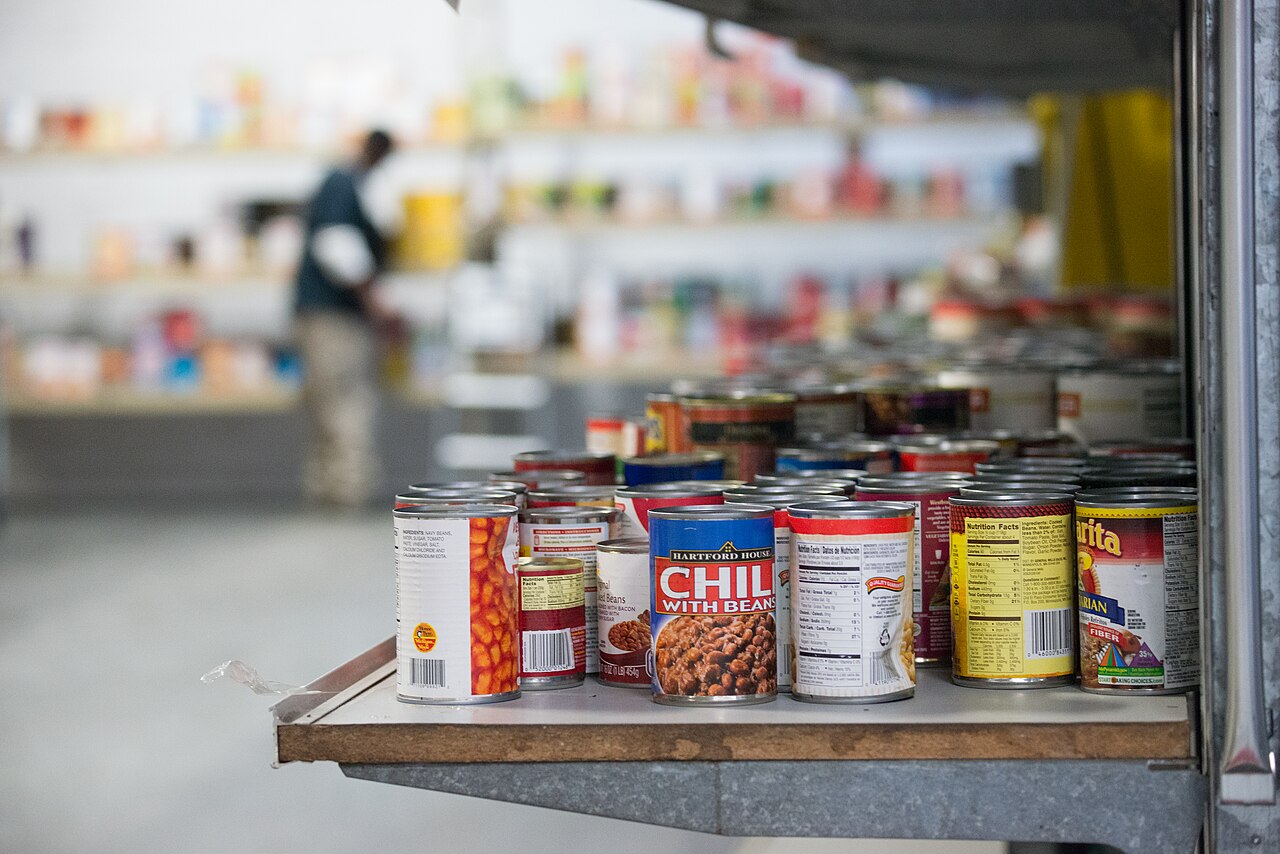
- USDA Foods - Community FoodBank of New Jersey (20160120-FNS-LSC-0434)Wikimedia Commons · Image, public domain, US Department of Agriculture
General information, not medical or benefits advice. This was a yearly online survey in one US state; it shows who reported going short of food, not why. Eligibility for food assistance depends on where you live and your circumstances. If you are struggling to afford food, a local food bank, a benefits adviser or your doctor's practice can point you to help.
Analysis by NutroPractic from the sources listed. Written for general readers; it does not replace advice from your own doctor.
From our articles
Read, then eat a little better
Plain-language guides on nutrition and wellness, backed by research.

Global data
Diabetes, obesity, child malnutrition and hunger, 1980 to 2050: what the numbers show
How diabetes, obesity, child malnutrition and hunger have changed since 1980, with sourced figures and a basic projection to 2050. Click a condition to explore the chart and its facts.
5 Oct 2026

Indian kitchen
Rice, roti and blood sugar: building a balanced Indian plate with the ICMR-NIN 2024 guidelines
About one in nine Indian adults has diabetes and many more have prediabetes. You don't have to give up rice or roti. How the ICMR-NIN Dietary Guidelines for Indians (2024) suggest building a plate, plus simple habits that help keep blood sugar steady.
3 Oct 2026

Micronutrients
Vitamin D and B12: two common gaps, from northern winters to vegetarian kitchens
Vitamin D runs low in Canadian and European winters, and surprisingly often in sunny India too. Vitamin B12 is a risk for vegetarians, people over 50 and people on certain medicines. Who is at risk, what the official advice is in North America, Europe and India, and where to get both.
3 Oct 2026
Newsfeed for your website
Want this feed on your website?
Add it to any site with one copy-and-paste snippet. No sign-up, and it updates itself every hour.
Start with a virtual consultation
Tell Dr. Triveni what you want to change. You will leave with a clear next step, whether you are in Toronto, London, New York or Chennai.