Endurance sport · October 11, 2026
Twenty riders took on the Cape Epic, eight days and 567 km of South African mountain trails, and half of each team drank a ketone shot after every stage and before bed. Their bodies wore down at the same rate as their teammates' on a lookalike placebo
Ketone drinks are sold to endurance athletes as a way to bounce back faster. Researchers in South Africa and Belgium tested one of them where it matters most: inside a real multi-day race, in pairs of riders who shared every kilometre. The drink raised blood ketones as promised. Heart rates, sleep, appetite, mood and reaction times did not budge from placebo. What's interesting is why, and who wrote the paper.
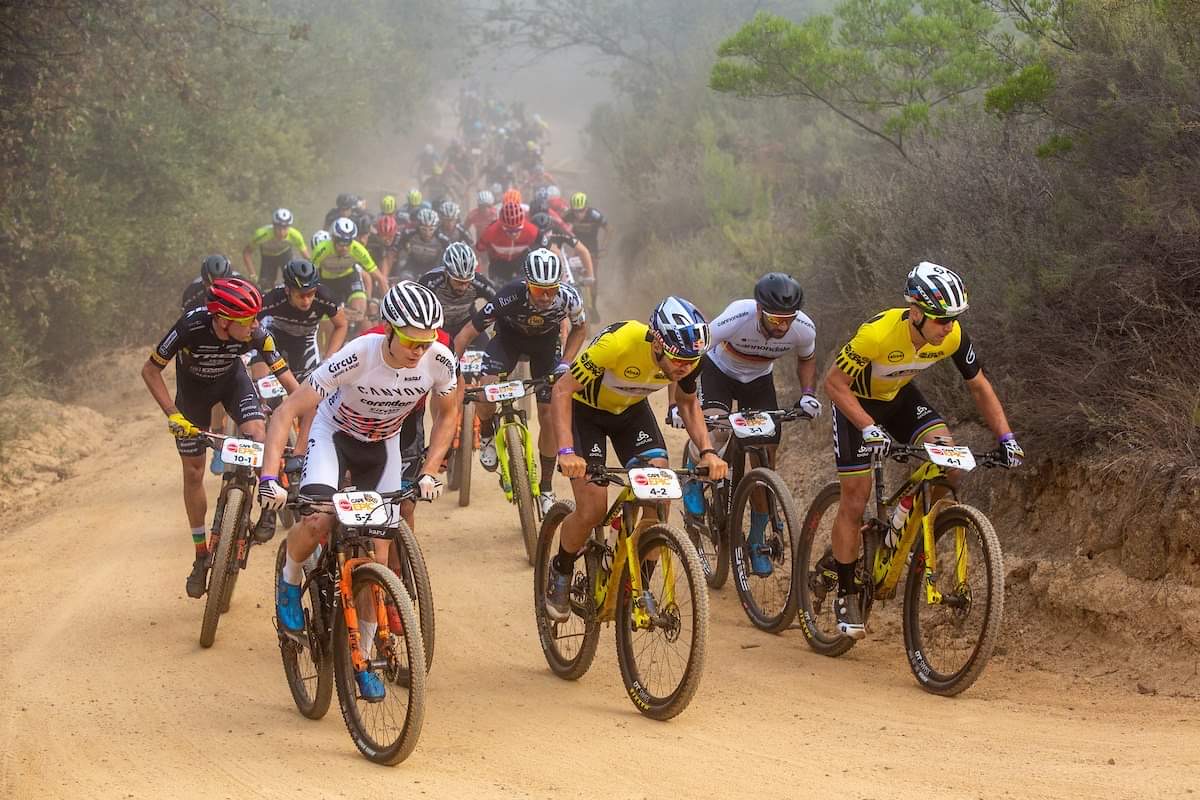
The Absa Cape Epic is a team race. Riders race in pairs and have to stay together, which makes it a neat place to run an experiment: two people on the same course, in the same heat, at the same pace, for eight days. In the 2025 edition that meant 567 km and 15,300 m of climbing in the Western Cape, with one stage reaching 43 °C.
A team from Stellenbosch University, KU Leuven and Hasselt University recruited ten pairs of trained riders who had entered the race. In each pair, one person was picked at random to drink Ketone-IQ, a commercial shot made of R-1,3-butanediol, and the other got a drink made to taste and feel the same with no active ingredient. Neither the riders nor the researchers knew who had which. Each rider took an 87.5 mL shot straight after every stage and another just before sleep. The paper was published on 9 October 2026 in the European Journal of Sport Science.
The idea comes from a solid line of lab research. The body makes ketones when food is short, and drinks that supply them raise blood levels without fasting. In earlier laboratory studies, a different and pricier product, a ketone ester, helped riders cope with deliberately brutal training blocks and protected their sleep after hard evening sessions. Butanediol is cheaper and tastes a little less harsh, but it is not a ketone itself: the liver has to convert it first, so blood levels rise more slowly and peak lower.
That is what happened here. Thirty to forty-five minutes after the post-stage shot, riders on the real drink averaged about 1.0 mmol/L of the main ketone in their blood, against about 0.4 on placebo, peaking near 1.5 by stage 6. The ester studies that found benefits reached 2 to 5 mmol/L.
Everything the researchers measured told the story of a hard race and nothing else. In both groups resting heart rate crept up by 4 to 7 beats a minute, and peak heart rate during stages fell by about 16 beats from the second stage on. Time spent in the easiest heart-rate zone went from about a quarter of the ride to three quarters, a sign of legs that would no longer go hard. Riders ate more as the week went on, around 60 g of carbohydrate an hour on the bike. By stage 6, reaction times had slowed by about 6.5%. REM sleep shrank late in the race. In none of these did the ketone riders differ from their teammates.
Two results look like effects at first glance and aren't. The ketone group reported feeling more mentally alert throughout, but they already felt that way before anyone drank anything. Their peak heart rates were lower across the race, but they fell at the same rate as the placebo group's. The authors flag both themselves, which is to their credit.
The authors suggest three reasons the drink did nothing: the ketone levels were too low, eight days is too short (the ester benefits in the lab took three weeks or more to appear), and fit riders racing at their own pace may simply have less to rescue than people pushed into overtraining on purpose. There was also real-world mess. Riders were told not to eat for 30 minutes after the post-stage shot, but most were soon into a recovery meal of around 92 g of carbohydrate and 45 g of protein, which may have blunted the rise.
Our reading: this is a small study, with 18 finishers, and the authors are right that it can't rule out a modest effect. But it is a properly blinded test of a product as people actually use it, in the conditions it is sold for, and the answer was no. It is also worth noticing who wrote it. One of the authors, Chiel Poffé of KU Leuven, led several of the laboratory studies that made ketone drinks look promising in the first place, and the drinks for this trial were supplied by the company that sells them. The paper reports a null result anyway. For a rider wondering where to spend money before a stage race, the evidence still points to the dull basics: enough carbohydrate on the bike, plenty of food and fluid afterwards, and sleep.
Ketone-IQ (R-1,3-butanediol) against placebo after each stage and before bed: 18 trained riders who finished the 2025 Cape Epic, 8 days
~1.0 vs ~0.4
Blood ketone (beta-hydroxybutyrate, mmol/L) 30 to 45 minutes after the post-stage drink, ketone against placebo. Laboratory studies that found benefits from ketone esters reached 2 to 5
0
Measures of heart rate, appetite, food intake, sleep, mood or thinking where the ketone drink changed the course of the race compared with placebo
−16 bpm
Average fall in peak heart rate during stages from stage 2 onwards, in both groups alike: a sign of accumulating fatigue
24% → 75%
Share of riding time spent in the easiest heart-rate zone, from the opening prologue to the later stages, in both groups
+6.5%
Slower reaction time after stage 6 than after stage 3, with no difference between the groups
8 + 10
Riders who finished on the ketone drink and on placebo. Two of the 20 who started, both on the ketone drink, dropped out (one injured)
Figures are from the full open-access paper (European Journal of Sport Science, published online 9 October 2026), its results, tables and discussion. Ketone values are the model-estimated averages (1.02 against 0.37 mmol/L); the 2 to 5 mmol/L range for ketone-ester studies is the authors' summary of earlier work. The riders were 15 men and 3 women, average age about 36 on placebo and 42 on the ketone drink. Each pair was split at random, one rider per arm. Two 87.5 mL doses added 175 kcal a day, which the authors counted in the food records. At the end, 4 of 18 riders guessed their drink correctly, so blinding largely held. The study was planned around large effects seen in ketone-ester trials (6 pairs needed), so it could miss smaller ones; the authors call the secondary results exploratory. The drinks were supplied by HVMN, the maker of Ketone-IQ; the authors declare no conflicts of interest. The '0' tile is our own count of the outcomes the paper reports.
- The study that started much of the excitement came from the same Leuven lab in 2019. Nine fit men who took a ketone ester after each of two daily sessions for three weeks could sustain a 15% higher training load in the final week than nine who took a control drink, and their energy balance stayed level while the control group's went negative.
- In a 2023 lab study, ten well-trained cyclists slept after hard evening intervals. The exercise cut their REM sleep by 26%, and 25 g of a ketone ester after the session and before bed prevented that drop. In this race study, REM sleep fell in both groups late in the week.
- Ketones are not only a fasting fuel for the brain. A 2013 review describes the heart and skeletal muscle as major users of ketone bodies when carbohydrate is scarce, which is part of why sports scientists got interested.
- Fatigue shows up in the heart rate before riders feel it. A 2014 Stellenbosch thesis on the Cape Epic, cited in this paper, found riders' peak heart rates had already dropped about 11 beats a minute by the third day.
- None of the 18 riders reported stomach problems from either drink, and appetite ratings did not differ between the two groups.
- Post-Exercise R-1,3-Butanediol did not Improve Markers of Fatigue or Recovery During a Multi-Stage Mountain Bike RaceEuropean Journal of Sport Science, 9 October 2026 · The trial (open access); read in full
- Full text on PubMed Central (PMC13650729)US National Library of Medicine · Free full text of the same paper
- Ketone ester supplementation blunts overreaching symptoms during endurance training overloadJournal of Physiology, 2019 · The three-week overload study
- Exogenous Ketosis Improves Sleep Efficiency and Counteracts the Decline in REM Sleep after Strenuous ExerciseMedicine & Science in Sports & Exercise, 2023 · The sleep study in ten cyclists
- Ketone body metabolism and cardiovascular diseaseAmerican Journal of Physiology: Heart and Circulatory Physiology, 2013 · Review of how the heart and muscles use ketones
- Cape epic petter fagerhaug 4 (photo)Wikimedia Commons · Image, CC BY 4.0
General information, not medical advice. This was one small trial in trained, healthy riders during a single race. Ketone drinks raise blood ketone levels and add calories; if you have diabetes, take medicines that affect blood sugar, or are pregnant, talk to your doctor before using one.
Analysis by NutroPractic from the sources listed. Written for general readers; it does not replace advice from your own doctor.
From our articles
Read, then eat a little better
Plain-language guides on nutrition and wellness, backed by research.
Global data
Diabetes, obesity, child malnutrition and hunger, 1980 to 2050: what the numbers show
How diabetes, obesity, child malnutrition and hunger have changed since 1980, with sourced figures and a basic projection to 2050. Click a condition to explore the chart and its facts.
5 Oct 2026
Indian kitchen
Rice, roti and blood sugar: building a balanced Indian plate with the ICMR-NIN 2024 guidelines
About one in nine Indian adults has diabetes and many more have prediabetes. You don't have to give up rice or roti. How the ICMR-NIN Dietary Guidelines for Indians (2024) suggest building a plate, plus simple habits that help keep blood sugar steady.
3 Oct 2026
Micronutrients
Vitamin D and B12: two common gaps, from northern winters to vegetarian kitchens
Vitamin D runs low in Canadian and European winters, and surprisingly often in sunny India too. Vitamin B12 is a risk for vegetarians, people over 50 and people on certain medicines. Who is at risk, what the official advice is in North America, Europe and India, and where to get both.
3 Oct 2026
Newsfeed for your website
Want this feed on your website?
Add it to any site with one copy-and-paste snippet. No sign-up, and it updates itself every hour.
Start with a virtual consultation
Tell Dr. Triveni what you want to change. You will leave with a clear next step, whether you are in Toronto, London, New York or Chennai.