Food is medicine · October 13, 2026
New Orleans gave people with high blood pressure $100 a month for groceries, in a store or online. Store shoppers spent more than nine in ten of their vouchers, online shoppers under two in three, and blood pressure did not measurably change in either group
'Food is medicine' is one of the busiest ideas in American health care: pay for healthy groceries and let the food do some of the work. A small trial backed by the American Heart Association tested the simplest version on 98 people and compared two ways of handing over the money. The fruit-and-vegetable figure went up in both groups. The more useful lesson is about where people actually like to shop.
Ask a doctor what someone with high blood pressure should eat and fruit and vegetables come near the top of the list. Ask that person why they don't eat more of them and the answer is often money, or the distance to a decent shop. So a growing number of American programmes skip the advice and hand over the groceries, or at least the money for them. The American Heart Association calls its version of this the Food Is Medicine initiative.
One of its first pilots, run by Duke University with the Louisiana Public Health Institute and University Medical Center New Orleans, was published in the Journal of the American Heart Association on 10 October 2026. It recruited 98 people in the New Orleans area whose blood pressure was not under control. Their average age was 57, and 65% were women.
Everyone got the same thing, a $100 food voucher every month for five months, plus leaflets on healthy eating. What differed was where the money could be spent. Half could spend it on Instacart, the online grocery delivery service. The other half could spend it in person at Rouses Market, a local supermarket chain. The question was whether one route would lead people to eat more fruit and vegetables than the other.
It didn't. The study found no difference between the two groups in how much fruit and veg people said they ate. Across both groups together, reported intake rose by 20% over the five months. That number hides a wide spread: the interquartile range ran from a 17% fall to a 93% rise, so at least a quarter of the participants said they were eating less produce at the end than at the start.
Where the groups did differ was in using the help at all. In the store group, more than 90% of the voucher money was used. In the online group, less than 64% was. People in the store group also engaged more with the educational material. The authors' conclusion points to technology: future programmes should 'address technological barriers'. A free $100 that has to be spent through an app, a delivery slot and an online checkout is, for some people, not quite free.
On health, the trial found nothing to report. There were no significant changes in blood pressure, weight or body mass index in either group.
That is not a verdict on food as medicine. This was a pilot, built to compare two delivery routes, not to test vouchers against no vouchers. With no group that got nothing, the 20% rise in fruit and veg can't be credited to the vouchers rather than to people knowing they were in a study, or to the season. Intake was self-reported, which tends to drift in the direction people think the researchers want. And five months of $100 a month is a modest dose for a condition that usually takes medicines, sustained changes in salt and diet, and time to shift.
The practical finding is a quieter one, and arguably more useful for anyone designing these schemes. Before deciding whether healthy food changes blood pressure, a programme has to get the food into people's kitchens. In this group of mostly older adults, a familiar supermarket did that far better than a delivery app.
Randomised pilot trial, New Orleans, USA: 98 adults with uncontrolled high blood pressure; $100 a month in grocery vouchers for 5 months, to spend online (Instacart) or in person (Rouses Market)
98
Participants, mean age 57, 65% women, all with uncontrolled high blood pressure
$100 × 5
A grocery voucher every month for five months, in both groups
> 90% vs < 64%
Share of the vouchers used: in-store group against online group
+20%
Reported fruit and vegetable intake, both groups together (interquartile range −17% to +93%)
No difference
Between online and in-store groups in fruit and vegetable intake, the main outcome
0
Significant changes in blood pressure, weight or BMI
Figures are from the published abstract of the paper in the Journal of the American Heart Association (doi 10.1161/JAHA.125.044984, online 10 October 2026). We could not open the full text, so we give no figures beyond the abstract. As stated there: randomised pilot trial; 98 participants with uncontrolled hypertension; $100 monthly food voucher to an online grocery platform or an in-store local grocery; both groups received educational materials; primary outcome change in self-reported fruit and vegetable consumption; secondary outcomes voucher use, engagement with educational materials, and changes in blood pressure, weight and BMI; analysed with generalised estimating equations over 5 months. Results: mean age 57, 65% women; no difference between arms in fruit and vegetable consumption; overall 20% increase (interquartile range −17% to 93%) within both arms; voucher use above 90% in-store and below 64% online; greater engagement with educational materials in-store; no significant changes in weight, BMI or blood pressure. The platform (Instacart) and store (Rouses Market), the five-month voucher period, the sponsors and the trial dates (March to October 2024) are from the ClinicalTrials.gov record NCT06214806. 'At least a quarter reported eating less' is our reading of the interquartile range. The trial had no group without vouchers.
- The trial's short title in its registry entry is 'Food Is Medicine: Makin' Healthy Groceries'. The researchers also planned to check how closely what people bought matched what they said they ate.
- In its registry entry, people without internet access at home, a library, a relative's or on their phone plan could not join, so every participant had some way to get online. The online group still left more than a third of its vouchers unspent.
- Instacart and Rouses Market are both listed as collaborators on the trial, alongside the American Heart Association and Duke University.
- Food-is-medicine programmes come in three main forms: medically tailored meals delivered ready to eat, medically tailored grocery boxes, and produce prescriptions or vouchers like the ones in this trial. The last is the cheapest and the least controlled.
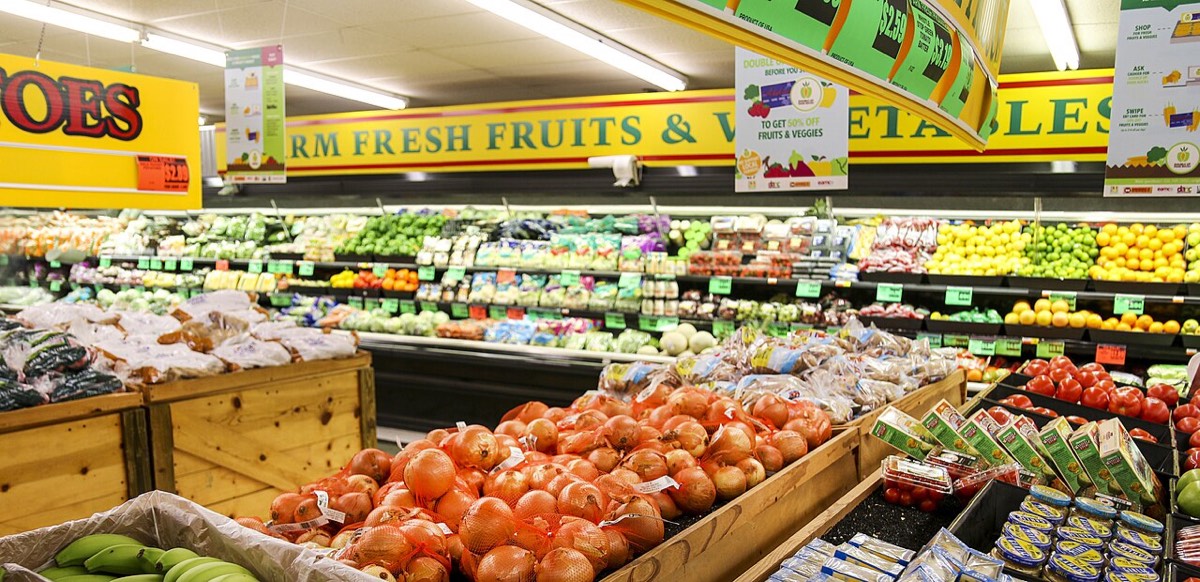
- The sign in the photo above advertises 50% off fruits and veggies, a common kind of produce incentive in American supermarkets. It has nothing to do with this trial.
- Pilot Randomized Trial of 2 Food Purchasing Interventions in Individuals With Hypertension in New Orleans: An American Heart Association Food Is Medicine InitiativeJournal of the American Heart Association, online 10 October 2026 · The study. We read the abstract only
- Food Is Medicine: Makin' Healthy Groceries (NCT06214806)ClinicalTrials.gov · Registry entry: arms, eligibility, sponsors and dates
- Fruit section of a grocery storeWikimedia Commons · Image, CC0, Alabama Extension
General information, not medical advice. This was a small pilot comparing two ways of giving out grocery vouchers. If you have high blood pressure, keep taking any medicines you have been prescribed and speak to your doctor or a registered dietitian before changing your diet.
Analysis by NutroPractic from the sources listed. Written for general readers; it does not replace advice from your own doctor.
From our articles
Read, then eat a little better
Plain-language guides on nutrition and wellness, backed by research.

Global data
Diabetes, obesity, child malnutrition and hunger, 1980 to 2050: what the numbers show
How diabetes, obesity, child malnutrition and hunger have changed since 1980, with sourced figures and a basic projection to 2050. Click a condition to explore the chart and its facts.
5 Oct 2026

Indian kitchen
Rice, roti and blood sugar: building a balanced Indian plate with the ICMR-NIN 2024 guidelines
About one in nine Indian adults has diabetes and many more have prediabetes. You don't have to give up rice or roti. How the ICMR-NIN Dietary Guidelines for Indians (2024) suggest building a plate, plus simple habits that help keep blood sugar steady.
3 Oct 2026

Micronutrients
Vitamin D and B12: two common gaps, from northern winters to vegetarian kitchens
Vitamin D runs low in Canadian and European winters, and surprisingly often in sunny India too. Vitamin B12 is a risk for vegetarians, people over 50 and people on certain medicines. Who is at risk, what the official advice is in North America, Europe and India, and where to get both.
3 Oct 2026
Newsfeed for your website
Want this feed on your website?
Add it to any site with one copy-and-paste snippet. No sign-up, and it updates itself every hour.
Start with a virtual consultation
Tell Dr. Triveni what you want to change. You will leave with a clear next step, whether you are in Toronto, London, New York or Chennai.