Ageing and loneliness · October 13, 2026
Twelve people over 65 who live alone in Barcelona let researchers photograph their fridges. In several kitchens the healthy food was right there. What was missing was someone to cook it for
Ask why older people living alone eat badly and the usual answers are money, mobility and knowledge. A small Barcelona study went into their kitchens, opened the fridge and asked them to talk. Only two of the twelve ate enough vegetables, even where the fridge was well stocked. 'I don't eat cockles alone,' one woman said. 'There are things to eat that are social.'
Researchers at the Open University of Catalonia spent the spring and summer of 2025 visiting twelve people aged 66 to 87 who live alone in Barcelona. Some had been widowed seven months earlier. Others had been on their own for decades. Everyone still did their own shopping and cooking, and nobody had dementia. Each visit was an interview of about an hour at the kitchen table, a short questionnaire on how closely they ate to a Mediterranean diet, and then three photographs: the open fridge, the open cupboard and the kitchen as a whole. The study came out in Frontiers in Nutrition on 8 October 2026.
The questionnaire scores were middling to low: 6.75 out of 14 on average, by the paper's count. Everyone cooked with olive oil, and eleven of the twelve chose chicken or other white meat over red. Then the gaps showed. Only two ate the recommended two servings of vegetables a day, and only three ate three pieces of fruit.
The photographs are what make the study unusual. The researchers scored them on a scale they built for the purpose, counting fresh produce, legumes, nuts, olive oil and home-cooked food in containers against ready meals and a cluttered microwave. Four kitchens scored well enough to count as 'promoting' a Mediterranean diet. In three of those four, the person's own diet still scored only moderate. The food was in the house and wasn't being eaten.
The interviews explain why. Cooking for one felt pointless. 'If I had to cook for one, I would eat a salad and a steak every day,' said one man, who cooks a big pot and lives off containers. Meals had shrunk to a single plate eaten in ten or fifteen minutes, always in the same seat, usually with the television on 'for company'. Several people skipped dinner or had a yogurt or herbal tea instead. One woman had stopped having dinner at all a fortnight earlier.
Some foods disappeared because they only made sense with other people. 'I don't eat cockles alone... or buy them, even if I like them. I know it's silly, but there are things to eat that are social,' one woman said. A man had given up wine because drinking alone felt wrong. Paella and home-made cannelloni went the same way. Restaurants were for company only: 'Eating out alone sometime? Never, never.' Fruit had a quieter problem. Bought for one, it went off before it was eaten, so people stopped buying it.
Men and women lived alone differently. For several widowed women, not having to cook for a husband felt like freedom, and their meals got simpler. Several of the men had never really learned to cook. The two lowest kitchen scores, both below zero, belonged to men: one heated frozen portions in the microwave and nothing else, the other had stopped looking after the kitchen after his wife died.
The one person who scored high on both measures was a 72-year-old woman who still cooks every day, for her granddaughters. The authors read her as the study's clearest lesson: having someone to feed protects the diet. It is one person, but she stood out.
This is a small qualitative study, and it says so. Twelve people in one city cannot tell you how common any of this is. The kitchen score is the authors' own and has not been validated. There are also loose ends in the paper. The methods count seven women and five men, but the participant table lists six of each. Averaged from that table, the diet scores come to about 6.2, not 6.75. And the text says three kitchens reached the 'promoting' level, then names four. None of this changes the picture the interviews paint, but the numbers deserve less weight than the stories.
What the study adds is a reason why 'eat more vegetables' leaflets may not reach people who eat alone. The authors' conclusion is that advice alone won't fix it, and that shared meals and company matter as much as the shopping list.
Mixed-methods study, Barcelona: 12 adults aged 66 to 87 living alone, interviewed at home in March to September 2025, with a Mediterranean diet questionnaire and photographs of fridge, pantry and kitchen
12
People over 65 living alone, interviewed at home for about 55 minutes each
6.75 / 14
Average Mediterranean diet score reported in the paper (moderate to low)
2 of 12
Ate the recommended two servings of vegetables a day
3 of 12
Ate three or more pieces of fruit a day
4 of 12
Kitchens that scored as 'promoting' a Mediterranean diet. Only one of those people ate that way
1
Person who scored high on both: she cooks every day for her granddaughters
Figures are from the open-access paper in Frontiers in Nutrition (doi 10.3389/fnut.2026.1947655, published 8 October 2026), which we read in full. Diet was scored with the 14-item Mediterranean Diet Adherence Screener (MEDAS: 5 or less is low, 6 to 8 moderate, 9 or more high). Kitchens were scored by two researchers from photographs with the authors' own HFE-MED-PHOTO index (−7 to 16 points; 9 or more 'promoting', +2 to +8 'vulnerable', +1 or less 'risk'); the group average was 5.83, and two kitchens scored below zero. Inconsistencies we found in the paper: the methods report 7 women and 5 men, while the participant table lists 6 of each; the MEDAS scores in that table average 6.17, not the 6.75 given in the text; the text says three participants reached a promoting kitchen score but names four (scores of 10, 12, 11 and 9, matching the table); the youngest age in the table is 68, against a stated range of 66 to 87. The quotes are the authors' English translations from Spanish or Catalan. Funded by the Spanish Research Agency as part of a national project on food, ageing and loneliness; the authors declare no conflicts of interest. 'Small' and 'deserve less weight' are our reading.
- Barcelona is one of Europe's older cities: 26% of its people are 65 or over, and among those over 80, three in ten live alone, according to the city figures quoted in the paper.
- 'Commensality' is the word researchers use for eating together. UNESCO listed the Mediterranean diet as part of humanity's intangible cultural heritage in 2010, and the listing covers the shared meal, not just the olive oil and vegetables.
- Of the four 'promoting' kitchens, one belonged to an 87-year-old man whose daughter comes once a week to clean and prepare fresh vegetables for him. His diet score was the second highest in the study.
- Every one of the twelve refused to shop online. Going to the shops almost every day was a reason to leave the house and talk to people, and they wanted to see and choose their fresh food themselves.
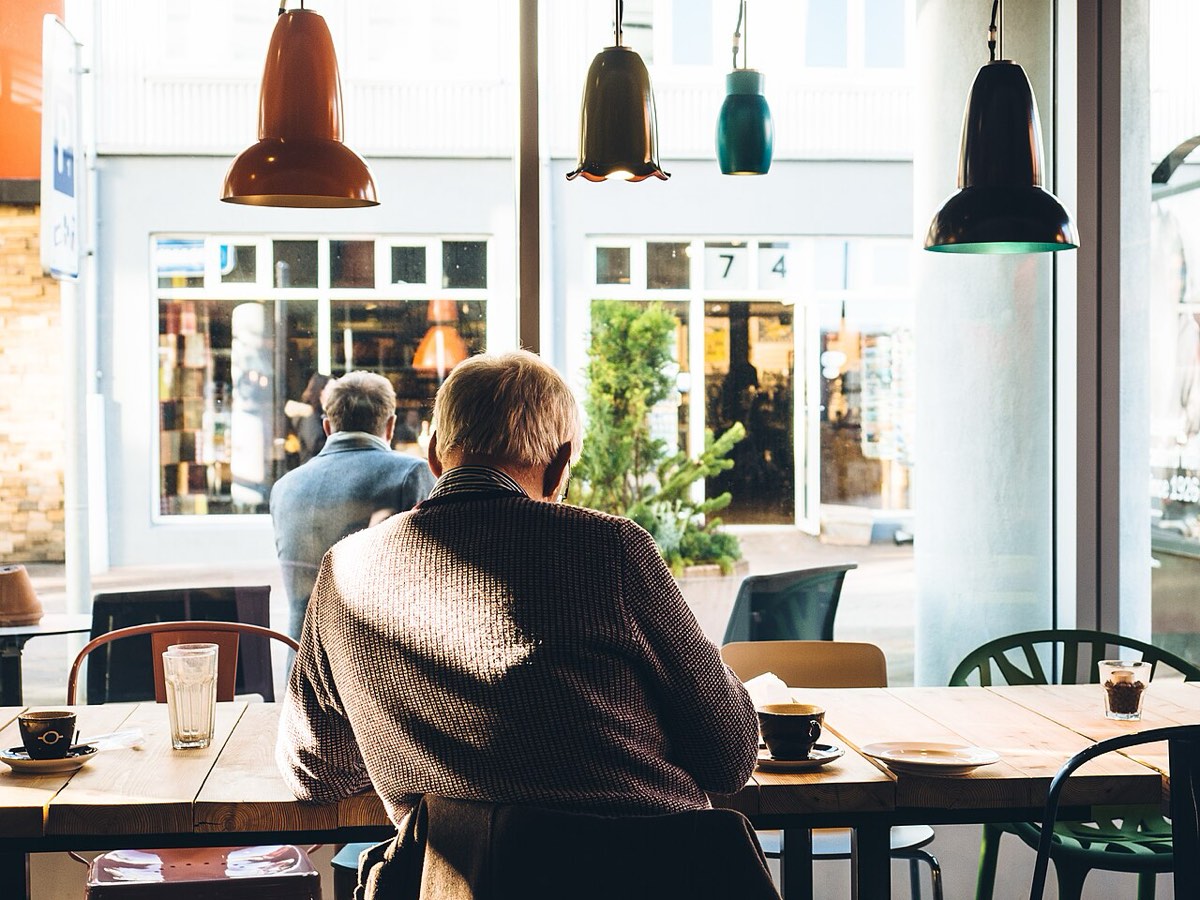
- The man in the photo is alone at a café table. Nobody in the study would do that: restaurants, they said, are for company.
- Unwanted loneliness, food practices, and Mediterranean diet adherence among older adults in Barcelona city (Spain)Frontiers in Nutrition, 8 October 2026 (open access) · The study. Full text read, including both tables, the limitations and the funding
- Mediterranean diet: inscribed on the Representative List of the Intangible Cultural Heritage of HumanityUNESCO · Background on the 2010 listing
- Old man reading newspaper with tea (Unsplash)Wikimedia Commons · Image, CC0, Jeff Sheldon
General information, not medical advice. This was a small interview study of twelve people and cannot show how common these patterns are or what causes them. If you or someone close to you is eating less, skipping meals or losing weight after living alone, speak to a doctor or a registered dietitian.
Analysis by NutroPractic from the sources listed. Written for general readers; it does not replace advice from your own doctor.
From our articles
Our guides on this subject
Plain-language guides on nutrition and wellness, backed by research.
Healthy ageing
Protein after 40: how much you really need, and why timing matters
The standard protein target was set to prevent deficiency, not to protect muscle as you age. What the research and expert groups suggest for adults over 40, how to spread protein across the day, and easy ways to hit 25 to 30 grams at breakfast.
3 Oct 2026

Global data
Diabetes, obesity, child malnutrition and hunger, 1980 to 2050: what the numbers show
How diabetes, obesity, child malnutrition and hunger have changed since 1980, with sourced figures and a basic projection to 2050. Click a condition to explore the chart and its facts.
5 Oct 2026

Indian kitchen
Rice, roti and blood sugar: building a balanced Indian plate with the ICMR-NIN 2024 guidelines
About one in nine Indian adults has diabetes and many more have prediabetes. You don't have to give up rice or roti. How the ICMR-NIN Dietary Guidelines for Indians (2024) suggest building a plate, plus simple habits that help keep blood sugar steady.
3 Oct 2026
Newsfeed for your website
Want this feed on your website?
Add it to any site with one copy-and-paste snippet. No sign-up, and it updates itself every hour.
Start with a virtual consultation
Tell Dr. Triveni what you want to change. You will leave with a clear next step, whether you are in Toronto, London, New York or Chennai.