Child development · October 13, 2026
Spanish researchers measured omega-3 in the cord blood of 953 newborns, then tested the children until they were 15. The fish omega-3 and the plant omega-3 went with different things at different ages, and one of them faded
Pregnant women are told that omega-3 matters for the baby's brain. Most of the evidence stops in the early years, when the children are still small. A Spanish birth cohort kept going through primary school and into the teens, and found the picture changes as the children grow. The plant omega-3 looked best at five. The fish omega-3 looked better at fifteen.
The blood left in the umbilical cord after a birth is a record of what reached the baby in the last stretch of pregnancy. Between 2003 and 2008 a Spanish project called INMA, short for Infancia y Medio Ambiente (childhood and environment), recruited 2,644 pregnant women in four regions and kept cord blood from many of the births. Years later, researchers measured three omega-3 fatty acids in 953 of those samples.
The three were DHA and EPA, which come mostly from fish and seafood, and ALA, the plant omega-3 found in walnuts, flaxseed and some vegetable oils. Then they went back to what the children had done since. The same children had sat computer tests of attention at about 5, 7 and 11, tests of working memory at 7, 11 and 15, and reasoning puzzles at about 9 and 15. The results came out in the European Journal of Epidemiology on 8 October 2026.
Averaged over the whole of childhood, two findings stood out. Children whose cord blood was in the top third for DHA were less inattentive than those in the bottom third, by 0.20 of a standard deviation, and had better working memory, by 0.24. Children in the top third for ALA were also less inattentive, by 0.19. EPA was linked to nothing at all, and none of the three was linked to reasoning scores overall.
A fifth of a standard deviation is small. It is a difference you can see across several hundred children and would not notice in one child.
The more interesting part is what happened with age. For ALA, the advantage sat at the start. The model put high-ALA children well ahead on attention at 5 and 7, and then the gap closed and reversed: by 15 the high-ALA group was the more inattentive one. Reasoning followed the same shape, ahead early and behind at 15.
DHA ran the other way. On attention, high-DHA children were no better at 5, a little better at 7, and the gap kept widening to 15. On reasoning they started behind and finished ahead. Working memory was the exception: the DHA advantage was largest in the early years and had mostly gone by 15.
The authors read this as two fats doing different jobs, ALA giving early support and DHA helping the slower maturing of attention and reasoning. That is one reading. Another is more cautious. The study tested three fatty acids against three kinds of thinking at several ages, and a pattern where an early advantage flips into a later disadvantage is the kind of result that needs to turn up again in another cohort before anyone leans on it.
There are plainer limits too. Nobody gave these mothers omega-3; the study only observed what was in the cord. Mothers with more DHA in their blood eat more fish, and families who eat more fish differ in other ways. The researchers adjusted for the mother's age, education, weight, alcohol and overall diet, and in extra checks for her verbal IQ, breastfeeding, the child's own fish and nut intake and mercury, and the results held. They still say plainly that leftover confounding 'remains a fundamental issue'. Cord blood also reflects the weeks before birth, not the whole pregnancy, and no blood was taken from the teenagers, so their own diet since can't be separated out.
One line in the funding section is worth knowing about. Alongside Spanish and European public funds, the California Walnut Commission gave support, and walnuts are a leading source of ALA. The authors declare no conflicts of interest, and the ALA result that lasted to 15 was not a flattering one.
None of this changes the standard advice, which is that pregnant women benefit from eating fish that is low in mercury a couple of times a week. What it adds is a reason to be patient with the science. A study that stopped at age 7 would have told a different story from one that ran to 15.
Birth cohort, Spain (INMA project: Asturias, Gipuzkoa, Sabadell, Valencia): omega-3 in cord plasma of 953 newborns, and attention, working memory and reasoning tests from age 5 to 15
953
Newborns with omega-3 measured in cord plasma, from 2,644 women recruited in 2003 to 2008
714 / 668 / 600
Children with attention, working memory and reasoning scores
−0.20 SD
Inattentiveness across childhood, highest against lowest third for DHA (95% CI −0.35 to −0.04)
+0.24 SD
Working memory across childhood, highest against lowest third for DHA (95% CI 0.08 to 0.39)
−0.44 → +0.56
Inattentiveness, high against low ALA, at age 5 and at age 15: the early advantage reversed
0
Significant links between EPA and any of the three outcomes
Figures are from the open-access paper in the European Journal of Epidemiology (doi 10.1007/s10654-026-01461-8, published 8 October 2026), which we read in full. Cord plasma ALA, DHA and EPA were expressed as a percentage of total fatty acids and split into thirds; the comparisons are the highest against the lowest third. Test scores were converted to age-specific z-scores, so differences are in standard deviations. Inattentiveness was the variability of reaction time (HRT-SE) on the Conners' Kiddie Continuous Performance Test and the Attention Network Test at about 5, 7 and 11 years; working memory was the 3-back score on the N-back task at 7, 11 and 15; fluid intelligence (we say 'reasoning') was Raven's Progressive Matrices and the Spanish Test of Primary Mental Abilities at about 9 and 15. Overall associations: ALA and inattentiveness β −0.19 (95% CI −0.35 to −0.02); DHA and inattentiveness β −0.20 (−0.35 to −0.04); DHA and working memory β 0.24 (0.08 to 0.39); none for fluid intelligence or EPA. The age-specific differences (ALA and inattentiveness −0.44 at age 5, −0.24 at 7, +0.56 at 15; ALA and fluid intelligence +0.76 at 5, +0.53 at 7, −0.37 at 15; DHA and inattentiveness −0.19, −0.43 and −0.67 from age 7 onward; DHA and working memory +0.54 at 5, +0.44 at 7, +0.24 at 11; DHA and fluid intelligence −0.40 at 5 and +0.40 at 15) are values predicted by the paper's mixed models, including at ages where that test was not given. Models adjusted for the child's sex and the mother's age, education, body mass index, Mediterranean diet score and alcohol in pregnancy. When the analysis was weighted for children lost to follow-up, the DHA and working memory trend with age was no longer statistically significant. 'Small' and the remarks about replication are our reading, not the authors'.
- EPA made up only 0.24% of the fatty acids in these babies' cord plasma, against more than 5% for DHA. The authors think the placenta favours passing DHA to the baby, which may be why EPA showed no link with anything.
- The working memory test was a '3-back': the child watches a stream of numbers and has to say whether the one on screen matches the one shown three steps earlier.
- The body can turn the plant omega-3, ALA, into DHA, but only a small share of it is converted. That is why fish and seafood, or algae oil for people who eat no fish, are the usual sources of DHA.
- Mothers in the two northern regions of the study, Asturias and Gipuzkoa, ate more fish and nuts and kept closer to a Mediterranean diet than those in Sabadell and Valencia.
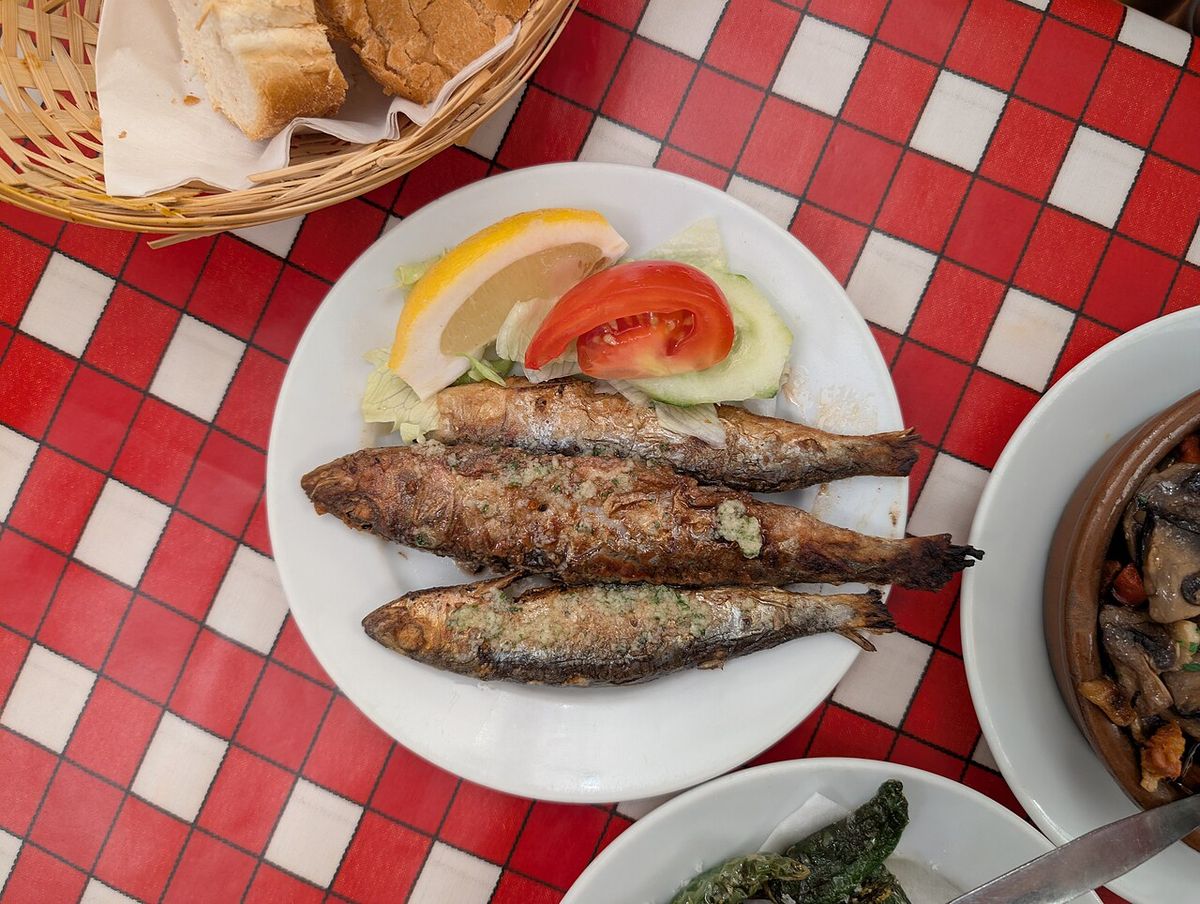
- The sardines in the photo were served at a Spanish restaurant in Brighton, England. Small oily fish like these are rich in DHA and EPA and sit low in the food chain, so they carry little mercury.
- Omega-3 cord plasma proportions and cognitive function trajectories from 5 to 15 years of age: a population-based cohort studyEuropean Journal of Epidemiology, 8 October 2026 (open access, CC BY 4.0) · The study. Full text read, including methods, limitations and funding
- INMA: Infancia y Medio Ambiente (Environment and Childhood) projectINMA project · The birth cohort the children belong to
- Sardinas Plancha - Casa Don Carlos 2025-10-01Wikimedia Commons · Image, CC0, Andy Li
General information, not medical advice. This was an observational study and cannot show that omega-3 in pregnancy caused the differences. If you are pregnant or planning a pregnancy, speak to your doctor or midwife about fish, seafood and supplements before changing what you take.
Analysis by NutroPractic from the sources listed. Written for general readers; it does not replace advice from your own doctor.
From our articles
Read, then eat a little better
Plain-language guides on nutrition and wellness, backed by research.

Global data
Diabetes, obesity, child malnutrition and hunger, 1980 to 2050: what the numbers show
How diabetes, obesity, child malnutrition and hunger have changed since 1980, with sourced figures and a basic projection to 2050. Click a condition to explore the chart and its facts.
5 Oct 2026

Indian kitchen
Rice, roti and blood sugar: building a balanced Indian plate with the ICMR-NIN 2024 guidelines
About one in nine Indian adults has diabetes and many more have prediabetes. You don't have to give up rice or roti. How the ICMR-NIN Dietary Guidelines for Indians (2024) suggest building a plate, plus simple habits that help keep blood sugar steady.
3 Oct 2026

Micronutrients
Vitamin D and B12: two common gaps, from northern winters to vegetarian kitchens
Vitamin D runs low in Canadian and European winters, and surprisingly often in sunny India too. Vitamin B12 is a risk for vegetarians, people over 50 and people on certain medicines. Who is at risk, what the official advice is in North America, Europe and India, and where to get both.
3 Oct 2026
Newsfeed for your website
Want this feed on your website?
Add it to any site with one copy-and-paste snippet. No sign-up, and it updates itself every hour.
Start with a virtual consultation
Tell Dr. Triveni what you want to change. You will leave with a clear next step, whether you are in Toronto, London, New York or Chennai.