Omega-3 · October 10, 2026
Omega-3 from a glass of chocolate soymilk instead of a capsule: it reached the blood in 21 adults, but 'as good as the capsule' is a stretch
Food scientists at Ohio State stirred algae oil into chocolate soymilk and gave it to healthy adults for four weeks, while another group swallowed algae oil capsules. EPA and DHA rose in everyone's blood, and nobody complained much about fishiness. The interesting part is the DHA comparison: the capsule won at first, and the tie only appeared after an adjustment in a study too small to settle it.
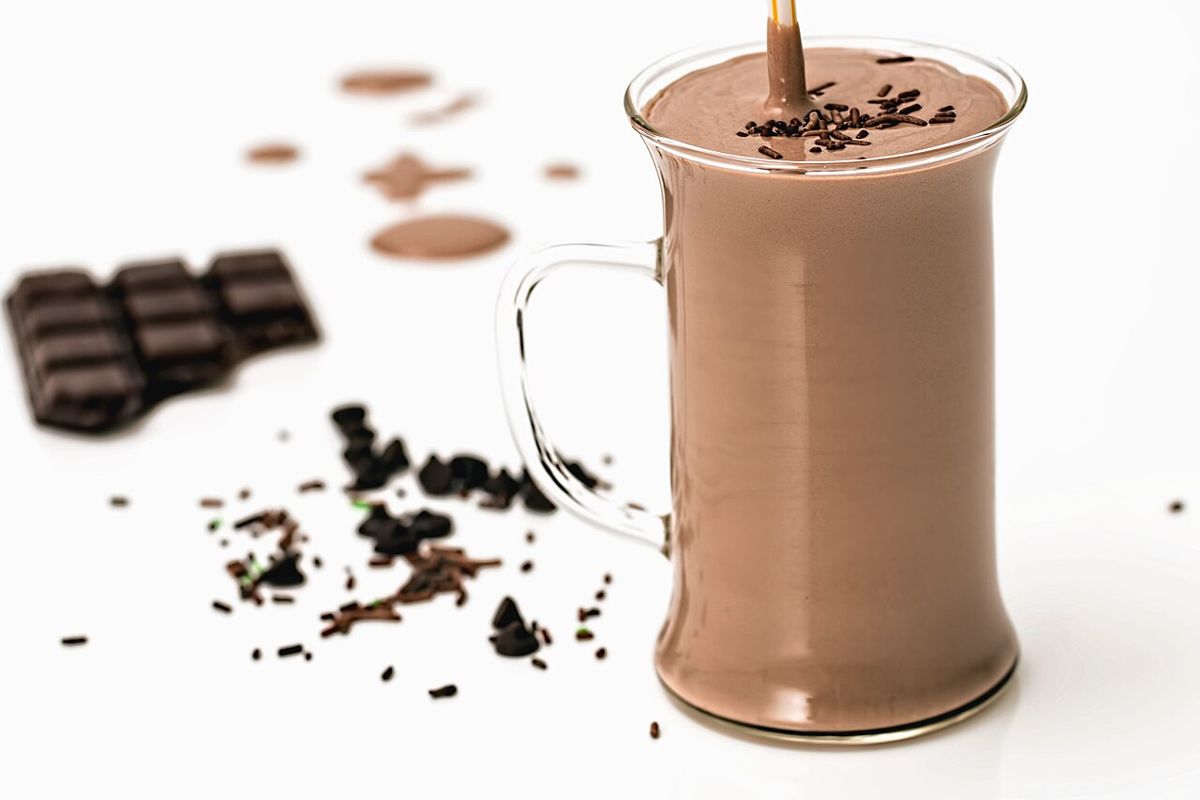
EPA and DHA are the two long-chain omega-3 fats that most people get from oily fish, and most people don't eat much oily fish. Capsules are the usual workaround. A team in the Department of Food Science and Technology at The Ohio State University wanted to know whether the same fats could ride in an ordinary drink instead, and chose soymilk, partly because it holds an oil emulsion well and partly because chocolate soymilk can hide the taste of algae oil. Their trial was published in Food & Function on 8 October 2026.
They screened 51 volunteers, randomised 23 and ended with 21: healthy adults with an average age of about 28, roughly half of them women, none of whom had taken omega-3 supplements in the previous three months. Everyone first spent two weeks drinking a plain chocolate soymilk with no algae oil in it. Then 10 people drank 12 US fluid ounces a day of the fortified version (200 mg of EPA and 320 mg of DHA), and 11 took two algae oil capsules a day (230 mg of EPA and 380 mg of DHA) for four weeks. All were asked to keep fish and other marine omega-3 out of their diet. Blood was drawn after an overnight fast at the start, at two weeks and at four weeks, and the team measured EPA and DHA as a share of the fats in red blood cells, in plasma and in a type of white blood cell.
Both routes worked. EPA and DHA were up in all three parts of the blood after two weeks and higher again after four, in both groups. People took what they were given: about 96% of the drinks and 97% of the capsules were consumed. The soymilk scored 6.0 out of 9 for overall liking on the first day and 6.1 on the last, which on that scale is 'like slightly', and its fishy-flavour rating stayed at 2 or below on a 10-point line. Some people reported nausea, gas, diarrhoea or bloating, mostly during the two run-in weeks on plain soymilk, and the paper says these had settled by the time the fortified drink began. There were no serious adverse events.
Now the comparison, which is the point of the trial. For EPA the two groups rose in step (P = 0.35). For DHA they did not: red blood cell DHA and plasma DHA both rose more in the capsule group (P = 0.01 for each). The authors point out that the capsules turned out to carry a little more of both fats than the drink, so they re-ran the analysis as change in blood level per milligram actually consumed, counting any stray fish people ate as well. On that basis the gap in red cell DHA was no longer statistically significant, with P = 0.08, and the abstract concludes that the soymilk is 'a comparable food-based alternative to traditional capsules'.
From here the reading is ours. 'No significant difference' and 'the same' are different claims, and this trial was not built to make the second one. The sample size was worked out to catch a 20% difference in red cell DHA, so anything smaller could slip through unseen, and a P of 0.08 from 21 people leans toward the capsule more than it rules a gap out. The dose correction is also the authors' second analysis; the model they set out with found a DHA difference. There are other reasons for caution in the methods: everyone knew which product they had, the paper states that allocation was not concealed, and the soymilk group started with a higher average BMI (25.6 against 22.8). The team's own models found that heavier people gained less EPA in their red cells, which may be part of why the drink group lagged, or may not. Nobody can tell from 21 people.
What the study does show is modest and still useful: algae oil mixed into soymilk gets into the blood, people will drink it daily for a month, and it doesn't taste of fish. That matters for vegetarians and vegans, for whom algae is the only direct source of EPA and DHA. What it does not show is a health effect of any kind. Nothing but blood fats was measured, and four weeks is too short even for those to level off, as the authors say; red blood cells take about four months to turn over. This is also a product the team developed, and nothing you can buy. The work was supported by the university's cancer centre and the US National Institutes of Health, and partly funded by the Ohio Soybean Council, which the paper says had no role in the product, the study design, the analysis or the writing. The authors declare no conflicts of interest.
Algae oil in chocolate soymilk or in capsules for 4 weeks in 21 healthy adults (Columbus, Ohio)
21
People who finished, of 23 randomised and 51 screened: 10 on fortified soymilk, 11 on capsules
520 vs 610 mg
EPA plus DHA a day in the soymilk (200 + 320 mg) and in the two capsules (230 + 380 mg)
P = 0.01
Red blood cell DHA rose more with capsules than with soymilk in the main model; the same was true in plasma
P = 0.08
The same red cell DHA comparison after adjusting for each person's actual intake: no longer statistically significant
96.1% and 96.8%
Share of the daily drinks and of the daily capsules that people actually consumed
6.1 out of 9
Overall liking of the fortified soymilk on day 28 ('like slightly'); the plain version scored 6.0
Figures are from the full open-access paper (Food & Function, published online 8 October 2026), its methods, tables 1 to 4 and discussion. Doses are those given in the abstract; the discussion describes the capsules as carrying 25 mg more EPA and 65 mg more DHA, a slightly different rounding of the same measurements. The 520 and 610 mg totals are our addition. The trial was open-label with a 2-week run-in on unfortified soymilk; groups were stratified by sex and randomised with a spreadsheet random number generator. Average age was 27.6 years in the capsule group and 27.7 in the soymilk group. Adherence to the low marine omega-3 diet was 95.4% (capsules) and 96.8% (soymilk). EPA comparison between groups: P = 0.35 in the main model for red blood cells, P = 0.78 after dose adjustment. Plasma EPA and both fats in white blood cells (peripheral blood mononuclear cells) did not differ between groups in either analysis. Fishy flavour on a 1 to 10 line scale: 1.0 for plain soymilk, 1.7 and 2.0 for the fortified drink on days 1 and 28. The paper's main text gives model estimates, not the average blood percentages at each visit (those are in its supplementary tables, which we did not use), so we quote no before-and-after blood levels. The soymilk also supplied 4.4 g of oleic acid a day from added high-oleic sunflower oil, against 0.3 g in the capsules, and blood oleic acid rose more in that group. The sample size was planned to detect a 20% difference in red cell DHA with 20 completers. The points about 'not significant' versus 'equivalent', the order of the two analyses, the open-label design and the unequal BMI are our own reading of the published methods and tables. Trial registration: NCT05802797.
- Fish don't make much EPA and DHA themselves. The fats are made by marine microbes and algae at the bottom of the food chain and concentrate in the fish that eat them, which is why algae oil can stand in for fish oil.
- The oil in this trial came from Schizochytrium, which is sold as an 'algae' but doesn't photosynthesise. It is a single-celled marine organism grown in fermentation tanks and fed sugar, a bit like yeast.
- A red blood cell lives for about 120 days, so the fats in its membrane reflect what you have eaten over months. Plasma fats change within hours or days of a meal, which is why researchers often measure both.
- Twelve US fluid ounces, the daily serving in this study, is about 355 ml: the size of a standard American soft drink can.
- The study drink was sterilised at 136 °C for four seconds. That short, very hot treatment is the same idea behind the long-life cartons of milk and plant drinks that sit unrefrigerated on shop shelves.
- Short-term bioavailability of EPA and DHA from an algae oil-fortified soymilk compared with algae oil capsulesFood & Function (Royal Society of Chemistry), 8 October 2026 · The study (open access, CC BY-NC 3.0); methods, tables, discussion, limitations, funding and conflict statements read in full
- Full text on PubMed Central (PMC13647988)PubMed Central · The full text used for the figures
- PubMed record and abstract (PMID 42847454)PubMed · Abstract, authors, publication details
- Trial registration NCT05802797ClinicalTrials.gov · The registration number given in the paper; we did not check the registry entry against the paper
General information, not medical advice. This was a small, short, open-label trial in healthy young adults that measured blood fats only, so it can't show that omega-3 from a fortified drink or a capsule prevents or treats any condition. Omega-3 supplements can interact with blood-thinning medicines; talk to your doctor or a registered dietitian before starting one, particularly if you are pregnant, have a bleeding disorder or take regular medication.
Analysis by NutroPractic from the sources listed. Written for general readers; it does not replace advice from your own doctor.
Newsfeed for your website
Want this feed on your website?
Add it to any site with one copy-and-paste snippet. No sign-up, and it updates itself every hour.
Start with a virtual consultation
Tell Dr. Triveni what you want to change. You will leave with a clear next step, whether you are in Toronto, London, New York or Chennai.